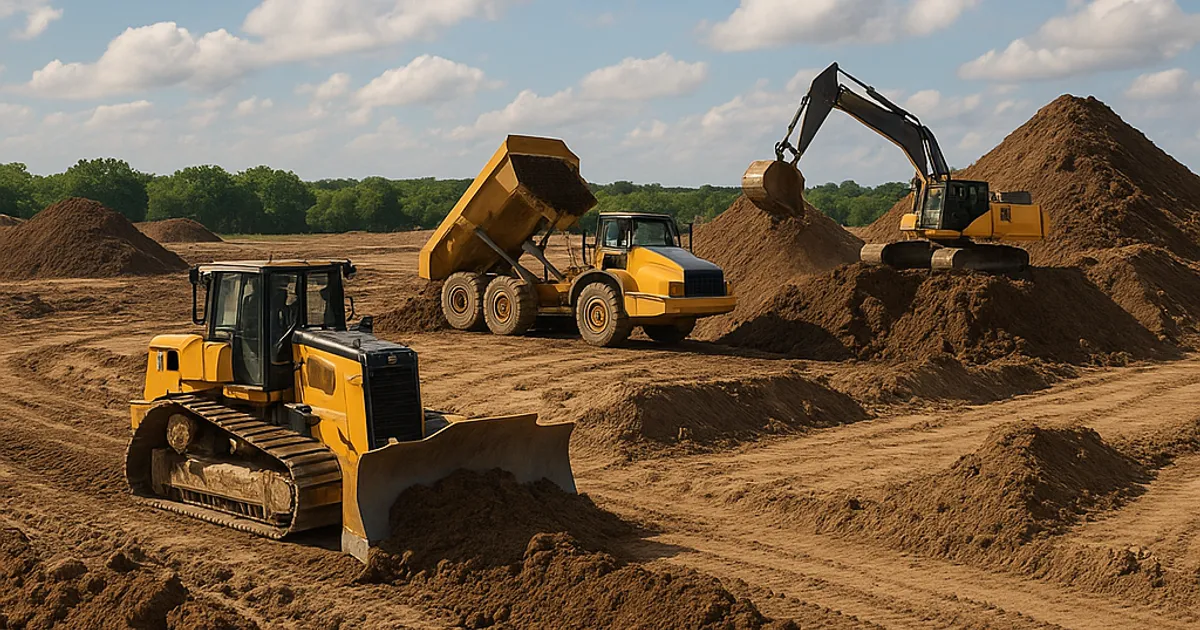
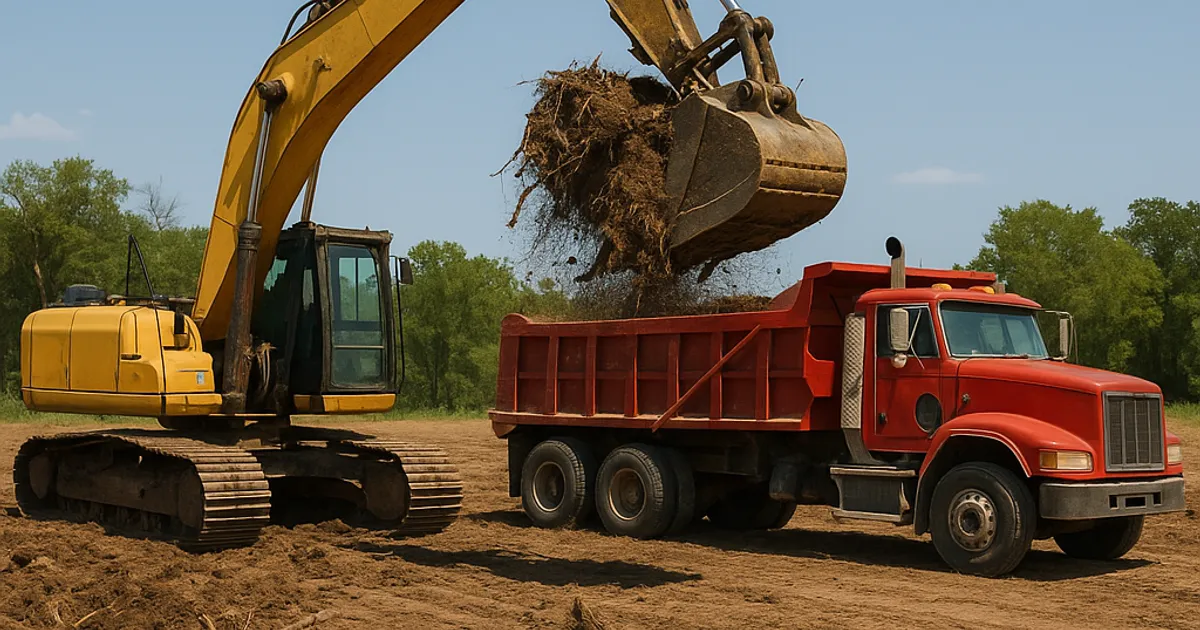
North Texas is booming. From sprawling master-planned communities in Frisco and McKinney to industrial parks along the I-35 corridor and mixed-use infill projects throughout Dallas proper, the DFW metroplex continues to be one of the most active construction markets in the United States. With all that development comes an enormous, often underestimated challenge: what do you do with the dirt?
Land clearing and demolition soil removal are not glamorous topics, but they are absolutely foundational to every successful earthwork project. Get this piece wrong — through poor planning, regulatory missteps, or inefficient hauling logistics — and a project that penciled out beautifully on paper can bleed money fast. Get it right, and you can actually turn excess soil into a cost-saving asset.
This guide is designed for general contractors, civil engineers, land developers, and earthwork subcontractors working across North Texas. We'll cover the full lifecycle of a land clearing and soil disposal project: site assessment, regulatory compliance, cost benchmarks, hauling logistics, beneficial reuse opportunities, and how modern platforms are changing the way contractors connect with soil supply and demand across the region.
Why North Texas Generates So Much Excavated Soil
The scale of development across the DFW metroplex is difficult to overstate. Dallas-Fort Worth is consistently ranked among the top three metros in the country for construction spending, and residential permitting alone has driven millions of cubic yards of earth movement every single year throughout the early 2020s. According to U.S. Census construction spending data, Texas has led the nation in single-family residential starts for multiple consecutive years.
The geology of North Texas compounds the volume challenge. The region sits atop the Blackland Prairie and Cross Timbers ecological zones, characterized by expansive clay soils — particularly the dark, heavy Houston Black clay that dominates the eastern suburbs — and limestone or caliche substrates that become increasingly prevalent as you move west toward Fort Worth and beyond. These soils are notoriously poor for structural fill without amendment, which means a significant portion of excavated material cannot simply be reused on-site. It has to go somewhere.
Demolition projects add another layer. As older neighborhoods in Oak Cliff, East Dallas, and South Dallas undergo redevelopment, the teardown and remediation of older structures generates not just concrete rubble but contaminated soils, decomposed organic material, and mixed-substrate fill that requires careful characterization before disposal or reuse.
Key drivers of soil generation in North Texas include:
- Residential subdivision development in Celina, Prosper, Anna, and the broader Collin County corridor
- Industrial and logistics facility construction in southern Dallas County and the Alliance corridor near Fort Worth
- Highway and infrastructure expansion, including ongoing TxDOT projects on US-75, SH-121, and I-635
- Commercial and mixed-use infill in Uptown Dallas, Deep Ellum, and Legacy West in Plano
- Flood control and detention basin construction by the Army Corps of Engineers and local municipalities
Each of these project types generates distinct soil profiles, disposal challenges, and reuse opportunities — which is exactly why having a clear strategy before the first blade hits the ground is so important.
Understanding North Texas Soil Types and Their Disposal Implications
Not all dirt is created equal, and in North Texas, the variety of soil conditions across even a single county can dramatically affect your disposal and reuse options.
Expansive Clay (Houston Black and Austin Chalk Soils)
The dominant soil type across much of Dallas, Collin, Denton, and Tarrant counties is expansive clay — soils that swell significantly when wet and shrink when dry. These soils are notoriously problematic for foundations, which is why post-tension slabs and pier-and-beam foundations are so common in the region. From a disposal standpoint, heavy clay is less desirable as structural fill because of its high plasticity index and poor drainage characteristics. However, it does have legitimate uses: pond embankments, berms, and surface grading on non-structural portions of a site.
Caliche and Limestone
As you move west of Fort Worth into Parker, Hood, and Palo Pinto counties, caliche and weathered limestone become increasingly common. These materials are harder to excavate — often requiring ripping or blasting — but they have significantly higher value as fill material. Crushed caliche is widely used as base course material on ranch roads and rural driveways across the region.
Sandy Loam and Fill-Grade Sand
Northeast Texas and areas around the Red River basin contain significant deposits of sandy loam and structural sand. These materials are in high demand across the DFW metro for drainage layers, utility bedding, and concrete aggregate. The fill dirt marketplace in Texas currently shows over 2 million cubic yards of material available statewide — including active listings like 100,000 yards of sand/sandstone available in Jewett, TX — illustrating just how much material is moving across the state at any given time.
Contaminated and Disturbed Fill
Urban redevelopment sites, particularly in older industrial corridors along the Trinity River and southern Dallas County, frequently encounter disturbed fill with unknown histories. This material may contain petroleum hydrocarbons, heavy metals, or construction debris. Proper characterization through soil testing is not just good practice — it's a legal requirement before this material can be transported or disposed of.
The Land Clearing Process: From Brush to Bare Ground
Land clearing in North Texas is more complex than simply pushing trees and brush aside. A professional land clearing operation for a significant development site typically follows a structured sequence that protects both the owner's investment and the contractor's liability exposure.
Phase 1: Pre-Clearing Assessment
Before any equipment rolls, a thorough site assessment is essential. This includes:
- Environmental Phase I assessment to identify recognized environmental conditions (RECs), including underground storage tanks, historical industrial use, or proximity to contaminated sites
- Wetlands delineation — North Texas has more jurisdictional wetlands than most people realize, particularly in low-lying areas along creek drainages and the Trinity River system. The U.S. Army Corps of Engineers regulates any filling of wetlands under Section 404 of the Clean Water Act, and unpermitted impacts can result in significant fines and restoration requirements
- Tree survey — Many North Texas municipalities, including the City of Dallas, have tree preservation ordinances that require permits to remove trees above a certain diameter at breast height (DBH)
- Utility marking — Call 811 before any excavation. North Texas has an extremely dense utility infrastructure, and unmarked lines are a serious safety and liability risk
- Stormwater pollution prevention plan (SWPPP) — Any site disturbing one acre or more requires a SWPPP and a construction general permit from the Texas Commission on Environmental Quality (TCEQ) before work begins. The EPA's stormwater discharge requirements for construction sites set the federal baseline, and TCEQ enforces these standards at the state level
Phase 2: Vegetation Clearing and Grubbing
Actual clearing work typically begins with brush cutting using forestry mulchers or rotary mowers, followed by tree removal and stump grubbing. In North Texas, cedar, elm, oak, and mesquite are common species encountered. Forestry mulching — which grinds vegetation in place and leaves a mulch layer — has become increasingly popular as an alternative to burning (which requires air quality permits and is restricted in many counties) or hauling woody debris to landfill.
Phase 3: Rough Grading and Topsoil Stripping
Once vegetation is cleared, the topsoil — typically the top 4 to 12 inches across most North Texas sites — is stripped and stockpiled separately. This material has value: it can be reapplied to finished slopes and landscape areas, reducing the need to import topsoil later. Rough grading establishes the general site contours and directs drainage to intended collection points.
Phase 4: Excavation and Soil Management
This is where volumes get serious. Depending on the project type, cut and fill volumes may be calculated in tens of thousands to hundreds of thousands of cubic yards. A well-executed mass grading plan balances cut and fill volumes on-site to minimize haul-off. When a site is in net cut — meaning more material is being removed than needed for structural fill — the excess has to leave the property. This is where soil disposal logistics become critical.
Demolition Soil Removal: Dallas-Specific Challenges
Demolition projects within the City of Dallas present a unique set of soil removal challenges that differ substantially from greenfield development on the suburban fringe.
Site Access and Traffic Management
Urban Dallas sites are often constrained by existing streets, neighboring structures, and utility conflicts. Getting large dump trucks in and out of tight urban sites requires careful logistics planning, coordination with the City of Dallas Office of Transportation for street use permits, and often staggered haul schedules to avoid peak traffic congestion.
Soil Characterization Requirements
The City of Dallas, like most major Texas municipalities, requires that soil from demolition sites be characterized before it can be accepted at most fill dirt disposal sites or reused as structural fill elsewhere. Characterization typically involves collecting soil samples at defined intervals and submitting them to an accredited laboratory for analysis of petroleum hydrocarbons (TRPH and BTEX), RCRA metals, and potentially asbestos if the demolition involved older structures.
Landfill vs. Beneficial Reuse
For clean demolition soils, landfill disposal is always an option — but it's an expensive one. Type IV landfill tipping fees in the Dallas-Fort Worth area have risen steadily through 2025 and into 2026, now commonly ranging from $8 to $18 per ton depending on the facility and material type. For a 10,000-cubic-yard project, that's a disposal cost of $80,000 to $200,000 or more, before accounting for hauling.
Beneficial reuse — finding another project site that needs your excess soil — is almost always the more economical choice when the material qualifies. This is exactly the problem that DirtMatch was built to solve: connecting contractors who have excess soil with projects that need fill, turning a disposal cost into a logistics solution.
Regulatory Framework for Soil Disposal in Texas
Navigating the regulatory landscape for soil disposal in North Texas requires familiarity with multiple overlapping jurisdictions. Here's a breakdown of the key frameworks:
Texas Commission on Environmental Quality (TCEQ)
TCEQ is the primary state environmental regulatory agency for soil disposal in Texas. Under TCEQ's Voluntary Cleanup Program (VCP) and regulatory guidance, excavated soils from sites with known or suspected contamination must be managed as solid waste or hazardous waste depending on characterization results. Clean, uncontaminated soils are generally not regulated as solid waste and can be reused without TCEQ approval, but the burden of demonstrating cleanliness falls on the generator.
Municipal Grading and Drainage Ordinances
Each municipality in North Texas has its own grading, drainage, and erosion control ordinances that govern how land clearing and grading work is conducted. The City of Dallas Engineering Standards, Plano's Development Standards, and Frisco's Land Development Code all contain specific requirements for grading permits, drainage studies, and erosion control measures. Violations can result in stop-work orders and significant fines.
Federal Environmental Regulations
For sites near waterways or with potential wetlands impacts, the Army Corps of Engineers (USACE) Regulatory Program governs Section 404 permits. Any discharge of dredged or fill material into waters of the United States — including many North Texas creek drainages and detention areas — requires a Section 404 permit or nationwide permit authorization before work begins.
OSHA Excavation Safety
For any trenching or excavation work associated with land clearing and utility installation, federal OSHA trenching and excavation standards apply. These regulations require a competent person on-site, soil classification before work begins, and appropriate protective systems for excavations deeper than five feet. Compliance is not optional — OSHA excavation violations are among the most commonly cited in Texas construction.
Cost Breakdown: What to Expect for Land Clearing and Soil Removal in North Texas (2026)
Cost transparency is one of the most valuable things a guide like this can offer. Here are realistic cost benchmarks for North Texas in 2026, based on current market conditions:
Land Clearing Costs
| Service Type | Cost Range | Unit |
|---|---|---|
| Light brush clearing (forestry mulching) | $1,200 – $2,500 | per acre |
| Heavy brush/tree clearing | $2,500 – $6,000 | per acre |
| Tree removal (individual, 12"+ DBH) | $800 – $3,500 | per tree |
| Stump grinding | $150 – $500 | per stump |
| Topsoil stripping and stockpile | $1.50 – $3.50 | per CY |
Earthwork and Grading Costs
| Service Type | Cost Range | Unit |
|---|---|---|
| Mass grading (dozer and scraper) | $2.00 – $6.00 | per CY |
| Export hauling (within 10 miles) | $8 – $15 | per CY |
| Export hauling (10–30 miles) | $14 – $22 | per CY |
| Landfill disposal (Type IV, clean soil) | $8 – $18 | per ton |
| Soil testing/characterization | $1,500 – $8,000 | per site |
Key Cost Variables
- Haul distance is the single biggest variable in soil disposal cost. Every additional mile of haul adds roughly $0.50–$1.00 per cubic yard in truck operating costs
- Material type affects compaction factor (bank vs. loose vs. compacted measure) and therefore actual volumes
- Site access — tight urban sites in Dallas require smaller equipment and more truck cycles, increasing unit costs
- Regulatory requirements — contaminated soil management can multiply disposal costs by a factor of 5–10x compared to clean material
- Fuel prices — diesel prices in Texas remain a significant variable in trucking costs and can shift project economics meaningfully quarter to quarter
For contractors looking to reduce haul costs, connecting with nearby projects that need fill is the most powerful lever available. Platforms like DirtMatch help contractors identify where excess soil can be delivered nearby — often eliminating landfill tipping fees entirely and sometimes generating revenue from material that would otherwise be a disposal liability.
Find or Post Dirt, Rock & Aggregate
Join thousands of contractors using DirtMatch to buy, sell, and exchange earthwork materials.
Try DirtMatch FreeHauling Logistics: Moving Dirt Efficiently Across DFW
Even when you know where the dirt is going, getting it there efficiently is a major operational challenge on large-scale North Texas projects.
Fleet and Equipment Considerations
Standard end-dump trucks carry approximately 14–18 cubic yards of material per load. Belly-dump trailer combinations can carry 20–25 yards but require more staging area at both ends. For urban Dallas sites, the standard tandem-axle end-dump is usually the most practical choice, though it means more truck cycles per volume moved.
GPS-enabled dispatch systems have become standard practice among competitive earthwork firms in DFW. Real-time tracking allows pit managers and project superintendents to monitor truck cycles, identify bottlenecks, and optimize routes dynamically — a meaningful efficiency gain on projects moving thousands of loads.
Road Weight Restrictions and Hauling Permits
Texas has specific load limits for trucks operating on state and county roads. During spring thaw — less of an issue in North Texas than further north but still relevant — some county roads post reduced weight limits. For overweight loads (common with wet, heavy clay material), a Texas DOT overweight permit is required. Permit fees vary by route and axle configuration.
Beyond the farm-to-market road network, hauling through incorporated municipalities requires coordination with city traffic engineering departments. Dallas, Fort Worth, Plano, and other cities may restrict heavy truck routes through residential areas or require specific haul routes to minimize pavement damage.
Scheduling Around Weather
North Texas weather is notoriously volatile. Spring and fall bring significant rainfall events that can turn graded sites into impassable mud fields overnight. Experienced earthwork contractors build weather contingency days into project schedules and maintain equipment for wet-weather operations. Tracking soil moisture content is also important for compaction operations — soil placed too wet or too dry won't achieve required density specifications under ASTM D698 or D1557 proctor testing standards.
Beneficial Reuse: Turning Disposal Cost Into Value
The most sophisticated land clearing and soil disposal strategies in North Texas don't just minimize disposal cost — they actively find value in excess material. Beneficial reuse of excavated soil is both an environmental best practice and an economic opportunity.
Common Beneficial Reuse Applications in North Texas
- Structural fill for residential subdivisions — New subdivision development in Collin, Denton, and Ellis counties constantly needs engineered fill to raise pad grades above base flood elevation or to level gently rolling terrain
- Detention basin construction — Regional detention basins require significant volumes of clay material for embankment construction. Excess clay from urban demolition projects can be a perfect match
- Farm and ranch land grading — Rural landowners throughout the North Texas area regularly seek fill material to improve drainage, create stock ponds, or raise building sites
- Road base and embankment — TxDOT and county road projects consume significant volumes of select fill for embankment construction. Material meeting TxDOT Item 132 specifications can be sold directly to road contractors
- Landscaping and topsoil markets — Screened topsoil and sandy loam are actively purchased by landscaping contractors, golf courses, and park departments across the metro
How the Matching Economy Works
The key to beneficial reuse is logistics — specifically, finding a receiving site that is close enough to the generating site to make hauling economically viable. This is where technology has genuinely changed the game. The DirtMatch platform currently shows over 1.8 million cubic yards needed across Texas, alongside more than 2 million cubic yards available — representing thousands of potential matches between contractors who have dirt and projects that need it. Getting started with DirtMatch takes minutes and gives contractors immediate visibility into nearby supply and demand.
For context on how active the Texas market is: a recent listing showed 20,000 yards of clay available in Eagle Pass, TX, while another listed a need for 5,000 yards of clean fill dirt in Tatum, TX — the kind of granular, location-specific matching that used to require phone calls and personal networks can now happen through a marketplace.
Environmental Compliance and Best Practices
Environmental compliance on land clearing and soil disposal projects in North Texas is not optional, and the consequences of violations can be severe — including stop-work orders, restoration requirements, and civil or criminal penalties.
Erosion and Sediment Control
All disturbed areas must be protected against erosion during and after construction. Standard best management practices (BMPs) in North Texas include silt fence installation along drainage paths, rock check dams in swales, inlet protection on storm drains, construction entrances to reduce mud tracking, and temporary seeding or mulching of disturbed slopes. TCEQ inspectors actively audit active construction sites, and violations of construction general permit conditions can result in enforcement actions.
Stormwater Management
North Texas sits within multiple watersheds — the Trinity River basin being the most significant — and municipal separate storm sewer system (MS4) permits require cities to enforce construction site stormwater controls. Many North Texas municipalities conduct their own site inspections independently of TCEQ, meaning effective stormwater management requires satisfying multiple regulatory audiences simultaneously.
Contaminated Soil Management
When soil testing reveals contamination, the management pathway depends on the nature and concentration of contaminants. For petroleum-contaminated soil, TCEQ's Texas Risk Reduction Program (TRRP) provides a risk-based framework for determining whether excavation, treatment, or monitored natural attenuation is the appropriate response. For heavy metals or other industrial contaminants, the pathway may involve solid waste or hazardous waste disposal at a permitted facility — a significantly more expensive proposition.
Engaging an environmental consultant early in the project process — before characterization results come back — allows contractors to pre-plan for multiple disposal scenarios and avoid being blindsided by unexpected findings.
Choosing the Right Land Clearing Contractor in North Texas
With dozens of land clearing and earthwork contractors operating across DFW, selecting the right partner for a significant project requires more than checking for a valid contractor's license.
Key Qualification Criteria
Licensing and Insurance: Texas does not require a specific state license for earthwork or land clearing, but most municipalities require a general contractor registration and proof of general liability and workers' compensation insurance. For projects near waterways or involving potential environmental impacts, the contractor should have relevant environmental compliance experience.
Equipment Capacity: Match the contractor's equipment fleet to your project scale. A one-man operation with a single dozer is appropriate for a residential lot. A 50-acre commercial site needs a contractor with scrapers, multiple excavators, and a dedicated truck fleet or established hauling partnerships.
References and Track Record: Ask specifically for references from projects of similar scale and soil type. North Texas expansive clay presents different challenges than sandy coastal soils, and you want a contractor who has demonstrated competence in local conditions.
Environmental Compliance History: Ask about any TCEQ or municipal enforcement actions. A contractor with a clean regulatory record is worth a premium on sensitive projects.
Soil Disposal Network: A well-connected contractor knows where excess soil can go within the local market. Contractors who participate in platforms that facilitate fill dirt exchange across Texas can often dramatically reduce your net disposal costs compared to contractors who default to landfill disposal for every load.
Questions to Ask Before Signing a Contract
- How will you handle soil characterization and what happens if contamination is found?
- Where does excess soil go, and is there a cost or credit associated with haul-off?
- What erosion control measures will be in place, and how will they be maintained?
- What is your plan for wet weather delays, and how does that affect the schedule?
- Who holds the construction general permit, and how will SWPPP compliance be managed?
Technology and Innovation in North Texas Earthwork
The earthwork industry in North Texas has not been immune to the technology wave reshaping construction more broadly. Several innovations are meaningfully changing how land clearing and soil disposal projects are planned and executed.
GPS Machine Control and Grade Technology
Modern excavators and motor graders equipped with GPS machine control systems can grade to design tolerance without traditional survey stakes. This reduces rework, improves accuracy, and speeds up rough grading operations significantly. For large-scale projects in Collin and Denton County where design grades are precisely engineered for drainage, machine control pays for itself quickly in labor savings.
Drone Survey and Volume Calculation
Drone-based topographic surveys have become standard practice for pre-construction volume calculations on North Texas earthwork projects. A drone can survey a 100-acre site in a few hours and generate accurate cut/fill volume estimates that would take a survey crew days to produce. This data also supports better soil disposal planning by providing accurate volume numbers early in the project timeline.
Digital Soil Marketplaces
Perhaps the most transformative technology for soil disposal logistics is the emergence of digital marketplaces that match soil supply and demand across geographic regions. Rather than relying on personal networks or making dozens of cold calls to find a place for excess material, contractors can now post available soil volumes and receive matching opportunities from nearby projects in real time. The DirtMatch Pro tier gives contractors enhanced visibility and priority matching — particularly valuable in competitive markets like DFW where large volumes move quickly.
Summary: Building a Smarter Soil Disposal Strategy in North Texas
Land clearing and demolition soil removal in North Texas is a logistically complex, regulatory-sensitive, and cost-significant aspect of every earthwork project in the region. The best contractors and developers approach soil management not as an afterthought but as a core element of project planning from day one.
A smart soil disposal strategy in North Texas in 2026 looks like this:
- Assess the soil early — characterize your material type, volume, and potential contamination before bid day
- Know your regulatory obligations — TCEQ permits, USACE Section 404, municipal grading permits, and OSHA excavation safety all apply
- Plan your logistics — haul distance is the biggest cost driver, and every mile saved matters at scale
- Pursue beneficial reuse first — landfill is the most expensive option and should be the last resort for clean material
- Leverage technology — GPS grading, drone surveys, and digital soil matching platforms all reduce cost and improve project outcomes
- Partner with the right contractor — equipment capacity, environmental compliance history, and local market knowledge all matter
North Texas will continue to be one of the most active construction markets in the country for the foreseeable future. The contractors and developers who build systematic, technology-enabled approaches to soil management will have a meaningful competitive advantage over those who treat dirt disposal as a last-minute problem to solve.
Whether you're a general contractor managing a 500-lot subdivision in Celina or a developer clearing an urban infill site in East Dallas, the principles are the same: know your dirt, plan your disposal, and connect with the resources that make it efficient. Platforms like DirtMatch exist precisely to make that connection faster, smarter, and more economical across the entire North Texas market.