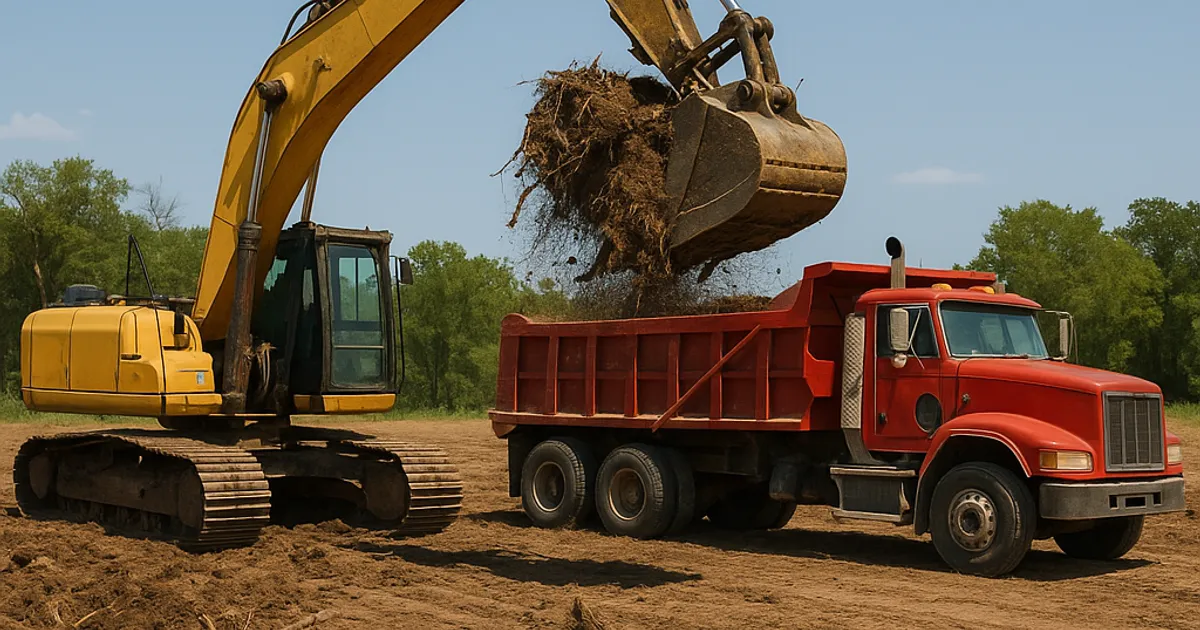
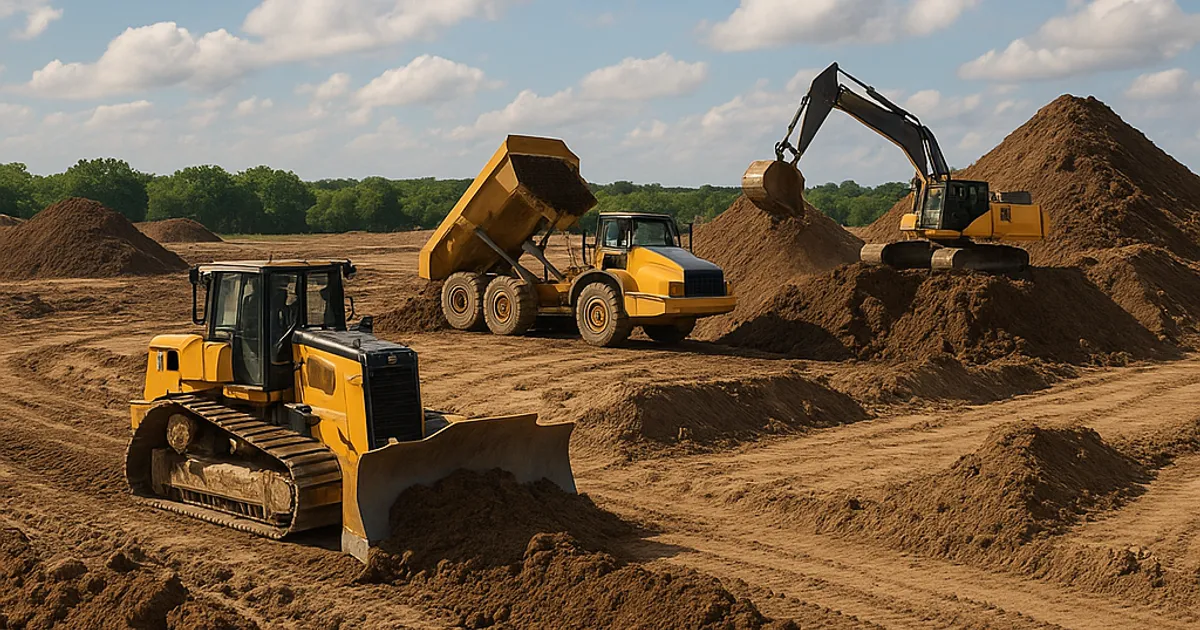
In the Dallas-Fort Worth Metroplex, dirt isn't just dirt—it's money. Every cubic yard you haul off site costs you, and every cubic yard you haul in costs you more. Cut and fill balancing sits at the intersection of civil engineering, logistics, and project economics, and for DFW developers working in one of the fastest-growing real estate markets in the United States, getting it right can mean the difference between a profitable project and a budget nightmare.
The DFW Metroplex added more than 170,000 new residents between mid-2024 and mid-2025, sustaining its position as one of the top two fastest-growing metros in the country. That growth is driving relentless demand for new residential subdivisions, industrial parks, mixed-use developments, and retail pads—all of which require substantial earthwork. Understanding cut and fill balancing isn't optional for developers in this region. It's a core competency.
This guide is designed for developers, land planners, project owners, and grading contractors operating across Dallas, Fort Worth, Frisco, McKinney, Allen, Mansfield, Burleson, and the broader DFW region. We'll walk through the science and strategy of cut-fill analysis, the unique soil and terrain challenges of North Texas, cost benchmarks, regulatory considerations, technology tools, and how to source or offload surplus material efficiently.
What Is Cut and Fill Balancing—and Why Does It Matter?
Cut and fill balancing is the process of engineering a site so that the volume of soil removed from high areas (cuts) equals the volume of soil needed to fill low areas (fills) on the same project. When cuts and fills are balanced, you eliminate the need to import fill dirt or export excess soil off-site—both of which are expensive, time-consuming operations that introduce supply chain risk.
The goal is a net-zero earthwork equation: every cubic yard excavated from a cut section is deposited into an adjacent fill section. In practice, perfect balance is rarely achieved, but experienced grading contractors and civil engineers design site plans with balance as the target, then manage the variance.
Why does this matter so much in DFW specifically?
- Land costs are high. With commercial land in suburban Dallas trading at $10–$30 per square foot and beyond in prime corridors, developers cannot afford to leave money on the table through inefficient earthwork.
- Sites are getting more complex. As the easy, flat land gets built out, developers are moving into rolling terrain in areas like Weatherford, Midlothian, and the Prosper-Celina corridor, where elevation changes of 30 to 80 feet across a single parcel are common.
- Trucking costs have escalated. Fuel surcharges, driver shortages, and the FMCSA's Hours of Service regulations have pushed the cost of hauling dirt to $12–$22 per loaded mile in the DFW market in 2026. A 200-truck-day haul event can easily cost $80,000–$150,000 that a balanced site would have avoided entirely.
- Regulatory scrutiny is increasing. TCEQ (Texas Commission on Environmental Quality) and municipal engineering departments across DFW are scrutinizing grading plans, drainage impacts, and stormwater management more carefully than ever before.
For all of these reasons, the financial stakes of cut-fill planning have never been higher in North Texas.
The DFW Terrain: What Makes North Texas Earthwork Unique
Not all grading markets are created equal. DFW presents a specific set of geotechnical and topographic challenges that directly influence how cut-fill balancing must be approached.
Expansive Clay Soils
The black and dark gray expansive clays of the Blackland Prairie—which runs through Dallas, Collin, Denton, and Tarrant counties—are arguably the biggest earthwork challenge in the region. These soils (predominantly Vertisols and Houston Black series) can swell by 4–8% in volume when wetted and shrink dramatically during drought. This expansion cycle causes:
- Differential settlement in fill sections if moisture conditioning isn't performed correctly
- Heave problems under slabs and pavements if clay is used as subgrade without lime stabilization
- Rejection of clay fill in structural fill applications without treatment
Contractors working in the DFW expansive clay belt must account for moisture-density relationships carefully. ASTM D698 and D1557 standard Proctor compaction tests are routinely specified in DFW geotechnical reports, and compaction specs of 95–98% of standard Proctor maximum dry density are typical for structural fill zones.
Lime treatment—typically at 4–8% lime by dry weight—is commonly required for expansive clay subgrades before pavement or slab construction. This treatment both stabilizes and slightly increases the volume of the treated clay, a factor that must be accounted for in fill volume calculations.
Limestone and Caliche Layers
Move west of downtown Fort Worth into Hood, Parker, and Johnson counties, or south into Ellis County, and you encounter another challenge: shallow limestone and caliche rock. These formations can be encountered as close as 18 inches below grade and require ripping or blasting for removal.
Limestone rock has a swell factor of approximately 30–40% when blasted and excavated—meaning 100 cubic yards of in-situ rock becomes 130–140 cubic yards of loose material. This swell factor dramatically affects cut-fill balance calculations. Many developers in the Fort Worth western suburbs have experienced the shock of discovering mid-project that their carefully balanced earthwork plan is suddenly generating a massive surplus of blasted limestone they didn't budget to haul.
Cross-Slope Terrain in the Northern Suburbs
The rolling terrain of Collin and Denton counties—particularly around McKinney, Prosper, Anna, and Sherman—features cross-slope topography with elevation changes that require extensive mass grading for residential subdivisions. Projects in these areas regularly involve moving 300,000 to over 1 million cubic yards of earth on a single subdivision grading contract.
How Cut-Fill Analysis Is Performed: The Engineering Process
A proper cut-fill analysis is a multi-step engineering exercise that begins long before a bulldozer ever touches the ground.
Step 1: Topographic Survey
Everything starts with an accurate topographic survey. Modern DFW projects use LiDAR (Light Detection and Ranging) drone surveys capable of capturing point cloud data at 1–4 inch horizontal resolution. A 100-acre site can be fully surveyed in a single day, with deliverables including georeferenced surface models, 1-foot contour lines, and digital terrain models (DTMs) ready for import into design software.
Traditional ground survey methods are still used for smaller sites or areas with heavy tree cover that blocks drone LiDAR, but aerial methods have become the industry standard for mid- to large-scale DFW developments.
Step 2: Grading Design and Finish Grade Determination
The civil engineer develops a proposed finish grade plan that satisfies:
- Positive drainage away from structures (minimum 2% grade away from buildings per IBC)
- Street and parking lot grades within allowable ranges (0.5% minimum to 8% maximum for most applications)
- Lot pad elevations that meet municipal floodplain requirements
- Utility slope requirements for gravity-fed sewer lines
- Aesthetic and functional objectives of the development program
The finish grade design is iteratively adjusted to bring cuts and fills into balance—or as close to balance as the site constraints allow.
Step 3: Volume Calculation
With existing and proposed surfaces defined, the engineer calculates earthwork volumes using one of several methods:
- Average End Area Method: The traditional manual calculation approach, still used for linear projects (roads, channels)
- Prismoidal Formula: A more accurate manual method for volume calculation between two cross-sections
- Grid Method: Divides the site into a grid of cells and calculates average cut or fill depth per cell
- 3D Surface Software: Tools like AutoCAD Civil 3D, Carlson Software, and Bentley InRoads generate cut-fill volumes directly from digital terrain model comparisons—the industry standard for DFW development projects today
Step 4: Shrink and Swell Adjustments
Raw volume calculations must be adjusted for shrink and swell factors based on soil type:
| Material Type | Swell Factor (Bank to Loose) | Shrinkage Factor (Loose to Compacted) |
|---|---|---|
| Common clay (DFW Blackland) | 1.20–1.30 | 0.85–0.90 |
| Sandy loam | 1.10–1.15 | 0.88–0.92 |
| Caliche/soft rock | 1.25–1.35 | 0.90–0.95 |
| Limestone (blasted) | 1.30–1.45 | 1.00–1.10 |
| Decomposed granite | 1.05–1.12 | 0.90–0.95 |
For DFW developers working in the Blackland Prairie, it's critical to note that compacted fill from native clay will shrink compared to its bank volume. This means you need more bank cubic yards of clay to fill a given volume than a raw calculation would suggest—a common source of earthwork budget overruns for inexperienced teams.
Step 5: Mass Haul Analysis
Once volumes are calculated and shrink/swell-adjusted, the engineer performs a mass haul analysis to determine the most economical movement of material across the site. The mass haul diagram is a graphical tool that shows cumulative cut and fill quantities along a baseline, revealing:
- Where material flows from and to
- The optimal haul distances for scrapers versus trucks
- Whether borrow or waste operations are required
For large DFW subdivisions, minimizing average haul distance can save $2–$6 per cubic yard in equipment time and fuel—translating to hundreds of thousands of dollars on a 500,000-cubic-yard job.
Cost Benchmarks for DFW Earthwork in 2026
Understanding realistic cost ranges is essential for developers building pro formas and evaluating grading bids.
Mass Grading Unit Costs (DFW Market, 2026)
| Work Item | Low | Mid | High |
|---|---|---|---|
| Mass grading (cut and fill, common earth) | $3.50/CY | $5.00/CY | $7.50/CY |
| Rock excavation (blasting + removal) | $18/CY | $28/CY | $45/CY |
| Lime stabilization (6% lime, 8" depth) | $4.50/SY | $6.00/SY | $8.00/SY |
| Import fill (material + haul, 0–5 miles) | $12/CY | $18/CY | $28/CY |
| Export/waste haul (0–10 miles) | $8/CY | $14/CY | $22/CY |
| Fine grading (subgrade prep) | $0.75/SY | $1.25/SY | $2.00/SY |
| Erosion control / SWPPP compliance | $0.50/SY | $0.90/SY | $1.50/SY |
Costs reflect DFW market conditions as of Q1 2026. Figures are directional estimates; actual bids will vary based on project size, soil conditions, haul distance, and contractor workload.
The True Cost of an Unbalanced Site
Consider a 200-acre residential subdivision in Celina with a 50,000 cubic yard fill deficit—meaning the site needs 50,000 CY of imported fill dirt to reach design grades. At $18/CY for import fill (material plus haul), that's $900,000 in unplanned cost that a better-balanced grading design might have avoided or significantly reduced.
Conversely, a site with a 50,000 CY surplus of cut material needs to pay to dispose of it. At $14/CY for waste haul, that's another $700,000 leaving the project budget unnecessarily.
These scenarios illustrate why developers increasingly view cut-fill balancing not just as an engineering task, but as a core value-engineering opportunity.
Regulatory Requirements Affecting DFW Earthwork
DFW developers face a layered regulatory environment that directly impacts how grading plans are designed and executed.
TCEQ Construction General Permit (CGP) and SWPPP
Any construction site disturbing one acre or more in Texas must obtain coverage under the TCEQ Construction General Permit (TXR150000) and implement a Storm Water Pollution Prevention Plan (SWPPP). The SWPPP must be prepared by a qualified person and include:
- Best Management Practices (BMPs) for erosion and sediment control
- Site map showing drainage patterns and disturbed areas
- Inspection schedule and recordkeeping requirements
The EPA's stormwater construction program establishes the federal framework that TCEQ implements at the state level. Non-compliance can result in fines of up to $25,000 per day per violation.
Municipal Grading Permits and Engineering Approvals
Every city in the DFW Metroplex has its own grading ordinance requirements, and they vary significantly:
- City of Dallas requires a grading permit for any grading exceeding 100 cubic yards or disturbing more than 10,000 square feet
- City of Fort Worth requires a grading permit for disturbances of 5,000 square feet or more
- Frisco, McKinney, Allen have development review processes requiring civil engineering approval of grading plans before permit issuance
- Many cities require a third-party geotechnical engineer to certify compaction testing during fill operations
FEMA Floodplain Considerations
DFW is crossed by numerous creek and river systems—the Trinity River, Elm Fork, West Fork, Village Creek, and dozens of tributaries—all with mapped FEMA Special Flood Hazard Areas (SFHA). Grading that impacts floodplain areas requires a Floodplain Development Permit and a No-Rise Certification from a licensed PE, demonstrating that the grading will not increase base flood elevations upstream.
Many DFW development sites require LOMR (Letter of Map Revision) applications to FEMA when grading significantly alters the hydraulic characteristics of a floodplain. LOMR processes can take 12–18 months and must be factored into project schedules.
Technology Tools Transforming DFW Grading Operations
The earthwork industry in DFW has embraced technology at an accelerating pace. For developers evaluating grading contractors, technology adoption is a meaningful differentiator.
GPS Machine Control
GPS-guided dozer and motor grader systems from providers like Trimble Construction allow equipment operators to achieve design grades with centimeter-level accuracy without grade stakes. Benefits include:
- 15–25% reduction in rework and over-grading
- Faster production cycles
- Real-time cut-fill tracking against the design model
- Reduced surveying costs during construction
Top-tier grading contractors in DFW now run fully GPS-equipped fleets, and developers should ask prospective contractors about their machine control capabilities during the bid process.
Drone Progress Surveys
Weekly or bi-weekly drone surveys allow contractors and developers to track actual cut-fill quantities against the design model in near real-time. This early warning capability lets teams identify developing imbalances before they become expensive problems.
Civil 3D and Cloud-Based Collaboration
Autodesk Civil 3D has become the de facto standard for grading design in DFW. Cloud-based project delivery through Autodesk Construction Cloud allows developers, civil engineers, and grading contractors to collaborate on the same live design model—reducing errors from working on outdated plan sheets.
Find or Post Dirt, Rock & Aggregate
Join thousands of contractors using DirtMatch to buy, sell, and exchange earthwork materials.
Try DirtMatch FreeStrategies for Achieving Balance on Challenging DFW Sites
When a site's natural topography makes perfect balance difficult, experienced DFW grading teams deploy a range of strategies.
Adjust Finish Grades Within Acceptable Limits
The civil engineer has some flexibility in setting finish grades. Raising or lowering pad elevations by 6–18 inches can meaningfully shift the cut-fill balance without compromising drainage or utility design. In a large subdivision, adjusting 50 lots by an average of 12 inches can swing the earthwork balance by tens of thousands of cubic yards.
Pond and Detention Basin Optimization
Most DFW subdivisions require detention or retention ponds for stormwater management. These features require significant excavation. Smart civil engineers size and locate ponds to consume surplus cut material, turning a waste problem into a needed design feature. On many DFW projects, detention pond excavation accounts for 20–40% of total cut volume.
Staged Mass Grading
On large multi-phase projects, grading different phases sequentially allows cut material from Phase 1 to be stockpiled and used as fill in Phase 2, even if the phases are geographically separated on the same master-planned development. This approach requires careful scheduling and material management but can eliminate significant import costs.
Material Exchange with Adjacent Projects
This is where the DFW development market gets particularly interesting. With dozens of large-scale projects under construction simultaneously across the Metroplex, one project's surplus cut can be another project's needed fill—if the right connection is made at the right time.
This is exactly the problem that DirtMatch was built to solve. Rather than paying for disposal of surplus material or importing expensive fill, DFW developers and contractors can use DirtMatch to connect with nearby projects that have the inverse need. The platform matches dirt suppliers with dirt seekers across the region, turning what would have been a costly haul-off into a mutually beneficial exchange. For developers managing tight earthwork budgets in a competitive DFW market, this kind of material exchange can save $5–$15 per cubic yard on tens of thousands of yards of material.
Finding and Vetting a Grading Contractor in Dallas-Fort Worth
Not all grading contractors are equal, and the DFW market—with its mix of expansive clay, caliche, and limestone—demands specific regional expertise. Here's how to evaluate prospective contractors.
Essential Qualifications
- Texas Department of Licensing and Regulation (TDLR) — Verify contractor licensing status for applicable work categories
- TPDES SWPPP qualifications — Contractor should have staff who are TCEQ-qualified to prepare and manage SWPPPs
- Geotechnical report experience — Can the contractor read and implement a geotech report, including lime treatment specifications and compaction testing requirements?
- Machine control capability — Do they operate GPS-equipped machines?
- Insurance — Minimum $2M general liability, workers' compensation, and auto coverage are standard on DFW grading contracts
Questions to Ask During the Bid Process
- What is your experience with expansive clay stabilization in the DFW Blackland Prairie?
- How do you track cut-fill volumes during construction against the design model?
- What is your plan if we encounter rock or unsuitable material during excavation?
- Who prepares your SWPPP, and how do you manage BMP maintenance?
- What subcontractors or brokers do you use for import fill and waste disposal?
Understanding the Grading Bid
Grading bids in DFW are typically structured as unit price contracts (price per cubic yard, per square yard, per linear foot) rather than lump sum. Unit price contracts offer flexibility when quantities vary—but developers must understand that the contractor's risk allocation shifts with this structure. Careful attention to the bid schedule of values and the contract's quantity adjustment provisions is essential.
If you're searching for qualified grading contractors across the DFW region, understanding how DirtMatch works can also open doors to a network of vetted earthwork professionals who are already active in the local material exchange market—giving you a pre-qualified pool of contractors who understand the region's material flows.
Managing Surplus and Deficit Material: The DFW Logistics Challenge
Even the best-engineered cut-fill balance rarely survives contact with reality without some variance. Unexpected rock, unsuitable soils, or design changes mid-project can create sudden surpluses or deficits that must be resolved quickly and cost-effectively.
When You Have Surplus Material
A surplus of cut material that cannot be used on-site creates pressure to find disposal options quickly—delays mean equipment idling and project schedules slipping. Traditional options include:
- Approved landfill disposal — $8–$20 per ton including haul in DFW, plus gate fees
- Agricultural or private land spreading — Requires landowner agreement and may require TCEQ notification depending on material type
- Donation to public projects — Some municipalities accept clean fill for road embankments or park grading
- Material exchange through a marketplace — The most economically efficient option when matched correctly
For contractors and developers with significant material surpluses, listing on DirtMatch connects you with projects actively seeking fill within your haul radius—often eliminating disposal costs entirely and sometimes generating value from material that would otherwise cost money to remove.
When You Have a Fill Deficit
Fill deficits require importing material, and sourcing quality fill quickly in the DFW market requires knowing where to look:
- Nearby development projects with surplus cut material (the best option for cost)
- Commercial borrow pits — Several operate in the DFW periphery (Parker County, Ellis County, Kaufman County)
- Topsoil suppliers — For finish grades requiring organic topsoil rather than structural fill
- Ready-mix concrete plants and quarries — For aggregate base or structural fill applications
Fill material quality must be verified against the project's geotechnical specifications. Common fill acceptance criteria in DFW include a maximum plasticity index (PI) of 35–50 for structural fill, free of organic material, debris, and particles larger than 6 inches.
Environmental Compliance in DFW Earthwork: What Developers Must Know
Environmental compliance is not optional, and the consequences of violations are severe. DFW developers must be aware of several key requirements.
Stormwater Pollution Prevention
The EPA's framework for stormwater discharges from construction activities establishes the federal standards that flow through TCEQ's Construction General Permit. On DFW sites, the most common SWPPP violations include:
- Inadequate silt fence installation or maintenance
- Failure to stabilize disturbed areas within required timeframes
- Tracking of mud onto public roads without washout stations
- Missing or inadequate concrete washout facilities
Fines can be assessed by both TCEQ and municipal inspectors. Some DFW municipalities (Dallas, Fort Worth, Plano) have active stormwater enforcement programs with dedicated inspection staff.
Waters of the U.S. (WOTUS) and Section 404 Permits
If grading activities involve filling, dredging, or disturbing jurisdictional wetlands or waterways, a Section 404 permit from the U.S. Army Corps of Engineers (USACE) may be required. The USACE's Fort Worth District has jurisdiction over DFW and has been active in enforcement of unpermitted wetland fill.
Developers should conduct a wetland delineation on any site with drainage features, wet areas, or proximity to streams before finalizing grading plans. Section 404 nationwide permits (NWPs) may cover smaller impacts (up to 0.1 acres under NWP 29 for residential development), but individual permits are required for larger impacts and can take 6–18 months to obtain.
Contaminated Soil Considerations
DFW has significant areas of industrial history, particularly in southern Dallas County, eastern Tarrant County, and along the Trinity River corridor. Developers acquiring infill sites or brownfields must conduct Phase I and potentially Phase II environmental site assessments before grading. Discovery of contaminated soils during grading triggers notification requirements under Texas Health and Safety Code and TCEQ rules, and contaminated material cannot be moved off-site without proper manifesting and disposal at a permitted facility.
Building a Better Pro Forma: How to Budget for Earthwork Uncertainty
Even with excellent planning, earthwork involves uncertainty. Here's how experienced DFW developers build resilient earthwork budgets.
Contingency Allocation
Standard practice in DFW is to carry a 10–15% earthwork contingency on sites with known soil challenges (expansive clay, potential rock) and 5–10% on straightforward sites. On sites with limited geotechnical data, contingencies of 20–25% are warranted.
Phased Geotechnical Investigation
Rather than relying on a single Phase 1 geotechnical report, leading developers in DFW commission additional soil borings and laboratory testing as site planning advances:
- Reconnaissance borings during due diligence (1 boring per 5–10 acres)
- Design borings after site plan is substantially complete (1 boring per 2–3 acres)
- Construction support borings in areas where rock or unusual conditions were encountered during design borings
Value Engineering Reviews
Before issuing grading plans for bid, experienced DFW developers conduct a formal value engineering review of the earthwork design with their civil engineer and geotechnical engineer. Key questions:
- Can any pad elevations be adjusted to improve balance?
- Is the detention pond design optimized to consume surplus cut?
- Are there any large fill areas that could be served by on-site material with minor routing changes?
- Is the lime treatment area/depth specification consistent with the geotechnical recommendations, or is it over-specified?
Why DirtMatch Is Changing the Earthwork Equation for DFW Developers
The traditional model for managing fill surplus and deficits in DFW has relied on contractor networks, broker relationships, and word of mouth. These informal channels work—until they don't. A project manager who can't reach their usual fill broker on a Friday afternoon, with a hundred trucks scheduled Monday morning, knows exactly what's at stake.
DirtMatch brings marketplace efficiency to a historically opaque market. By connecting developers, grading contractors, and material suppliers across the Metroplex in a structured platform, DirtMatch makes it possible to find a fill source or a surplus buyer in hours rather than days. For DFW developers managing the complex logistics of cut-fill balancing across multiple concurrent projects, that speed and transparency is genuinely valuable.
The platform is particularly well-suited to the DFW market's scale and diversity of activity. With major developments underway from Celina to Mansfield, from Weatherford to Rockwall, the Metroplex has the density of earthwork activity to make material matching highly effective. You're not searching a sparse marketplace—you're tapping into one of the most active construction regions in the country.
If you're a DFW developer or grading contractor looking to optimize your earthwork economics, get started with DirtMatch to see how material matching can reduce your haul costs and turn surplus dirt from a liability into an asset.
Conclusion: Cut-Fill Balance Is a Competitive Advantage in DFW
In a market as competitive and dynamic as Dallas-Fort Worth, cut and fill balancing is far more than an engineering exercise. It's a strategic lever that experienced developers use to control costs, compress schedules, and manage risk in one of the most challenging—and rewarding—development environments in America.
The fundamentals are straightforward: know your soils, invest in accurate survey and design, account for shrink and swell, apply technology, comply with regulations, and build a network of grading partners who can help you source or offload material efficiently. The execution, in North Texas's expansive clay and caliche terrain, requires experience, preparation, and the right partners.
Whether you're grading your first infill lot in Dallas or mass-grading a 1,000-acre master-planned community in the northern suburbs, the principles in this guide will help you approach earthwork with confidence—and a healthier project budget.