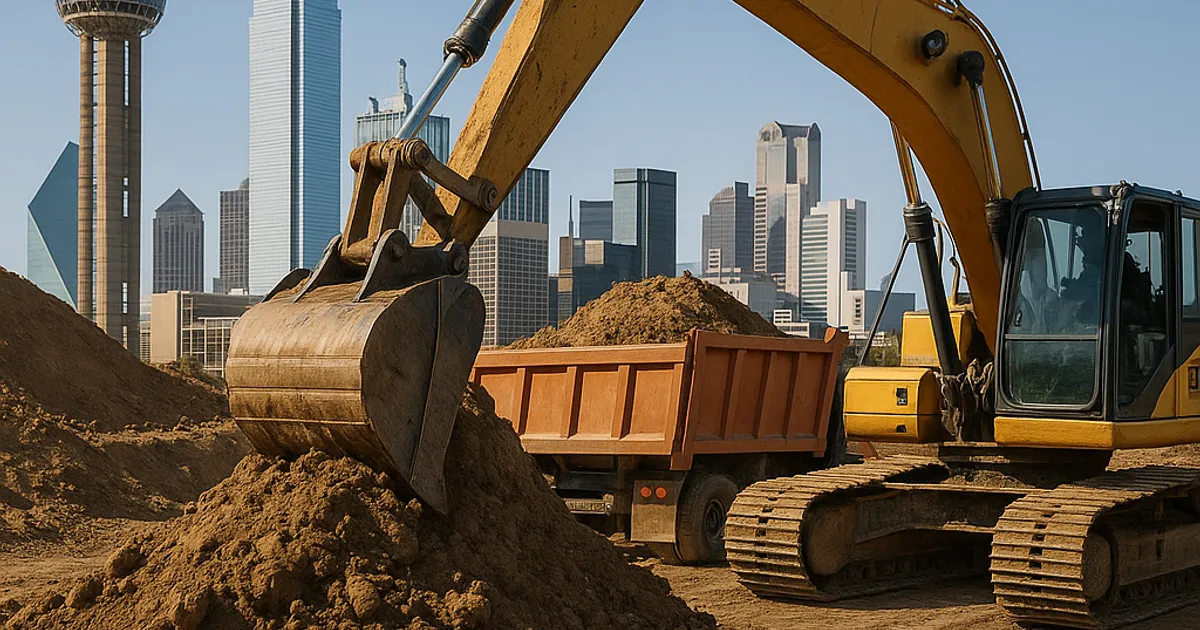
The Dallas-Fort Worth metro is one of the fastest-growing construction markets in the United States, with billions of dollars in residential, commercial, and infrastructure projects breaking ground every year. All of that development means one thing for earthwork contractors: enormous volumes of dirt, rock, and aggregate must be excavated, transported, and placed — and every cubic yard of that movement is subject to a complex web of local, state, and federal rules.
Failure to understand Dallas dirt hauling regulations isn't just a paperwork problem. It can result in stop-work orders, fines reaching tens of thousands of dollars, project delays that cascade into contract penalties, and liability exposure that can sink a company. Whether you're a seasoned earthwork contractor or a developer encountering grading requirements for the first time, this guide is your definitive reference for dirt hauling permits in Texas and DFW excavation rules.
We'll walk through every layer of the compliance stack — from the City of Dallas Development Services permits to TCEQ stormwater rules, truck weight regulations, and environmental soil screening requirements — and show you how forward-thinking contractors are using platforms like DirtMatch to stay ahead of both regulatory requirements and material logistics.
Why Dallas Dirt Hauling Compliance Is More Complex Than You Think
Many contractors assume that dirt hauling is simple: load, haul, dump. In reality, moving dirt in the DFW area touches at least four distinct regulatory domains simultaneously. A single mid-size commercial grading project in Dallas can require:
- A Grading and Drainage Permit from the City of Dallas Development Services Department
- A Texas Pollutant Discharge Elimination System (TPDES) Construction General Permit from the Texas Commission on Environmental Quality (TCEQ)
- Overweight or oversize vehicle permits from TxDOT and potentially the City of Dallas
- Haul route approvals from the City's Public Works and Transportation Department
- A floodplain development permit if any portion of the site falls within a FEMA-designated Special Flood Hazard Area
- Possible Section 404 coordination with the U.S. Army Corps of Engineers if jurisdictional wetlands are present
Each of these permit tracks has its own application process, fee schedule, timeline, and compliance obligations. And in a region spanning 11 counties and dozens of municipalities — each with its own ordinances — the rules can change significantly depending on whether your project sits in Dallas proper, Frisco, Irving, Garland, or any of the dozens of incorporated cities that make up the metro.
The DFW construction market processed an estimated $18.4 billion in permitted construction value in 2023 alone, according to regional building permit data compiled by the North Texas real estate analytics community. That volume of activity means regulatory agencies are actively scrutinizing sites and enforcing compliance more aggressively than ever.
City of Dallas Grading and Drainage Permits
What Is a Grading Permit and When Do You Need One?
The City of Dallas requires a Grading Permit for any land disturbance activity that involves moving, removing, or depositing soil on a property. Under the Dallas Development Code (Chapter 51A) and the City's Stormwater and Floodplain Management Ordinance, a grading permit is generally required when:
- More than 100 cubic yards of material is moved on a single lot
- Any grading occurs within a floodplain or drainage easement, regardless of volume
- The project involves cut or fill slopes exceeding 2 feet in height
- Grading activity will disturb more than one acre of land (which also triggers state stormwater permit requirements)
For residential projects, the threshold is slightly lower — homeowners and contractors working on single-family lots must obtain a grading permit for cuts or fills exceeding 2 feet or 50 cubic yards in environmentally sensitive areas.
How to Apply for a Dallas Grading Permit
Applications are submitted through the City of Dallas's ePlan online portal, which replaced the paper-based process in 2021. The typical application package includes:
- Completed application form with project address, legal description, and contractor license information
- Grading Plan prepared and sealed by a licensed Texas Professional Engineer (PE) or Registered Professional Land Surveyor (RPLS) — required for projects exceeding 5,000 square feet of disturbance
- Drainage Report demonstrating that post-construction stormwater runoff does not increase peak flows to adjacent properties
- Erosion Control Plan showing Best Management Practices (BMPs) such as silt fences, rock check dams, and inlet protection
- TPDES Notice of Intent (NOI) confirmation number if the site disturbs one or more acres
Permit Fees and Processing Times
Dallas grading permit fees are calculated based on the volume of material to be moved:
| Volume of Material (Cubic Yards) | Base Permit Fee |
|---|---|
| Up to 100 CY | $85 |
| 101 – 1,000 CY | $175 |
| 1,001 – 10,000 CY | $350 |
| 10,001 – 50,000 CY | $700 |
| Over 50,000 CY | $700 + $50 per additional 10,000 CY |
Processing times for complete applications typically run 10–15 business days for standard reviews and 20–30 business days for projects requiring floodplain review or FEMA coordination. Expedited review is available for an additional 50% surcharge on the base fee.
Pro tip: Incomplete applications are the number-one cause of permit delays. Ensure your drainage report addresses the City's 10-year and 100-year storm event analysis requirements — reviewers will kick back applications that model only one return period.
TCEQ Stormwater Permits: The TPDES Construction General Permit
Understanding the Texas CGP (TXR150000)
For any construction project in Texas that disturbs one or more acres of land — including dirt hauling and grading activities — the Texas Commission on Environmental Quality (TCEQ) requires coverage under the Texas Pollutant Discharge Elimination System (TPDES) Construction General Permit, permit number TXR150000.
This permit, which corresponds to the EPA's federal stormwater construction permit program, requires operators to:
- File a Notice of Intent (NOI) with TCEQ at least 7 days before commencing earth disturbance (or 2 days for small sites between 1–5 acres under certain conditions)
- Develop and implement a Stormwater Pollution Prevention Plan (SW3P), which is Texas's equivalent of the federal SWPPP
- Inspect the site at least once every 14 calendar days and within 24 hours of any rain event exceeding 0.5 inches
- Document all inspections and maintain records on site for at least 3 years
- File a Notice of Termination (NOT) within 30 days of achieving final stabilization
The EPA's stormwater construction program provides the federal framework that TCEQ's TPDES permit implements at the state level — understanding both layers helps contractors recognize where Texas rules are stricter than federal minimums.
SW3P Requirements for DFW Dirt Hauling Projects
A compliant SW3P for a typical DFW grading and dirt hauling project must address:
- Site description including drainage patterns, receiving waters, and acres disturbed by phase
- Sequence of major construction activities correlated with BMPs
- List of potential pollutants — for dirt hauling, this includes sediment, concrete washout, fuels, and hydraulic fluids from equipment
- BMP descriptions and locations — silt fences, stabilized construction entrances, sediment basins, and perimeter controls
- Maintenance procedures for each BMP
- Responsible party certifications signed by the legally responsible party (LRP)
Failure to maintain a compliant SW3P or conduct required inspections can result in TCEQ enforcement actions. Administrative penalties under Texas Water Code §7.102 can reach $10,000 per day per violation, and TCEQ has actively pursued enforcement in the DFW watershed in recent years due to the area's sensitivity around Lake Lewisville, Lake Lavon, and the Trinity River system.
NOI Filing Fees
TCEQ currently charges $100 per NOI filing for construction general permit coverage, payable online through the TCEQ online filing system (STEERS). Small construction operators (sole proprietorships with gross revenues under $1 million) may qualify for reduced fees under the agency's small business policy.
TxDOT and City Haul Route Permits
Overweight and Oversize Vehicle Permits in Texas
Dirt hauling trucks — particularly end dumps and belly dumps operating at maximum legal weight — must comply with Texas Transportation Code Chapter 623 and TxDOT's Office of Oversize/Overweight Permits regulations.
In Texas, the standard legal weight limits for trucks on state highways are:
| Axle Configuration | Maximum Gross Weight |
|---|---|
| Single Axle | 20,000 lbs |
| Tandem Axle | 34,000 lbs |
| Tridem Axle | 42,000 lbs |
| Gross Vehicle Weight (Interstate) | 80,000 lbs |
| Gross Vehicle Weight (State Highway, 5-axle) | 80,000 lbs |
Texas does allow certain Designated routes with higher weight limits — known as Texas Farm-to-Market and Ranch-to-Market road weight postings — but these vary by county and season. Collin County, Denton County, and Tarrant County all have specific seasonal weight restrictions on unpaved county roads that affect rural site access during wet seasons.
For loads exceeding legal limits, contractors must obtain a Single-Trip Permit or Annual Blanket Permit from TxDOT. Annual blanket permits for standard overweight loads cost approximately $600–$800 per vehicle and cover unlimited trips on approved routes throughout the year.
City of Dallas Haul Route Requirements
The City of Dallas separately requires contractors to submit a Haul Route Plan for any project that will generate significant truck traffic on city streets. This requirement kicks in for projects generating more than 100 truck trips per week on city-maintained roadways.
- Identify all streets to be used by hauling trucks, using City-preferred routes that minimize impacts to residential streets and school zones
- Specify hours of operation (Dallas generally restricts heavy truck traffic to 7:00 AM – 9:00 PM on weekdays and 8:00 AM – 8:00 PM on weekends in residential areas)
- Include a street condition pre-survey documenting existing pavement damage before hauling begins
- Provide a road restoration bond or deposit calculated at $0.05–$0.15 per square foot of roadway used
Municipalities like Frisco, McKinney, and Allen — all experiencing explosive growth — have implemented even more stringent haul route programs, sometimes requiring dedicated construction traffic management plans reviewed by the city engineer.
Floodplain Development Rules in the DFW Area
FEMA Floodplain Considerations
Dallas is bisected by the Trinity River and numerous tributaries, making floodplain management a critical part of any grading project. The City of Dallas participates in FEMA's National Flood Insurance Program (NFIP) and enforces Dallas City Code Chapter 41A, which regulates development in Special Flood Hazard Areas (SFHAs) — areas with a 1% annual chance of flooding, commonly called the 100-year floodplain.
Any fill placed within an SFHA in Dallas requires a Floodplain Development Permit in addition to the standard grading permit. The City's floodplain administrator reviews fill placement to ensure it does not raise the Base Flood Elevation (BFE) by more than 0.1 feet at any adjacent structure, per FEMA's no-rise standard.
For large-scale fill operations in or near the floodplain, a Conditional Letter of Map Revision (CLOMR) may be required before construction begins, followed by a Letter of Map Revision (LOMR) after grading is complete to officially update the FEMA flood map. CLOMR/LOMR processing through FEMA typically takes 4–6 months and costs between $3,000–$8,000 in review fees alone, not counting the engineering costs to prepare the hydraulic model.
Trinity River Corridor
Projects near the Trinity River Corridor face additional scrutiny under the City of Dallas Trinity River Corridor Development Certificate program. Any development within the Trinity River levee system or the corridor's defined floodway requires review and approval from the U.S. Army Corps of Engineers' Fort Worth District, which manages the federal levee system under its regulatory authority. Coordination timelines with the Corps can add 3–6 months to a project schedule.
Environmental Soil Screening: What Goes In the Ground Matters
Texas Risk Reduction Program (TRRP) and Fill Soil Standards
Not all dirt is created equal, and in Texas, placing contaminated fill on a property — even unknowingly — can create significant liability under the Texas Risk Reduction Program (TRRP), administered by TCEQ under 30 TAC Chapter 350.
The TRRP establishes Protective Concentration Levels (PCLs) for hundreds of chemical constituents in soil. Fill dirt imported to a site must not contain contaminants above residential or commercial PCLs (depending on the land use), or the party placing the fill can be held liable for cleanup costs.
For DFW contractors, the practical implication is clear: always request a soil characterization or source documentation for imported fill material. Reputable sources should be able to provide:
- A statement that the material is clean fill (no demolition debris, no waste materials)
- Basic analytical data for sites in areas with known or suspected contamination history
- Chain of custody documentation showing where the material originated
DirtMatch's marketplace platform makes this due diligence easier by connecting buyers with verified fill dirt sources across the DFW region. Right now, the fill dirt market in Dallas shows over 586,000 yards of material available and more than 1.5 million yards needed — with 1,035 matches made in the last 30 days alone. For example, a recent listing posted 25,000 yards of clean fill dirt available in Melissa, TX, offering contractors in the northern metro a compliant, documented source without long haul distances.
Soil Testing Requirements
For projects involving fill placement under structures, roadways, or in environmentally sensitive areas, soil testing to ASTM International standards is often required:
- ASTM D2487 — Standard Practice for Classification of Soils for Engineering Purposes (Unified Soil Classification System)
- ASTM D698 / D1557 — Standard Proctor and Modified Proctor compaction tests, establishing maximum dry density and optimum moisture content
- ASTM D1556 / D6938 — In-place density testing for compaction verification
Most Dallas city projects and TxDOT contracts specify compaction to 95% of Modified Proctor density for structural fill and 90% for non-structural embankment fill.
Find or Post Dirt, Rock & Aggregate
Join thousands of contractors using DirtMatch to buy, sell, and exchange earthwork materials.
Try DirtMatch FreeContractor Licensing and Insurance Requirements
Texas Contractor Licensing for Earthwork
Texas does not have a single statewide general contractor license for commercial construction. However, earthwork and grading contractors operating in Dallas must navigate:
- City of Dallas Contractor Registration — required for any contractor pulling permits within city limits. Registration requires proof of general liability insurance ($500,000 minimum per occurrence for most trades) and workers' compensation coverage.
- Texas Department of Licensing and Regulation (TDLR) — oversees certain specialty licenses including underground utility contractors and electrical work associated with grading projects (site lighting, irrigation systems).
- TCEQ Licensed Irrigator — required if the grading project includes irrigation system installation or modification.
Insurance Requirements
Contractors hauling dirt in DFW should carry at minimum:
| Coverage Type | Recommended Minimum |
|---|---|
| Commercial General Liability | $1,000,000 per occurrence / $2,000,000 aggregate |
| Commercial Auto (trucking) | $1,000,000 combined single limit |
| Workers' Compensation | Statutory limits per Texas law |
| Umbrella/Excess Liability | $5,000,000 (for large projects) |
| Pollution Liability | $1,000,000 (recommended for excavation near USTs or contaminated sites) |
The Federal Motor Carrier Safety Administration (FMCSA) requires all for-hire motor carriers operating in interstate commerce to maintain minimum liability insurance — typically $750,000 for dry bulk carriers. Contractors hauling exclusively within Texas must still comply with the Texas Department of Motor Vehicles (TxDMV) intrastate carrier requirements.
Municipal Variation: DFW City-by-City Permit Differences
One of the most important things to understand about DFW excavation rules is that they vary significantly by municipality. The City of Dallas's requirements, while detailed above, do not apply in Fort Worth, Frisco, McKinney, Plano, Arlington, or any of the other independent cities in the metro. Each has its own development code and permit process.
Key Differences Across Major DFW Cities
| City | Grading Permit Threshold | Haul Route Required | Online Permitting |
|---|---|---|---|
| Dallas | >100 CY or 2-ft cut/fill | Yes, >100 trips/week | Yes (ePlan) |
| Fort Worth | >50 CY | Yes, project-specific | Yes (MyPermit) |
| Frisco | >500 SF disturbance | Yes, all projects | Yes |
| McKinney | >100 CY | Yes, >50 trips/week | Yes |
| Plano | >1 acre or >500 CY | Case-by-case | Yes |
| Arlington | >250 CY | Yes, major projects | Partial |
| Garland | >100 CY | Yes, case-by-case | Yes |
Frisco deserves special attention given its explosive growth — the city processed more than $2.1 billion in construction permits in 2023 and has invested heavily in its development review staff and electronic permitting systems. Contractors working in Frisco should expect thorough drainage reviews and active field inspections, particularly as the city manages rapid expansion of its roadway and utility infrastructure.
Irving — home to major commercial and industrial development near DFW International Airport — has its own Environmental Services Division that reviews grading plans for compliance with the city's Stormwater Quality Management Ordinance, which mirrors state TPDES requirements but adds local notification requirements for neighbors within 300 feet of major grading operations.
Step-by-Step Permit Process for a Typical DFW Dirt Hauling Project
To make this concrete, here's how the permit process typically unfolds for a mid-size commercial grading project — say, a 15-acre mixed-use development in the Dallas ETJ:
Step 1: Pre-Application Meeting (Weeks 1–2)
Schedule a pre-application conference with the City's Development Services Department. Bring conceptual grading plans and drainage calculations. Identify floodplain, wetland, and sensitive area constraints at this stage.
Step 2: Engage a Licensed Engineer (Weeks 2–4)
Retain a Texas PE to prepare the Grading Plan, Drainage Report, and Erosion Control Plan. For projects near floodplains, a hydrologic and hydraulic (H&H) study may also be required.
Step 3: TCEQ NOI Filing (At Least 7 Days Before Grading)
File the TPDES NOI online through TCEQ STEERS. Develop the SW3P simultaneously — it must be complete and on-site before earth disturbance begins.
Step 4: City Permit Application (Weeks 3–6)
Submit the complete application package through the city's ePlan or online portal. Pay applicable fees. Respond to any reviewer comments within the city's specified timeframe (typically 10 business days) to avoid restarting the review clock.
Step 5: Haul Route Approval (Weeks 3–5, Concurrent)
Submit the haul route plan to the city's Public Works department. Conduct the pre-construction pavement survey with city staff or an approved third-party firm.
Step 6: Permits Issued — Begin Work
Post the grading permit on-site. Implement all BMPs before commencing grading. Maintain inspection logs per TPDES requirements.
Step 7: Ongoing Compliance
Conduct bi-weekly SW3P inspections. Respond to city inspections promptly. Update the SW3P if project scope or phasing changes.
Step 8: Closeout
File TCEQ Notice of Termination within 30 days of final stabilization. Submit as-built grading plan to the city if required. Release haul route bond after city inspection confirms no pavement damage.
For contractors who need to source or offload large volumes of material during this process, getting started with DirtMatch can significantly simplify the logistics side. With thousands of active listings across DFW — including contractors needing fill in Frisco and Burleson and suppliers with materials available in Melissa and Irving — matching supply and demand is faster than making phone calls down a contractor list.
Cost Summary: What Permits and Compliance Really Cost in DFW
Budgeting for permits and compliance is often underestimated. Here's a realistic cost breakdown for a mid-size (10–15 acre) grading project in Dallas:
| Compliance Item | Estimated Cost |
|---|---|
| City Grading Permit Fee | $700 – $1,500 |
| Engineering (Grading Plan + Drainage Report) | $8,000 – $25,000 |
| TCEQ NOI Filing Fee | $100 |
| SW3P Preparation | $2,000 – $5,000 |
| SW3P Inspections (professional inspector) | $3,000 – $8,000 per year |
| Haul Route Plan and Pre-Survey | $1,500 – $4,000 |
| Road Restoration Bond | $5,000 – $20,000 |
| Floodplain Permit (if applicable) | $500 – $1,500 |
| CLOMR/LOMR (if applicable) | $15,000 – $40,000 |
| Soil Testing (per ASTM standards) | $2,000 – $6,000 |
| Total Estimated Compliance Cost | $23,000 – $111,000 |
These figures don't include potential fines for non-compliance, which can dwarf permit costs. A single TCEQ enforcement action for inadequate stormwater controls on a 10-acre site could result in penalties of $50,000–$200,000 depending on the severity and duration of the violation.
The takeaway: investing in proper compliance upfront is always cheaper than remediation and penalties. And reducing unnecessary hauling costs — by matching surplus dirt with nearby projects that need it rather than hauling to distant disposal sites — can help offset compliance costs significantly. That's where platforms like DirtMatch Pro create real financial value for earthwork contractors operating across the DFW market.
Common Permit Mistakes DFW Contractors Make
After reviewing the full compliance landscape, here are the most common and costly mistakes contractors make on DFW dirt hauling projects:
1. Underestimating Disturbed Area
Contractors frequently calculate only the footprint of active grading and forget to include access roads, staging areas, and material stockpiles. TCEQ counts all disturbed areas toward the one-acre threshold — and inspectors measure from aerial imagery.
2. Starting Grading Before the NOI is Accepted
Filing the NOI online doesn't immediately confer permit coverage. The 7-day waiting period is mandatory. Starting grading the day after filing is a common violation.
3. Not Updating the SW3P for Scope Changes
If phasing changes, new contractors come on-site, or drainage patterns shift, the SW3P must be updated. Many contractors treat it as a one-time document rather than a living plan.
4. Ignoring Neighboring Municipality Limits
In the DFW patchwork of cities, a haul route often crosses two or three jurisdictions. Contractors sometimes obtain a haul route permit from one city and assume it covers the whole route.
5. Placing Fill Without Documentation
Accepting fill dirt from an unknown source without soil characterization documentation creates environmental liability that can follow the property owner for decades under TRRP.
6. Missing the TCEQ NOT Filing
Once a project achieves final stabilization, contractors have 30 days to file the Notice of Termination. Missing this deadline technically keeps the site in active permit status and subject to inspection requirements indefinitely — and accrues ongoing compliance obligations.
How DirtMatch Helps DFW Contractors Navigate the Regulatory Landscape
Compliance doesn't exist in a vacuum — it intersects directly with project logistics. The tighter your material sourcing and disposal are managed, the easier it is to stay within permitted haul routes, minimize truck trips (reducing haul route exposure), and document the provenance of fill material.
DirtMatch, the leading platform for connecting dirt suppliers and buyers across North Texas and beyond, helps earthwork contractors solve these logistical challenges in ways that directly support regulatory compliance:
- Verified material listings make it easier to source fill dirt with documented origins, supporting TRRP due diligence requirements
- Proximity matching reduces haul distances, which means fewer truck trips, lower haul route impact, and simpler route planning
- Real-time marketplace data — with over 586,000 yards currently available and 1.5 million yards needed in the DFW market — means contractors can find compliant disposal or sourcing solutions quickly rather than hauling to far-flung sites
Understand how DirtMatch works and you'll see why it's become an essential tool for DFW earthwork contractors looking to reduce costs, simplify compliance, and keep projects moving on schedule.
Key Takeaways for DFW Earthwork Contractors
Dallas dirt hauling regulations are complex but manageable when approached systematically. Here are the non-negotiable fundamentals every DFW contractor must have in place:
- Always check the specific municipality's requirements — Dallas rules don't apply in Fort Worth, Frisco, or McKinney
- File your TCEQ NOI at least 7 days before breaking ground on sites over one acre
- Have a complete, site-specific SW3P on-site from day one — not a template, a real plan
- Budget for compliance realistically — permits and engineering for a mid-size project can easily reach $30,000–$50,000 before a blade touches soil
- Document your fill sources — contaminated fill creates liability that survives project completion
- Know your truck weights and routes before mobilizing — TxDOT and city haul route requirements are enforced
- Plan for permit timelines — 4–8 weeks for a standard grading permit is realistic; floodplain projects take longer
With the right preparation, the right professional team, and the right tools for managing material logistics, DFW dirt hauling projects can be executed efficiently, compliantly, and profitably — even in one of the most actively regulated construction markets in the country.