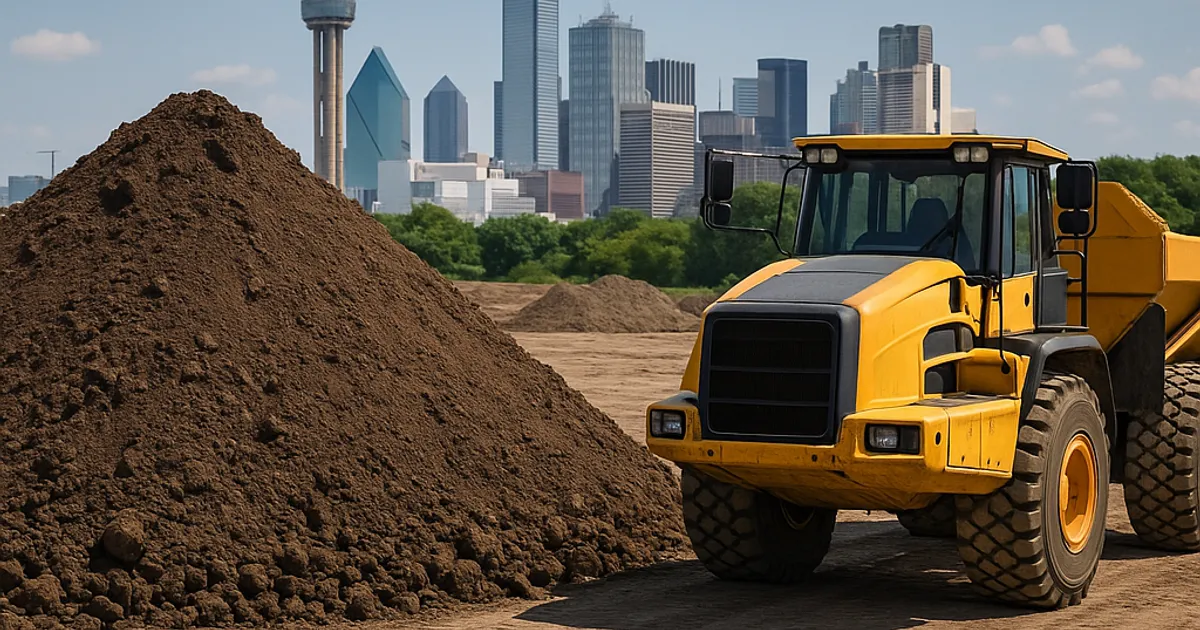
The Dallas-Fort Worth metroplex runs on earthwork. With a regional population pushing 8 million and a construction pipeline that shows no signs of slowing, the DFW area is one of the most active earthmoving markets in the United States. Highways widen. Warehouses rise. Master-planned communities push outward into Denton, Collin, Ellis, and Johnson counties. Data center campuses consume hundreds of acres. Every one of these projects moves dirt — enormous quantities of it, often in directions that make no economic sense.
Here's the familiar scenario: a grading crew in Frisco is paying to haul 40,000 cubic yards of clean sandy loam to a landfill. Three miles away, a developer is paying a premium to truck in select fill from a commercial quarry for a pad site. Neither party knows the other exists. The market has failed both of them.
Dirt matching platforms exist to fix exactly this problem. By digitally connecting contractors who have surplus excavated material with those who need fill, these platforms are eliminating one of the most persistent inefficiencies in the North Texas construction market. For DFW earthwork contractors operating on thin margins in a highly competitive environment, knowing how to use these tools — and how to use them well — is increasingly a competitive differentiator.
This guide covers everything you need to know: how dirt matching services work, the types of material that move through these platforms, the geological and regulatory realities of the DFW market, the economics of dirt exchange, and how to evaluate which platform is right for your operation.
Why DFW Has a Chronic Dirt Coordination Problem
The scale of construction activity in the Dallas-Fort Worth metroplex is genuinely difficult to overstate. According to US Census Bureau construction spending data, Texas has ranked among the top states in total construction put in place for more than a decade, with the DFW metro anchoring that dominance. Residential, commercial, industrial, and public infrastructure projects overlap constantly across a 13-county footprint that spans thousands of square miles.
That density of activity should theoretically make dirt logistics easier — there are so many projects happening simultaneously that supply and demand should roughly balance out. In practice, the opposite is true. The coordination problem scales with the market. Without a centralized way to surface available material and match it to nearby demand, individual contractors are flying blind. They haul to the landfill because it's the default, not because it's the best option.
The financial toll is significant. Industry estimates suggest that unnecessary dirt hauling — material that goes to disposal when it could have gone to a nearby project — adds thousands of dollars per project in avoidable costs. Across the DFW market, operating at this scale, that inefficiency compounds into hundreds of millions of dollars of waste annually.
Digital dirt matching platforms address the root cause: information asymmetry. When contractors can search a real-time database of available material and post their own needs, the market clears more efficiently. Supply meets demand closer to its origin, truck trips are reduced, tipping fees disappear, and both the excavating contractor and the fill-seeking developer come out ahead.
The Geology of DFW: Why Material Type Matters
North Texas is not uniform ground. The region spans multiple distinct geological formations, and the type of soil or rock a contractor encounters depends heavily on which part of the metroplex they're working in. This geological diversity makes material specification — knowing exactly what you have and what you need — essential to any successful dirt exchange.
Blackland Prairie and Expansive Clay
Black expansive clay, colloquially known as "black gumbo," dominates large portions of Dallas County and central Tarrant County. This material is notorious among builders for its extreme shrink-swell behavior: it expands dramatically when wet and contracts when dry, exerting pressures that can crack foundations, heave pavement, and buckle utility lines. In some formations, the plasticity index (PI) of this clay exceeds 40 — far above the threshold for use as structural fill under most specifications.
Black gumbo generated on a grading project is difficult to place as fill. It needs moisture conditioning, lime treatment, or it needs to go away entirely. Contractors who excavate it often have no choice but to haul it off-site, which is precisely the kind of material a dirt matching platform helps manage — not by finding a fill buyer, but by connecting the excavating contractor with a disposal outlet or a project that can use treated material.
Sandy Loam and Select Fill Zones
Move north into Denton County or northwest into Parker County, and the soil profile changes favorably. Sandy loam with low plasticity indices is more common in these areas, and this material is highly sought after as select fill for residential foundations, road subgrade, and utility trench backfill. Contractors excavating in these zones often hold a genuine commodity — clean, low-PI material that nearby developers would happily receive.
Rock Formations: Eagle Ford Shale and Austin Chalk
The southern and southwestern portions of the metroplex — Cedar Hill, Mansfield, Midlothian, and areas extending toward Johnson and Ellis counties — encounter the Eagle Ford Shale and Austin Chalk formations. These rock units require specialized equipment to excavate (heavy rippers or blasting in hard chalk), and the resulting material ranges from soft, fissile shale to competent limestone cobbles. Well-graded limestone rock is excellent aggregate for road base and drainage layers. Shale-dominant excavation generates material with more limited reuse options, though it can still function as bulk fill in non-structural applications.
Understanding your material at the formation level isn't just good practice — it's the foundation of an effective dirt exchange listing. Platforms that require detailed material specification inputs create better matches and fewer disputes down the line.
How Dirt Matching Platforms Work: The End-to-End Process
At their core, dirt matching platforms are digital marketplaces that aggregate supply-side and demand-side listings for excavated material. The mechanics are straightforward, but the sophistication varies considerably between platforms.
Step 1: Create a Material Listing
A contractor with surplus excavated material — the supply side — creates a listing that describes:
- Material type: Sandy loam, expansive clay, decomposed granite, rip-rap, topsoil, select fill, mixed fill, etc.
- Volume: Estimated cubic yards available, with an indication of confidence level (rough estimate vs. measured).
- Location: GPS coordinates or address of the source site.
- Availability window: When the material will be accessible for pickup. Timing matters — construction schedules shift constantly.
- Material condition: Whether it's been tested, what moisture conditions it's in, whether it contains debris or organics.
- Terms: Whether the contractor is offering the material free (self-haul), charging a tipping fee, or offering payment to a contractor who will haul it away.
Step 2: Search and Match
On the demand side, a contractor needing fill material searches the platform's database using filters for location radius, material type, volume range, and availability. The platform surfaces matching listings ranked by proximity and specification compatibility.
The best platforms go beyond keyword matching. They incorporate material specification logic — so a contractor searching for select fill with PI ≤ 20 won't get matched with listings for high-plasticity clay — and they surface haul distance as a primary factor, since trucking cost is almost always the deciding variable in whether a dirt exchange makes financial sense.
Step 3: Connect and Negotiate
Once a match is identified, the platform facilitates contact between the two parties. From there, the contractors negotiate the terms of the exchange: who arranges and pays for trucking, whether there's a cost transfer, timing coordination, and site access logistics. Some platforms offer integrated messaging, contract templates, and even connections to independent trucking brokers.
Step 4: Execute the Move
Material moves from the source project to the receiving project. In the ideal scenario, trucks that would have made empty return trips from one site now carry material directly to a second project — cutting total truck miles, reducing road wear, and eliminating landfill tipping fees entirely.
How DirtMatch works follows this exact workflow, with tools designed specifically for the earthwork industry: GPS-based proximity search, material type filtering, volume validation, and direct contractor-to-contractor messaging. If you're new to dirt exchange platforms, it's worth walking through the process before your next excavation project kicks off.
The Financial Case for Using a Dirt Exchange in DFW
The economics of dirt exchange in a market like DFW are compelling, and the math isn't complicated. Let's walk through a realistic North Texas scenario.
The supply side: A site development contractor grading a mixed-use commercial project in Prosper generates 20,000 cubic yards of sandy loam that tests clean and meets TxDOT select fill specifications. The contractor's options:
- Haul to a landfill or approved disposal site: estimated $9–$15 per cubic yard including trucking, tipping fees, and labor. Total disposal cost: $180,000–$300,000.
- Post on a dirt matching platform and connect with a nearby project needing fill: disposal cost reduced to near zero, or the contractor may even collect a modest per-yard fee from the receiving project.
The demand side: A residential developer in Celina is building 200 lots in a new subdivision and needs 18,000 cubic yards of select fill to bring pads to grade. The developer's options:
- Purchase select fill from a commercial sand and gravel operation: estimated $14–$22 per cubic yard delivered. Total fill cost: $252,000–$396,000.
- Source the same material from a nearby excavating contractor through a dirt exchange: cost potentially reduced to trucking only, at $6–$10 per cubic yard. Total cost: $108,000–$180,000.
Both parties save substantially. The platform that connected them creates real, measurable value on both sides of the transaction — and does so while reducing the total number of truck trips on DFW roads.
Cost Comparison: Traditional Dirt Logistics vs. Dirt Exchange
| Scenario | Traditional Approach | Via Dirt Exchange |
|---|---|---|
| Disposal cost (supply side, per CY) | $9–$15 | $0–$3 |
| Fill material cost (demand side, per CY) | $14–$22 | $6–$10 |
| Total truck trips (per 10,000 CY) | ~500–650 (disposal + delivery) | ~250–350 (direct haul) |
| Landfill tipping fees | Full cost | Eliminated |
| Environmental footprint | High | Reduced |
The savings are largest when supply and demand are geographically close — which, in a dense construction market like DFW, happens more often than contractors realize. The platform's job is to surface those opportunities before both parties default to the expensive option.
Types of Material Traded Through DFW Dirt Exchanges
The range of material that moves through dirt matching platforms in North Texas is broader than many contractors expect. Understanding what trades well — and what doesn't — helps you set realistic expectations and write better listings.
Select Fill (High Demand)
Clean, low-PI sandy loam and sandy clay with a plasticity index of 20 or below is the most sought-after material in the DFW exchange market. It functions as structural fill under foundations and slabs, road subgrade, utility backfill, and general grading fill. Material from Denton, Collin, and northwest Tarrant counties tends to fall into this category naturally. If you generate select fill, you have leverage — demand consistently outpaces supply on most platforms.
Topsoil (Moderate Demand)
Stripped topsoil — the upper 4–12 inches of organic-rich surface material — trades actively among landscaping contractors, golf course developers, and residential lot finishers. Quality varies significantly; topsoil that's been stockpiled for months and is well-aged is more valuable than freshly stripped material full of weed seed and debris. Volume tends to be smaller than structural fill transactions, but turnaround is often faster.
Decomposed Granite and Crushed Rock (Moderate-High Demand)
Contractors working in western Tarrant and Parker counties frequently encounter decomposed granite and soft limestone during excavation. When properly processed, this material is excellent for road base, drainage aggregate, and hardscape applications. It trades well on dirt exchange platforms, particularly when buyers in urban infill areas need a stable base course material.
High-Plasticity Clay (Difficult to Place)
Expansive black clay with PI above 25 is the hardest material to move through an exchange platform. Most structural fill specifications reject it outright. However, it's not without use — compacted clay can function as liner material for retention ponds, landfill cells, and erosion control berms. Listing it with accurate characterization (PI value, moisture content, test data) is the key to finding the narrow pool of buyers who can use it.
Concrete Rubble and Demolition Material (Situational)
Crushed concrete and clean demolition material can be recycled as aggregate base or used in non-structural fill applications. Texas Commission on Environmental Quality (TCEQ) rules govern the reuse of demolition debris; contractors dealing in this material need to ensure their listings clearly identify the material type and that any receiving project confirms regulatory compliance before accepting.
Texas Regulatory Framework: What DFW Contractors Need to Know
Dirt exchange doesn't happen in a regulatory vacuum. North Texas contractors moving material between sites need to understand several layers of regulatory requirements that govern how soil can be transported, deposited, and reused.
TCEQ and Fill Material Quality
The Texas Commission on Environmental Quality (TCEQ) sets standards for fill material used in regulated contexts, particularly when soil is being placed near water bodies, floodplains, or sensitive environmental areas. Contractors sourcing material from sites with unknown histories — particularly urban infill parcels, former industrial sites, or properties near dry-cleaning operations — should be aware that contaminated soil cannot legally be transferred as fill without proper characterization and, in many cases, remediation. Accepting contaminated material on a project site can create serious environmental liability under federal CERCLA rules.
Stormwater and SWPPP Requirements
Both the source project and the receiving project are typically covered by stormwater pollution prevention plans (SWPPPs) under EPA NPDES Construction General Permit requirements. When material is moving between sites, both contractors need to ensure their erosion and sediment controls account for the earthwork activity associated with the exchange. Inspectors in DFW municipalities have become increasingly vigilant about SWPPP compliance as the region's watershed management programs have matured.
Texas DOT Specifications for Select Fill
For projects that ultimately tie into TxDOT right-of-way or involve state-funded infrastructure, fill material must meet TxDOT Item 132 or Item 247 specifications depending on application. Contractors receiving fill for these projects should request material certifications or test reports before accepting a dirt exchange load. Most reputable platforms allow sellers to attach documentation directly to their listings.
Local Municipal Requirements
Individual DFW municipalities add their own layers. The City of Dallas, Fort Worth, Frisco, McKinney, and most other major cities require grading permits that specify approved disposal locations and, in some cases, require documentation of where imported fill originated. Before accepting fill from an exchange platform, confirm that your project's grading permit allows fill from third-party sources and understand what documentation your city inspector may request.
Find or Post Dirt, Rock & Aggregate
Join thousands of contractors using DirtMatch to buy, sell, and exchange earthwork materials.
Try DirtMatch FreeEvaluating Dirt Matching Platforms: What to Look For
Not all soil matching services are built equally. As the category has grown, the range of platforms has expanded from basic classified-ad boards to purpose-built construction technology tools. Here's how to evaluate your options.
Material Specification Matching
The most important feature of any dirt exchange platform is whether it matches on material specification, not just geography. A platform that serves you listings of expansive clay when you're searching for select fill is worse than useless — it wastes your time and creates false hope. Look for platforms that require detailed material description inputs and filter matches accordingly.
Geographic Precision
In a market as spread out as DFW, hauling distance is the critical variable. A cubic yard of free fill dirt is no longer free if you have to truck it 45 miles to get it. The best platforms display precise origin coordinates, allow you to set your own radius threshold, and surface haul distance prominently in search results.
Volume Verification
Volume estimates in construction are notoriously unreliable. A contractor who thinks they have 10,000 cubic yards might actually have 7,000 by the time excavation conditions are factored in. Good platforms build in volume uncertainty indicators and allow listings to be updated in real time as conditions change.
Integrated Trucking Connections
The deal is only as good as the truck that executes it. Some platforms have built-in connections to regional trucking brokers or owner-operators who can be dispatched to handle the haul. For DFW contractors who don't have their own fleet, this feature can be the difference between a dirt exchange that happens and one that stalls on logistics.
Reputation and Review Systems
As with any marketplace, trust matters. Platforms that include contractor ratings, verified business profiles, and transaction history create accountability that benefits both parties. A contractor who consistently overstates material volumes or misrepresents soil quality should be identifiable before you spend time negotiating with them.
DirtMatch was built by people who understand the earthwork industry from the ground up — the platform's design reflects the real operational constraints that DFW contractors face, from tight project schedules to the regulatory requirements that govern material transfer in Texas. Exploring DirtMatch Pro gives contractors access to advanced matching tools, priority listing placement, and expanded search radius options that can be particularly valuable in a market as competitive as DFW.
How to Write a Listing That Actually Gets Results
Posting a listing on a dirt matching platform is simple. Writing a listing that generates real, qualified inquiries takes a little more thought. Here's what separates listings that move material from listings that sit idle.
Be Specific About Material Type
Don't just say "fill dirt." Specify the soil classification, estimated plasticity index if known, moisture condition, and whether it contains any rock, organic matter, or debris. Contractors on the demand side are evaluating your listing against their project's fill specifications — the more detail you provide, the faster they can make a decision.
Lead with Availability
Construction schedules shift constantly. Clearly state when your material will be accessible for loading, how long the availability window lasts, and what the site access situation looks like (gate codes, hours, truck size restrictions). Listings that include this information convert significantly faster than vague "call for details" posts.
Include Testing Data When Available
If you've had your material tested — even basic Atterberg limits or a standard proctor — include those results. Demand-side contractors will trust your listing more, and you'll spend less time fielding questions. For high-volume transactions, offering to share a recent geotechnical report excerpt can accelerate the deal considerably.
Price It Clearly
Ambiguity around cost is one of the most common reasons dirt exchange deals fall apart before they start. Be explicit about your terms: Is the material free to anyone who hauls it? Is there a tipping fee? Are you offering payment to a contractor who will take it off your hands? Clear pricing terms attract serious inquiries and filter out tire-kickers.
Common Mistakes DFW Contractors Make With Dirt Exchanges
Even experienced earthwork contractors make avoidable mistakes when using soil matching platforms for the first time. Here are the most common pitfalls and how to sidestep them.
Waiting Too Long to Post
The single biggest mistake is posting your surplus material listing after you've already committed to hauling it to a disposal site. Dirt exchange connections take time — typically days to a week or more to negotiate, confirm, and schedule. Post your listing as soon as you know you'll have surplus material, ideally before excavation begins. The earlier you post, the more likely you are to find a match before the default option (landfill) takes over by inertia.
Overestimating Volume
Contractors consistently overestimate available volumes in the early stages of a project. Swell factors, unexpected rock, and design changes all reduce what actually comes out of the ground. Post conservative volume estimates and update them as conditions become clearer. A demand-side contractor who shows up expecting 15,000 cubic yards and finds 9,000 will not be a repeat exchange partner.
Ignoring Haul Distance Economics
A dirt match that looks attractive on paper can become a money-loser if the haul distance is too long. At current diesel prices and trucking rates in the DFW market, a round-trip haul of more than 20–25 miles often erases the savings on both sides. Use your platform's distance filters aggressively, and run the trucking math before committing to any exchange.
Skipping Documentation
In Texas, moving material between project sites without documentation is an invitation to regulatory problems. Always get a written agreement — even a simple email confirmation — that describes the material, volume, source address, and destination. If your municipality requires grading permit amendments to document fill sources, handle that paperwork before the first truck rolls.
Accepting Material Without Verification
On the demand side, don't accept fill material without at minimum a visual inspection and, for structural applications, basic lab testing. The consequences of placing expansive clay under a foundation that called for select fill can be catastrophic and expensive. Most geotechnical firms in DFW can turn around basic Atterberg limit tests quickly and inexpensively. That cost is cheap insurance.
Sustainability Benefits: Why Dirt Exchange Is an Environmental Win
Beyond the financial case, dirt matching platforms deliver measurable environmental benefits that are increasingly relevant to DFW contractors navigating green building requirements, municipal sustainability initiatives, and client expectations around responsible construction practices.
Reduced Landfill Pressure
The DFW metroplex's rapid growth has placed significant pressure on regional landfill capacity. Clean excavated soil that occupies landfill airspace is a particular source of inefficiency — it's not contaminated, it's not hazardous, and it has genuine utility in construction. Every cubic yard of excavated material redirected from landfill to beneficial reuse through a dirt exchange extends landfill capacity and reduces tipping costs for the entire construction community.
Lower Carbon Footprint Per Project
Heavy truck traffic is the dominant source of construction-related emissions in urban markets. Reducing total truck trips — by moving material directly from source to need rather than making separate disposal and delivery trips — cuts diesel consumption, greenhouse gas emissions, and particulate pollution. In a market where DFW municipalities are increasingly scrutinizing construction air quality impacts, this matters both environmentally and reputationally.
Soil Conservation
Commercial sand and gravel operations are not a renewable resource on any human timescale. Every cubic yard of natural aggregate that can be replaced by recycled excavated material preserves virgin mineral resources. The USDA Natural Resources Conservation Service recognizes reuse of excavated soil as a best practice for soil conservation, and increasingly, sustainable construction certification programs reward projects that source fill from local excavation rather than quarried materials.
Getting Started: A Practical Action Plan for DFW Contractors
If you're ready to integrate dirt matching into your operation, here's a practical sequence to follow.
Step 1: Inventory your upcoming projects. Before your next excavation or grading job kicks off, estimate whether you'll generate surplus material or need to import fill. Build that assessment into your pre-construction planning, not as an afterthought.
Step 2: Create your platform profile. Get started with DirtMatch by setting up a contractor profile that reflects your operation — service area, typical material types, truck fleet capacity, and the kinds of projects you work on. A complete profile generates more inbound inquiries than a bare-bones listing.
Step 3: Post early. As soon as your project's excavation quantities are reasonably defined, post your surplus listing or your fill need. The earlier your listing is visible, the larger the pool of potential matches.
Step 4: Run the haul distance math. Before committing to any exchange, calculate total trucking cost for the proposed haul. Confirm that the exchange saves money relative to your alternatives. If it does, proceed. If the math is marginal, keep the listing up while you explore other matches.
Step 5: Document everything. Get material agreements in writing, keep testing records, and confirm permit compliance before material moves. Treat a dirt exchange with the same documentation discipline as any other subcontractor arrangement.
Step 6: Build your exchange network. The contractors you exchange with successfully today are the ones you'll call first on the next project. Treat dirt exchange relationships as long-term business relationships, not one-time transactions. Repeat partnerships are faster, lower-friction, and increasingly reliable.
For contractors managing multiple active projects simultaneously, DirtMatch Pro provides tools to manage multiple listings, track exchange activity across projects, and surface high-priority matches in real time — features that make a genuine difference when your operation is large enough that dirt logistics are a daily management challenge rather than an occasional concern.
The Bigger Picture: Where Dirt Exchange Is Headed in DFW
Dirt matching technology is still relatively early in its adoption curve in the DFW market, but the trajectory is clear. As construction activity remains intense, as landfill costs continue to rise, and as municipal sustainability requirements tighten, the pressure to manage excavated material more intelligently will only increase.
In 2026, the most forward-thinking DFW earthwork contractors are already treating their surplus material as a resource to be managed strategically, not a liability to be disposed of as quickly as possible. They post listings before projects begin. They search for nearby fill sources before calling a quarry. They maintain platform profiles and build exchange relationships the same way they maintain relationships with equipment dealers and subcontractors.
The infrastructure of the DFW dirt exchange market is also maturing. Geotechnical firms are increasingly comfortable providing abbreviated material characterization reports specifically formatted for exchange platform listings. Municipal grading departments in several DFW cities are developing streamlined processes for documenting fill sources from third-party exchanges. Regional trucking operators are building their scheduling around platform-generated exchange loads.
The direction of travel is unmistakable. Soil matching services are moving from a niche workaround to a standard component of earthwork project management in North Texas. Contractors who build familiarity with these platforms now will be better positioned as the market continues to develop — and will hold a cost and efficiency advantage over competitors who stick with the default options.
If you're ready to see what the DFW dirt exchange market looks like right now — what material is available near your next project, who's looking for the fill you're about to generate — get started with DirtMatch and explore the platform built specifically for earthwork contractors working in markets like this one.
Have questions about how dirt matching works or whether your material qualifies? Visit our frequently asked questions page or contact us directly — the DirtMatch team works with North Texas contractors every day and can help you evaluate whether a specific project is a good fit for the platform.