
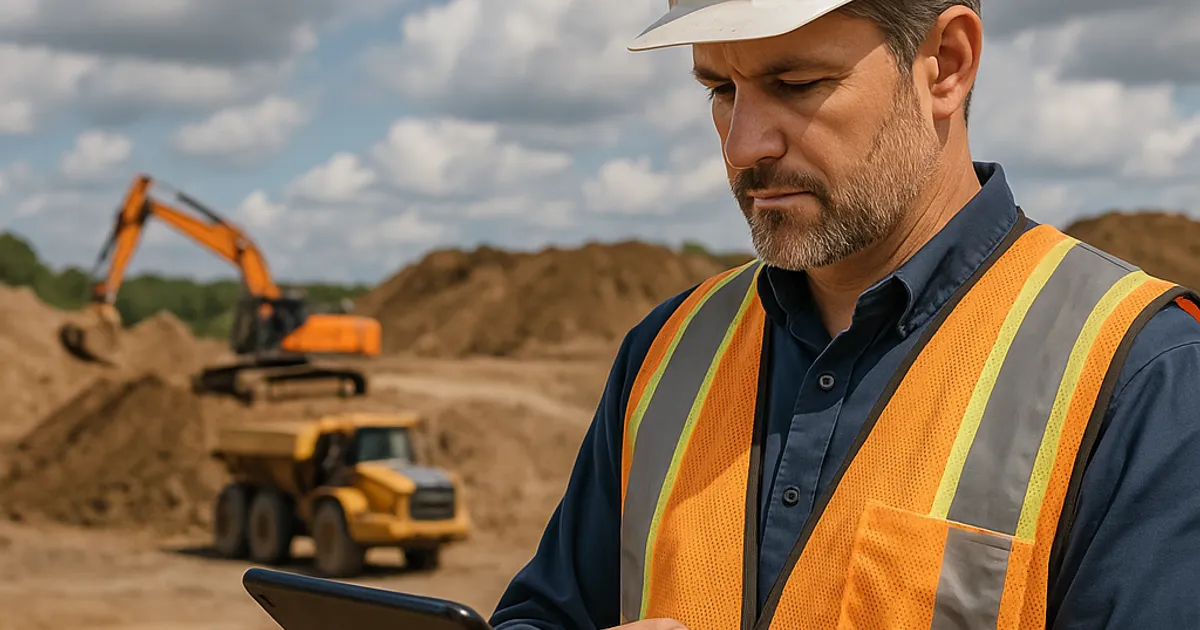
The gap between how earthwork contractors operated a decade ago and how the best firms operate today is staggering. Where foremen once phoned in daily quantities from a muddy cab, superintendents now pull live production dashboards on a tablet while standing at the cut edge. Where project managers once reconciled paper timecards on Friday afternoons, automated cloud systems now push labor costs into job cost reports the moment an operator clocks out in the field.
Cloud-based project management is no longer a luxury reserved for the Bechtel-scale firms of the world. In 2026, even small-to-mid-size earthwork contractors — the grading subs, the mass excavators, the utility corridor specialists — are leveraging platforms like Procore, B2W, HCSS, and Vista by Viewpoint to compete smarter, bid more accurately, and keep their field operations tightly connected to the office.
This guide is written specifically for earthwork contractors. We'll cover what to look for in earthwork software, how to evaluate the leading platforms, what field-to-office integration really means in practice, and how emerging digital tools — including material exchange platforms like DirtMatch — are filling critical gaps that even the most sophisticated construction management software leaves behind.
Why Earthwork Contractors Face Unique Project Management Challenges
Before diving into software solutions, it's worth acknowledging that earthwork is genuinely different from other construction trades — and those differences create specific software requirements that generic project management tools often fail to address.
Production Is Measured in Volume, Not Units
A framing crew counts walls. A concrete crew counts cubic yards of pour. But an earthwork crew measures production in bank cubic yards moved, compacted cubic yards placed, and loads hauled — quantities that shift constantly based on swell and shrinkage factors, soil classification, and moisture conditions. Your project management software needs to handle these material transformations natively, not as a workaround.
The Field-Office Gap Is Larger
Earthwork projects frequently span miles of right-of-way or hundreds of acres of mass grading. Unlike a building construction site where everyone works in a defined vertical structure, earthwork crews are dispersed. A dozer operator pushing fill on pad three may be a half-mile from the water truck and two miles from the superintendent's field trailer. Real-time data transmission from machine to office isn't just convenient — it's operationally essential.
Material Logistics Are Complex
Earthwork projects involve constant movement of dirt, rock, aggregate, and spoil — often from multiple sources to multiple destinations. Managing import fill, tracking export spoil disposal, coordinating aggregate delivery from quarries, and reconciling truck counts against pay quantities requires a level of material logistics sophistication that most generic project management platforms weren't built to handle.
Weather Sensitivity Creates Rapid Re-Planning
A single rain event can shut down compaction operations, reverse a week's worth of subgrade preparation, or turn a haul road into an impassable quagmire. Earthwork project managers need tools that support rapid schedule re-sequencing and can model the cost impact of weather delays in real time.
According to data from the AGC of America, earthwork and site preparation consistently rank among the most schedule-volatile phases of construction, with weather-related delays accounting for up to 22% of total project delay days on grading-intensive projects.
The Core Architecture of Cloud-Based Earthwork Software
Understanding how modern construction management platforms are structured helps contractors make better purchasing decisions. Most enterprise-grade platforms are built on a core architecture with several interconnected modules.
Estimating and Bid Management
For earthwork contractors, the estimating module is mission-critical. Look for platforms that support takeoff-to-bid workflows, allow input of equipment production rates (e.g., dozer push rates by soil type), and integrate with popular takeoff tools like Trimble Business Center or Agtek. B2W Software, designed from the ground up for heavy civil contractors, has long been considered the gold standard here, offering production-based estimating that matches how earthwork is actually built.
Job Costing and Budget Control
Cloud-based job costing gives project managers a live view of budget vs. actual performance by cost code. For a mass grading project, this might mean tracking actual cost per compacted cubic yard against the estimated unit cost, broken down by equipment, labor, and fuel. Platforms like Procore and HCSS HeavyJob push field-collected data — hours, quantities, equipment usage — directly into the job cost ledger without manual re-entry.
Scheduling and Look-Ahead Planning
Earthwork projects benefit from three-week look-ahead schedules that tie closely to production forecasts. The best earthwork software integrates scheduling with production data, so that when your dozer hours fall short on Tuesday, the system automatically recalculates when the pad will be ready for concrete.
Document Control and Compliance
Permit conditions, inspection reports, SWPPP documentation, and daily reports all need a centralized home that's accessible to field crews, office staff, and owners alike. Cloud-based document management eliminates the "which version is current?" problem that plagues paper-based operations.
Field Data Collection
This is where field-to-office integration lives. Mobile apps that allow operators, foremen, and superintendents to log production quantities, report equipment issues, capture photos, and submit daily reports from the field — without visiting the office trailer — are the backbone of a modern earthwork operation.
Head-to-Head: The Leading Earthwork Project Management Platforms
The market for construction management software has matured significantly, but the options can still be overwhelming. Here's a detailed comparison of the platforms most commonly used by earthwork and heavy civil contractors in 2026.
Procore
Procore is the dominant general construction management platform by market share, and its earthwork capabilities have grown substantially through partnerships and integrations. Its strengths lie in project communication, document management, RFI and submittal workflows, and owner-facing reporting. Its weaknesses — at least out of the box — are in production-based cost tracking and heavy equipment management, which matter enormously to earthwork contractors. That said, Procore's open API and robust integration marketplace allow it to connect with specialized earthwork tools, making it a strong central hub for contractors who use best-of-breed software.
Best for: Mid-to-large earthwork contractors who work as GC subs and need robust owner/GC-facing communication tools alongside their field operations data.
Approximate cost: $375–$1,200/month depending on company revenue tier (Procore charges on a per-year, unlimited-user basis tied to revenue).
B2W Software
B2W is purpose-built for heavy civil and earthwork contractors. Its Estimate module is widely regarded as the best production-based estimating tool in the industry. B2W Track handles daily field reporting and connects back to Estimate so that actual production can be compared against estimate assumptions in real time. B2W Maintain handles equipment maintenance and repair tracking. The platform is designed around the way earthwork is actually built — by production unit, by equipment resource, by shift.
Best for: Dedicated earthwork and heavy civil contractors who want a fully integrated suite built specifically for their trade.
Approximate cost: $800–$2,500+/month depending on modules and company size.
HCSS (Heavy Construction Systems Specialists)
HCSS offers HeavyBid for estimating and HeavyJob for field operations and job costing. Like B2W, it was designed for the heavy civil contractor and has deep roots in earthwork, highway, and utility construction. HeavyJob's mobile field reporting is particularly strong, with a reputation for reliability in low-connectivity environments — critical when you're grading a remote pipeline corridor with spotty cell service. HCSS also offers fleet management and safety tools.
Best for: Contractors with large equipment fleets and complex field operations who need ruggedized mobile data collection.
Approximate cost: $700–$2,000+/month depending on modules.
Vista by Viewpoint (Trimble)
Vista is an ERP-level platform that combines accounting, project management, and field operations in a single system. For earthwork contractors who are tired of disconnected accounting and project management software, Vista offers a unified financial backbone. Since Trimble's acquisition of Viewpoint, Vista has also deepened its integration with Trimble's GPS machine control and field layout technology, creating a compelling end-to-end data story for contractors who use Trimble grade control.
Best for: Mid-to-large contractors who want a single platform for accounting, project management, and field operations.
Approximate cost: $1,000–$4,000+/month depending on company size and modules.
Comparison Table
| Platform | Best For | Earthwork-Specific? | Estimating | Field Reporting | Accounting | Starting Price/Mo |
|---|---|---|---|---|---|---|
| Procore | GC subs, communication | Partial | Via integrations | Strong | Via integrations | ~$375 |
| B2W | Heavy civil specialists | Yes | Excellent | Strong | Via integrations | ~$800 |
| HCSS | Large fleet operators | Yes | Excellent | Excellent | Via integrations | ~$700 |
| Vista (Trimble) | ERP-seeking contractors | Partial | Moderate | Moderate | Excellent | ~$1,000 |
| Procore + B2W | Best-of-breed combo | Yes | Excellent | Excellent | Via integrations | ~$1,200+ |
Field-to-Office Integration: What It Really Means for Dirt Contractors
The phrase "field to office" gets thrown around constantly in construction technology marketing, but for earthwork contractors, it has very specific, practical meaning. True field-to-office integration means that data generated at the cut, at the fill, or in the cab flows automatically — without re-entry — into the systems that drive decisions in the office.
Real-Time Production Tracking
Consider a highway embankment project where three scrapers, two dozers, and a compactor are working a 10-hour shift. In a traditional operation, the foreman keeps a tally sheet, totals up the numbers at the end of the shift, and drives them to the office where a project engineer enters them into a spreadsheet. By the time anyone knows whether the shift met production targets, it's too late to do anything about it.
With field-to-office integration, the foreman logs quantities every two hours on a mobile app. The project engineer sees live production in the cloud-based dashboard. If production is running 15% behind at the midpoint of the shift, the superintendent can make adjustments — add a truck, re-route the push — while there's still time to recover.
GPS Machine Control Integration
Platforms like Trimble and Topcon now allow GPS machine control data — blade position, pass counts, grade verification — to feed directly into project management dashboards. This creates a digital record of what was built, where, and when, which is invaluable for pay quantity documentation and quality assurance. Trimble Construction technology, for example, integrates with multiple construction management platforms to push as-built data directly into the project record.
Automated Daily Reports
A well-configured field-to-office system can auto-generate a daily report from the data entered in the field — crew counts, equipment hours, quantities, weather conditions, and photos — and push it to the owner, GC, and project file simultaneously. This eliminates a task that used to consume 30–45 minutes of a foreman's evening and ensures that documentation is consistent and complete.
Equipment Telematics Integration
Modern earthmoving equipment from manufacturers like Caterpillar (Cat Connect), Komatsu (KOMTRAX), and Deere (JDLink) transmits machine health data — engine hours, fault codes, fuel consumption, idle time — via cellular or satellite to fleet management systems. The best construction management platforms can ingest this telematics data and surface it alongside project data, giving managers a unified view of where their assets are, how they're performing, and what they're costing.
Material Tracking and the Missing Piece Most Software Misses
Here's a dirty secret about most construction management platforms, including the best ones: they're built around labor hours, cost codes, and contract line items. They're not built around dirt.
For earthwork contractors, material is often the largest variable cost on the job. Import fill that costs $12/CY delivered on a 50,000 CY project represents $600,000 — and the price, source, and quality of that fill can make or break the job's profitability. Yet most project management platforms treat fill dirt as a simple line item with a fixed cost, with no mechanism to track sourcing, quality, or real-time pricing.
This is the gap that specialized platforms and marketplaces are beginning to fill. Contractors working in fast-growth markets — from the dirt exchange in Denver to the dirt exchange in Los Angeles — are increasingly turning to material-specific platforms to handle the sourcing, pricing, and logistics of dirt, rock, and aggregate that their project management software wasn't designed to manage.
DirtMatch works alongside your existing project management stack to solve exactly this problem — connecting earthwork contractors with verified sources of fill dirt, clean spoil, and aggregate materials in their project area, so material sourcing becomes a tracked, optimized workflow rather than a series of phone calls to whoever answers first. For contractors managing multiple active projects with different fill requirements, this kind of specialized marketplace integration can meaningfully reduce material costs and sourcing time.
Building a Digital Workflow: Implementation Strategy for Earthwork Contractors
Choosing the right software is only half the battle. Successful implementation is where most contractors stumble — and where the ROI either materializes or disappears.
Step 1: Audit Your Current Workflows
Before selecting a platform, document how your operation currently handles estimating, job costing, field reporting, and document management. Identify the friction points — where data gets lost, re-entered, or delayed. This audit will reveal which software capabilities matter most for your specific operation.
Step 2: Define Your Integration Requirements
Most earthwork contractors already use accounting software (QuickBooks, Sage, Spectrum) and may use equipment telematics platforms, GPS machine control systems, or standalone estimating tools. Your new project management platform needs to integrate with these existing systems, or you'll trade one set of data silos for another. Prioritize platforms with proven integrations with your existing tools.
Step 3: Start with One Project
Rolling out new software across an entire company simultaneously is a recipe for chaos. Select one active project — ideally one with a willing, tech-comfortable superintendent — and implement the full workflow there first. Use that project to identify configuration issues, training gaps, and workflow adjustments before scaling company-wide.
Step 4: Train the Field, Not Just the Office
The most common reason construction software implementations fail is that field personnel never adopt the mobile data collection tools. Office staff are eager to use the shiny new dashboard, but if foremen aren't logging quantities and hours in the app, the data feeding that dashboard is incomplete. Invest in field training, make the mobile interface as simple as possible, and create accountability for daily data entry.
Step 5: Measure Adoption and ROI
Set baseline metrics before go-live: time spent on daily reports, frequency of pay quantity disputes, days to close monthly job cost reports, and actual-vs-estimated production variance. Measure these same metrics three and six months after implementation to quantify the software's impact on your operation.
Find or Post Dirt, Rock & Aggregate
Join thousands of contractors using DirtMatch to buy, sell, and exchange earthwork materials.
Try DirtMatch FreeThe Cost-Benefit Case for Earthwork Software in 2026
Skeptical contractors often ask whether the subscription costs of cloud-based project management software are worth it. The data suggests a compelling return, even for smaller operations.
Labor Savings on Administrative Tasks
A project engineer or office manager spending four hours per week reconciling field timecards, daily reports, and quantity tracking represents roughly $8,000–$12,000 in annual labor cost for that single function, assuming a $50/hour fully burdened rate. Automated field-to-office workflows can reduce that time by 60–70%, paying for a basic software subscription in administrative savings alone.
Reduced Pay Quantity Disputes
One of the most expensive problems on earthwork projects is disputes over pay quantities — how many cubic yards were actually moved, compacted, or hauled. These disputes can delay payment for months and consume significant management time. GPS-verified quantities and digital daily reports create an audit trail that resolves disputes faster and prevents many from arising at all. Industry estimates suggest that pay quantity disputes add 2–4% to the administrative cost of earthwork projects that rely on paper-based documentation.
Better Bid Accuracy
Production-based estimating software, when fed with actual historical production data from completed jobs, produces significantly more accurate bids. Contractors using B2W or HCSS consistently report that the feedback loop between estimated and actual production rates allows them to tighten their bid spread — reducing the margin they need to carry as a contingency buffer — without increasing risk.
Faster Collections
Cloud-based applications for pay apps and billing, particularly when integrated with document management, reduce the cycle time from work completion to invoice submission and approval. For earthwork contractors carrying large equipment costs, every day of faster collection has real financial value.
Compliance, Documentation, and the Digital Paper Trail
Earthwork projects carry significant regulatory compliance obligations that project management software can help manage.
Stormwater and Environmental Compliance
Land-disturbing activities above one acre typically require a SWPPP (Stormwater Pollution Prevention Plan) and regular inspection documentation under the EPA's NPDES Construction General Permit. Cloud-based document management systems can store SWPPP documentation, schedule inspection reminders, and maintain a timestamped record of inspection reports — creating a defensible compliance record if regulators ask questions.
Safety Documentation
Safety inspection records, toolbox talk logs, incident reports, and equipment inspection checklists can all be managed within cloud-based platforms. This is particularly important for excavation work, which carries elevated risk and specific regulatory requirements under OSHA 29 CFR 1926 Subpart P regarding soil classification, protective systems, and competent person oversight.
Subcontractor Compliance Tracking
For earthwork contractors who manage trucking subcontractors, aggregates suppliers, or specialty excavation subs, cloud-based platforms can track insurance certificates, W-9s, and prequalification status — reducing the risk of working with uninsured or non-compliant vendors.
Emerging Technologies Reshaping Earthwork Project Management
The pace of technology adoption in earthwork is accelerating, and several emerging capabilities are beginning to move from experimental to mainstream.
Drone-Based Quantity Surveys
UAV (drone) surveys using photogrammetry software can now produce stockpile volumes and cut/fill calculations accurate to within 1–2% in a fraction of the time required by traditional survey crews. Platforms like DroneDeploy and Pix4D can integrate with project management software to push survey data directly into quantity tracking systems. In 2026, drone surveys are rapidly becoming a standard workflow item on mass grading projects, not an exotic capability.
AI-Powered Production Forecasting
Several construction software vendors are now incorporating machine learning models that analyze historical production data — equipment utilization rates, weather patterns, crew productivity — to generate more accurate production forecasts. These models get smarter as they accumulate more job data, creating a compounding advantage for contractors who have been digitizing their operations consistently.
Integrated Material Sourcing
As earthwork software matures, the integration between project management platforms and material sourcing tools is becoming more seamless. Contractors in active construction markets — from the dirt exchange in San Francisco to the dirt exchange in Seattle — are benefiting from platforms that connect the demand side (project managers who need fill) with the supply side (projects generating clean export material) in ways that reduce both cost and environmental impact.
DirtMatch Pro gives earthwork contractors priority access to verified material listings across their project regions, with the kind of real-time availability data that makes material logistics planning as trackable as any other project management function. For contractors managing tight schedules where import fill delivery windows are critical path items, this level of visibility can be the difference between hitting a milestone and blowing a deadline.
Telematics-Driven Productivity Analysis
Next-generation equipment telematics platforms are moving beyond simple hour tracking to provide cycle time analysis, payload monitoring, and idle time breakdowns that allow managers to identify specific productivity improvements. When this data is fed into a project management platform alongside production quantities, it creates a powerful feedback loop for continuous improvement.
Choosing the Right Platform for Your Operation Size
Not every earthwork contractor needs an enterprise-grade suite. Here's a practical framework for matching software scale to company size.
Small Contractors (Under $5M Annual Revenue)
At this scale, the priority is getting field data out of paper and text messages and into a centralized digital system. Entry-level tools like Fieldwire, Buildertrend, or even a well-configured Procore Basic subscription can deliver significant value without overwhelming a small team's capacity for adoption. Focus on daily reports, photo documentation, and basic job costing integration with QuickBooks.
Budget guidance: $200–$600/month.
Mid-Size Contractors ($5M–$25M Annual Revenue)
This is the sweet spot where purpose-built earthwork software like HCSS HeavyJob or B2W Track starts to deliver the most value. At this revenue level, the time saved on administrative workflows and the improvement in job costing accuracy produce measurable ROI. Integration with a production-based estimating platform is a high priority.
Budget guidance: $600–$2,000/month.
Large Contractors ($25M+ Annual Revenue)
At this scale, full-suite implementations — Procore plus B2W, or HCSS plus Viewpoint, or Vista by Trimble — deliver the most value. ERP-level accounting integration, multi-project dashboard reporting, and advanced analytics capabilities justify the higher investment. Dedicated implementation support and ongoing training programs are essential.
Budget guidance: $2,000–$8,000+/month.
The Human Factor: Getting Your Team to Actually Use the Software
No software article would be complete without an honest discussion of adoption — the stubborn human problem that technology alone cannot solve.
Earthwork contractors who have successfully implemented cloud-based project management consistently cite a few common success factors:
Executive sponsorship matters more than anything. When the owner or president visibly uses the software, asks for reports from it, and holds team members accountable for keeping it current, adoption follows. When software implementation is delegated to an office manager and ignored by leadership, it quietly dies.
Make the mobile app dead simple. Field crews will not use an app that requires 15 taps to log a daily quantity entry. The best earthwork software platforms design their mobile interfaces specifically for operators and foremen who may be in gloves, in a cab, or in poor lighting. Test the mobile UX before purchasing.
Tie the software to something people care about. Connect field data entry to payroll accuracy, pay quantity documentation, and bonus calculations. When foremen understand that accurate daily reporting directly affects whether the company gets paid — and whether their crew's overtime is correctly captured — compliance improves dramatically.
Build in quick wins. Identify two or three immediate pain points that the software solves visibly — eliminating a paper form that everyone hates, automating a report that took three hours to compile, resolving a recurring pay dispute with digital evidence — and make sure those wins are visible and celebrated early in the rollout.
Building Your Digital Earthwork Ecosystem
The most sophisticated earthwork contractors in 2026 aren't relying on a single platform to run their operations. They're building integrated digital ecosystems where specialized tools talk to each other, creating a unified operational picture.
A mature earthwork digital ecosystem might include:
- Estimating: B2W Estimate or HCSS HeavyBid
- Field operations & job costing: B2W Track or HCSS HeavyJob
- Project communication & document management: Procore
- Accounting & ERP: Sage 300 CRE, Vista by Trimble, or Spectrum
- Equipment telematics: Caterpillar VisionLink, KOMTRAX, or JDLink
- GPS machine control: Trimble or Topcon, integrated with as-built data
- Drone surveys: DroneDeploy or Pix4D, integrated with quantity tracking
- Material sourcing: DirtMatch for fill, spoil, and aggregate logistics
The key to making this ecosystem work is investing in integration — APIs, data connectors, and defined handoff points between systems — so that data flows without manual re-entry. Companies that get this right operate with a level of visibility and control that creates genuine competitive advantage: they bid more accurately, execute more efficiently, and collect faster than contractors who are still running on spreadsheets and phone calls.
For contractors just beginning to explore how a connected digital workflow can improve their material logistics alongside their project management, getting started with DirtMatch is a natural first step — a focused, purpose-built tool that addresses one of earthwork's most persistent pain points without requiring a complete technology overhaul.
Key Takeaways for Earthwork Contractors Evaluating Project Management Software
If you take nothing else from this guide, here are the most important principles for earthwork contractors navigating the cloud-based project management landscape in 2026:
Production-based platforms outperform generic construction software for earthwork contractors. B2W and HCSS were built for your trade; configure them accordingly.
Field adoption is the make-or-break factor. The best software in the world fails if foremen don't use the mobile app. Invest in training and build accountability into the process.
Integration is not optional. A project management platform that doesn't connect to your accounting software, estimating tools, and equipment telematics creates new data silos, not fewer.
Material logistics is a gap that most platforms leave open. Supplement your project management stack with specialized material sourcing tools to close this gap.
Start with one project, measure outcomes, then scale. Phased implementation consistently outperforms company-wide rollouts for earthwork contractors.
The ROI is real, but it takes 90–180 days to materialize. Be patient with adoption, consistent with data entry requirements, and disciplined about measuring the right metrics.
The contractors who will dominate the earthwork market in the years ahead are the ones investing in their digital infrastructure today. Cloud-based project management isn't a cost of doing business — it's a competitive weapon. Use it like one.