The sound of a diesel engine rumbling across a mine site or construction grade used to mean one thing: a skilled operator behind the wheel. In 2026, that same rumble increasingly comes from a cab with no one inside. Autonomous and semi-autonomous haul trucks have crossed the threshold from experimental technology into mainstream heavy industry, and the ripple effects are being felt from open-pit copper mines in Chile to highway construction corridors in the American Southwest.
For earthwork contractors, aggregate producers, and construction project managers, understanding this technology is no longer optional. Whether you're bidding on large-scale grading projects, managing a fleet of off-highway trucks, or sourcing fill materials for a development site, autonomous equipment is reshaping costs, timelines, labor dynamics, and competitive positioning across the board. This comprehensive guide breaks down exactly how the technology works, who's using it, what it costs, and what it means for your business in 2026.
What Are Autonomous and Semi-Autonomous Haul Trucks?
At the most basic level, an autonomous haul truck is a large off-highway or on-highway vehicle capable of navigating, loading, and dumping material without a human operator physically present in the cab. Semi-autonomous trucks, by contrast, still require a human — but that human may be monitoring multiple vehicles remotely, or only intervening at specific stages of the haul cycle such as loading or dumping.
The distinction matters more than it might appear. Full autonomy (sometimes referred to as SAE Level 4 or Level 5 in the on-highway context, though mining equipment uses its own classification frameworks) means the truck makes all navigation and operational decisions independently within a defined geofenced area. Semi-autonomy covers a broad spectrum: from trucks with advanced collision avoidance systems and automatic braking, to vehicles that drive themselves on established haul roads but need operator input at the shovel or crusher.
Key Technology Components
Autonomous haul trucks rely on a sophisticated stack of interlocking technologies:
- GPS/GNSS Positioning: High-precision dual-antenna GPS systems (often accurate to within 2–5 centimeters) define the truck's position on a digital map of the haul road network. Most systems use RTK (Real-Time Kinematic) corrections broadcast from a local base station.
- LiDAR and Radar Sensors: Light Detection and Ranging sensors create real-time 3D maps of the truck's immediate surroundings, detecting obstacles, personnel, and other vehicles. Radar supplements LiDAR in dusty or low-visibility conditions.
- Computer Vision and AI: Cameras paired with machine learning algorithms identify site-specific hazards, recognize loader signals, and monitor road conditions. The AI models are trained on millions of haul cycles and continually updated.
- Fleet Management Systems (FMS): A centralized software brain dispatches trucks, optimizes routing, manages queuing at shovels and dumps, and monitors every vehicle in the fleet in real time. Major platforms include Komatsu's FrontRunner and Caterpillar's MineStar Command.
- High-Speed Site Communications: Autonomous trucks require robust, low-latency wireless networks — typically private 4G LTE or, increasingly in 2026, 5G private networks — to maintain constant contact with the FMS and remote operators.
- Onboard Safety Systems: Redundant braking systems, emergency stop capabilities accessible remotely or by on-site personnel, and automatic safe-park protocols ensure that a communication loss doesn't result in a runaway truck.
The integration of all these systems is what separates a truly autonomous haul truck from a machine with a few driver-assist features. The engineering challenge is enormous, which is why full commercial deployment has concentrated in the controlled, mapped environments of large surface mines rather than dynamic public construction sites.
A Brief History: From Remote Control to Full Autonomy
The roots of autonomous mining trucks trace back to the early 1990s, when Komatsu began experimenting with remotely operated vehicles in Japanese mines. The first commercial autonomous haul truck system — Komatsu's Autonomous Haulage System (AHS) — was deployed at Codelco's Gabriela Mistral copper mine in Chile in 2008. That initial fleet of four Komatsu 930E trucks marked a turning point, proving that autonomous haulage was operationally viable at industrial scale.
Caterpillar followed with its Cat® Command for hauling system, and Rio Tinto launched its groundbreaking "Mine of the Future" program in Western Australia's Pilbara iron ore region, deploying what would grow into the world's largest autonomous truck fleet. By 2020, Rio Tinto was operating over 130 autonomous trucks across multiple sites. By 2026, that number has grown to over 250 vehicles, and the Pilbara operation has become the benchmark that the entire industry references.
The technology accelerated sharply in the early 2020s as AI capabilities improved, 5G networks expanded into remote areas, and a global shortage of experienced heavy equipment operators created urgent economic pressure to automate. Today, autonomous haulage is standard practice in large-scale iron ore, copper, coal, and oil sands operations worldwide, and semi-autonomous systems are making meaningful inroads into quarrying and large earthmoving projects.
The Major Players: Who Makes Autonomous Haul Trucks in 2026?
The autonomous haul truck market in 2026 is dominated by a small number of major OEMs, each offering their own integrated hardware-software ecosystem.
Komatsu
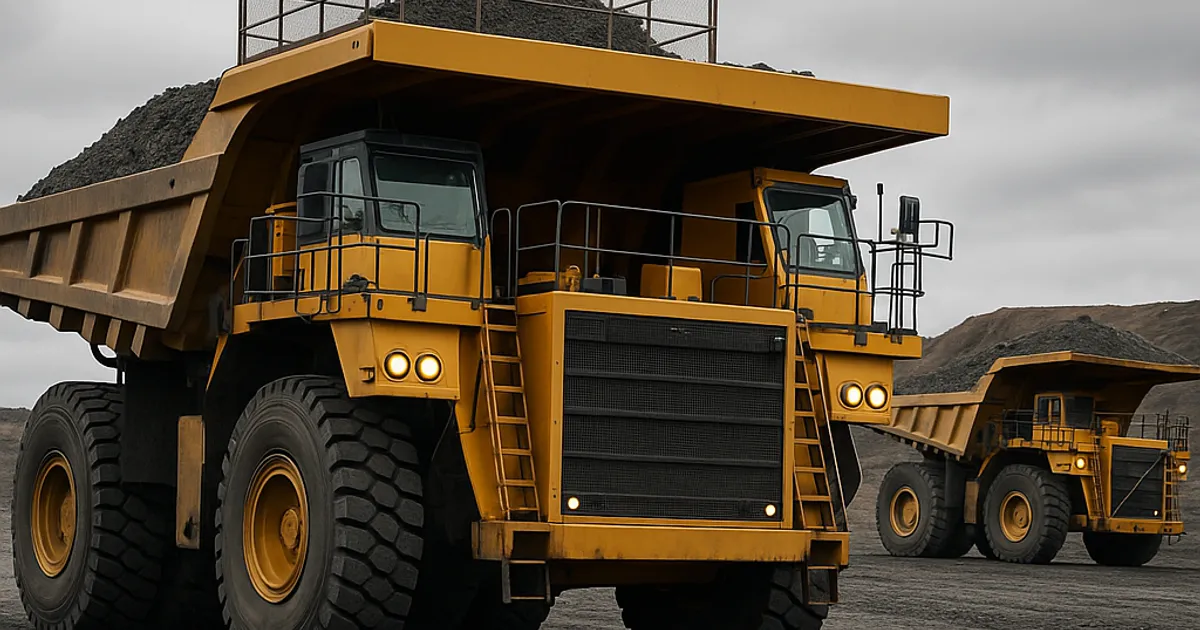
Komatsu remains the global leader in autonomous haulage by fleet size. Their AHS platform has logged over 5 billion tons of material moved autonomously as of early 2026, with deployments across Australia, Chile, Canada, and the United States. The Komatsu 930E-5 and 980E-5 ultra-class trucks (300–400 ton payload capacity) are the workhorses of their autonomous fleet. Komatsu has also announced their next-generation "AHS 3.0" platform featuring improved AI obstacle detection and seamless integration with electric and hydrogen powertrains.
Caterpillar
Caterpillar's Cat Command for hauling system runs on their 793, 797, and new 798 AC electric drive trucks. Cat takes a more open-architecture approach than Komatsu, allowing their MineStar Fleet system to integrate with non-Cat loading equipment. The Cat 798 AC, introduced commercially in 2025, carries a 400-ton payload and is available from the factory with autonomous-ready hardware. Caterpillar also partners with Trimble for precision positioning technology across their autonomous and semi-autonomous product lines.
Epiroc and ASI Mining
ASI Mining (a subsidiary of Epiroc) has taken a different approach: retrofitting existing haul trucks — including older Komatsu and Cat models — with autonomous systems. Their Mobius platform allows mine operators to automate trucks they already own without purchasing new equipment. This retrofit pathway has opened autonomous haulage to mid-tier mining operations that lack the capital for new ultra-class trucks.
Volvo and Liebherr
Volvo's autonomous truck program has focused more on semi-autonomous systems for quarrying and construction, including the HX04 battery-electric autonomous hauler designed for smaller earthmoving operations. Liebherr's T 264 and T 284 trucks have been integrated with autonomous systems through partnerships with technology companies, and Liebherr has announced a native autonomous platform expected to reach commercial availability in late 2026.
Emerging Competitors
Chinese manufacturers, particularly XCMG and SANY, have entered the autonomous haul truck market aggressively since 2022, initially targeting domestic coal and iron ore mines before expanding internationally. Their price points — roughly 20–30% below Western OEMs — are beginning to create competitive pressure in price-sensitive markets.
Performance and Productivity: What the Data Actually Shows
The business case for autonomous haul trucks rests on a compelling set of performance metrics — but understanding the nuances behind the numbers is critical before drawing conclusions about your own operation.
Productivity Gains
Autonomous trucks consistently operate at higher utilization rates than manned vehicles. Where a skilled human operator might achieve 18–20 operating hours per day (accounting for shift changes, breaks, fatigue, and relief delays), autonomous trucks in well-managed operations routinely achieve 22–23.5 operating hours per day. That 15–25% increase in operating hours directly translates to material moved.
Speed is more nuanced. Autonomous trucks are programmed to operate at speeds that optimize payload, fuel consumption, and tire wear rather than maximum velocity. In many operations, they run 5–10% slower than the fastest human operators — but they run consistently. Rio Tinto's data from the Pilbara shows that eliminating the variability in operator behavior (speed fluctuations, braking habits, cornering technique) reduces tire wear by up to 20% and fuel consumption by 10–15%, partially offsetting the productivity benefit of higher utilization.
FMS dispatch optimization is often the most underappreciated productivity driver. Autonomous fleets eliminate queue time at shovels and crushers by coordinating arrivals mathematically rather than relying on radio communication and driver judgment. Studies from multiple Pilbara operations show queue time reductions of 30–40%, meaning each truck completes more cycles per shift even if individual cycle speeds are similar to manned operations.
Safety Performance
The safety record of autonomous haul trucks is arguably the technology's most compelling selling point. The OSHA-reportable incident rate in haul truck operations drops dramatically when automation is introduced. Fatigue-related incidents — which account for a disproportionate share of serious haul truck accidents, particularly on night shifts — are eliminated entirely in fully autonomous operations. Speeding violations, distracted driving, and operator-error collisions disappear from the incident log.
BHP's autonomous truck operations in Western Australia reported zero haul truck operator fatalities over a seven-year period ending in 2026, compared to an industry-wide average that has historically seen multiple fatalities annually per large fleet. It's important to note that autonomous operations introduce different safety considerations — interactions between autonomous trucks and manned light vehicles, maintenance personnel on haul roads, and failure modes of the autonomous systems themselves — which require rigorous Traffic Management Plans and site-specific protocols.
True Cost of Ownership: The Numbers That Matter
Understanding the economics of autonomous haul trucks requires looking beyond the sticker price to the full lifecycle cost picture.
Capital Costs
A new ultra-class autonomous haul truck (300+ ton payload) carries a purchase price in the range of $5.5 million to $9 million USD depending on configuration, powertrain choice, and autonomous system integration level. The site infrastructure required to support an autonomous fleet — RTK base stations, private wireless network, FMS servers, control room, and operator training facilities — typically adds $3 million to $15 million per site depending on size and complexity. For a fleet of 20 trucks, total capital investment can easily reach $150–200 million before the first ton of ore is moved autonomously.
Retrofit solutions through companies like ASI Mining reduce capital requirements significantly. Retrofitting an existing 240-ton haul truck with full autonomous capability costs roughly $800,000 to $1.5 million per vehicle, plus the shared site infrastructure costs.
Operating Cost Reductions
The productivity and efficiency gains described above translate directly to operating cost reductions. Industry analysis from multiple large-scale deployments consistently shows:
| Cost Category | Manned Fleet | Autonomous Fleet | Change |
|---|---|---|---|
| Operator labor (per ton moved) | $0.45–$0.80 | $0.08–$0.15 | -75% to -85% |
| Fuel consumption (per ton) | Baseline | -10% to -15% | -10% to -15% |
| Tire costs (per ton) | Baseline | -15% to -20% | -15% to -20% |
| Maintenance (per ton) | Baseline | -5% to -10% | -5% to -10% |
| Incident-related costs | Variable | Near-zero | -90%+ |
The dramatic reduction in per-ton labor costs is the primary driver of the business case. However, operators must be replaced with FMS controllers, remote operations supervisors, and additional IT and telecommunications staff — so the labor savings at the truck level are partially offset by new categories of skilled employment.
Payback Period
For large mining operations running 20+ trucks, autonomous systems typically achieve payback in 3–6 years in high-labor-cost environments (North America, Australia, Western Europe). In lower-labor-cost regions, the payback period extends to 7–12 years, which explains why autonomous adoption in South American and African mining operations has lagged behind Australian and Canadian deployments.
Semi-Autonomous Systems: The Middle Ground for Earthmoving Contractors
While full autonomy dominates the conversation, semi-autonomous features are making the most immediate impact for mid-sized earthmoving contractors who aren't operating mega-mine haul fleets.
Operator Assist Technologies
Semi-autonomous features available today on commercially available haul trucks include:
Automatic Speed Management: Trucks automatically slow to safe speeds at intersections, crests, and defined hazard zones without operator input. This is now standard equipment on virtually all new large off-highway trucks.
Collision Avoidance Systems (CAS): Radar and camera systems detect pedestrians, light vehicles, and other trucks and apply automatic emergency braking. Several states and Canadian provinces now effectively mandate CAS on surface mining haul routes.
Automatic Retarder Control: The truck's retarding system is managed automatically based on gradient, load, and speed — protecting the brakes and reducing heat-related failures.
Payload Management Systems: Load cells and suspension sensors measure payload in real time, alerting the operator (or FMS) when trucks are overloaded or underloaded, optimizing cycle efficiency.
Lane Keeping and Road Edge Detection: The truck monitors its position on the haul road and provides steering correction to prevent run-off-road incidents — one of the most common haul truck accident types.
Teleoperation and Remote Operation
A growing segment of the semi-autonomous market involves teleoperation: a qualified operator at a remote control station, potentially located miles from the actual truck, controls the vehicle via real-time video feeds and control inputs. Teleoperation is particularly valuable for hazardous zones (blast areas, unstable slopes, confined spaces) where putting an operator in the cab creates unacceptable risk.
The economics of teleoperation are compelling even without full autonomy: a single skilled teleoperator can manage 2–4 semi-autonomous trucks simultaneously, effectively multiplying that operator's productivity by 2–4x.
Regulatory Landscape: Autonomous Equipment in 2026
The regulatory framework governing autonomous haul trucks remains fragmented and evolving. On private mine sites and quarries, which represent the vast majority of current autonomous deployments, regulation is primarily handled through internal site safety management systems, mine safety legislation at the state/provincial level, and industry standards developed by bodies like the Mining Industry Road Safety Alliance (MIRSA) in Australia.
In the United States, large surface mines operating autonomous trucks must navigate MSHA (Mine Safety and Health Administration) regulations, which have been updated periodically to address autonomous equipment but still contain significant ambiguity. MSHA's guidance documents require mine operators to develop site-specific Traffic Management Plans, train all site personnel to recognize and interact safely with autonomous vehicles, and implement positive communication systems between autonomous trucks and manned equipment.
For autonomous equipment operating on or near public roads — a frontier that highway construction automation is beginning to approach — the Federal Motor Carrier Safety Administration and state DOTs become the relevant regulatory bodies. As of 2026, no U.S. state permits fully autonomous operation of commercial haul trucks on public highways without a human operator available to assume control, though several states have active pilot programs with varying requirements.
The regulatory picture for construction-site automation is similarly complex, with OSHA's General Industry and Construction standards applying to equipment operation on active construction sites. Contractors deploying semi-autonomous systems on earthmoving projects must conduct thorough hazard analyses and document how the autonomous system addresses each identified hazard.
Find or Post Dirt, Rock & Aggregate
Join thousands of contractors using DirtMatch to buy, sell, and exchange earthwork materials.
Try DirtMatch FreeImpact on Labor: Displacement, Transformation, and New Roles
No discussion of autonomous haul trucks is complete without honestly addressing the labor question. The technology does eliminate the traditional haul truck operator role in fully automated operations. This is not a hypothetical — Komatsu's AHS deployments in Australia and Chile have directly replaced hundreds of operator positions at individual mine sites.
However, the labor story is more complex than simple displacement. According to data from the Bureau of Labor Statistics, construction and extraction occupations are projected to see continued net employment growth through 2030 even accounting for automation, driven by infrastructure investment and housing demand. The composition of that employment is shifting rather than shrinking.
New roles created by autonomous haul truck operations include:
- FMS Controllers and Remote Operations Supervisors — typically requiring strong computer skills and quick decision-making; often commanding salaries 20–30% above traditional operator wages
- Autonomous Systems Technicians — responsible for maintaining sensors, communications hardware, and software; a highly skilled role requiring specialized training
- Data Analysts and Optimization Specialists — mining the operational data produced by autonomous fleets to identify efficiency opportunities
- Cybersecurity Specialists — protecting autonomous fleet communications and FMS infrastructure from increasingly sophisticated threats
The transition creates genuine workforce challenges, particularly for experienced operators who may not want or be able to transition into technology-intensive roles. Forward-thinking operators are investing in retraining programs and working with community colleges and trade schools to develop new curriculum for autonomous systems technicians.
Autonomous Haulage in Earthmoving: Beyond the Mine Site
While mining has driven autonomous haul truck development, the technology is beginning to extend into broader earthmoving and construction applications — and this is where the story gets particularly relevant for contractors working on grading, site preparation, and aggregate production projects.
Quarry and Aggregate Production
Large quarry operations share many characteristics with surface mines: defined haul roads, controlled access, repetitive cycles, and high material volumes. Several large aggregate producers in the United States and Europe have deployed or are piloting autonomous haul truck systems within their quarry boundaries. Martin Marietta, Vulcan Materials, and CRH have all reported autonomous or semi-autonomous equipment pilots at U.S. facilities as of 2026, though full deployment across their quarry networks remains limited.
The quarry application faces some unique challenges: shorter haul distances (often under one mile) reduce the per-cycle productivity advantage of autonomous operation; more complex traffic patterns including customer pickup vehicles and tanker trucks require more sophisticated traffic management; and the economics of smaller operations (under 20 trucks) are harder to justify at current system costs.
Large-Scale Site Preparation and Earthmoving
Mass grading projects — dam construction, highway cuts and fills, airport expansion — represent the next frontier for autonomous haul trucks in construction. These projects share the controlled-environment characteristic of mines: defined boundaries, repetitive haul patterns, and large enough material volumes to amortize infrastructure costs.
Several large infrastructure projects in the United States are actively piloting autonomous or semi-autonomous haul truck operations in 2026, though contractors are generally cautious about publicizing specifics given competitive sensitivities. The technology integration challenges on construction sites are significant: constantly changing grades, more variable road conditions, and the presence of multiple subcontractors and crew types make the environment less predictable than a mature mine haul road.
For earthmoving contractors working on projects in rapidly growing regions — including dirt exchange in Denver and dirt exchange in Los Angeles where large-scale grading projects are driven by ongoing infrastructure investment and housing development — staying informed about autonomous equipment availability and economics is becoming a competitive necessity.
How Material Sourcing Adapts in an Automated World
As haul truck fleets become more automated and data-rich, the entire supply chain for earthmoving materials is under pressure to modernize as well. Autonomous fleets generate precise data on material volumes moved, cycle times, and fuel consumption — data that makes procurement decisions more quantifiable and accountable than ever before.
This creates an interesting opportunity for technology-forward platforms to serve as the connective tissue between data-rich autonomous operations and the material supply side. Contractors managing automated haul operations need reliable, efficiently sourced dirt, rock, and aggregate to keep those expensive autonomous trucks productive. Downtime caused by material supply disruptions is even more costly when the equipment capital investment is this high.
For contractors navigating complex projects across multiple regions, platforms like DirtMatch streamline the process of connecting with local material sources — whether you need fill dirt for a large grading project or aggregate for haul road construction and maintenance. By matching contractors with nearby suppliers, DirtMatch reduces transport costs and keeps projects on schedule, which is critical when your haul fleet represents millions in capital investment.
Contractors in active construction markets like dirt exchange in San Francisco and dirt exchange in Seattle are already using tools like DirtMatch to find local material sources efficiently, reducing the logistics complexity that can derail even well-automated operations.
Challenges and Limitations: What Autonomous Trucks Can't Do (Yet)
Honest assessment of autonomous haul truck technology requires acknowledging its current limitations:
Geofencing Constraints: Current autonomous systems excel in well-mapped, geofenced environments with predictable haul roads. Dynamic construction sites with daily grade changes, moving crew positions, and evolving road networks challenge the mapping and AI systems significantly.
Weather and Visibility: Heavy rain, fog, blowing dust, and snow degrade sensor performance. Most deployed autonomous systems have defined operational weather windows and will automatically return to safe park or alert remote operators when conditions exceed system capabilities.
Soft Ground and Mud: Current autonomous trucks struggle in deep mud or poorly maintained haul roads in ways that experienced operators would manage intuitively. Fleet management systems are increasingly incorporating road condition data to route trucks away from deteriorating surfaces.
Loading Equipment Integration: Autonomous truck efficiency is only as good as the loading equipment it works with. Manned shovels and excavators loading autonomous trucks create a human-machine interface that limits the full efficiency potential of the autonomous system. Fully autonomous loading equipment is in advanced development but not yet commercially widespread.
Cybersecurity: Autonomous fleet communications are potential targets for cyberattacks. In 2025, a cybersecurity research team demonstrated the theoretical ability to disrupt autonomous haul truck communications at a test facility, prompting accelerated investment in hardened communications and intrusion detection across the industry.
Initial Site Mapping: Setting up an autonomous system on a new site requires extensive initial mapping, infrastructure installation, and software configuration — a process that takes weeks to months and represents a real barrier for shorter-duration projects.
The Road Ahead: Autonomous Haulage in 2026 and Beyond
The trajectory of autonomous haul truck technology in 2026 points clearly toward broader adoption, lower costs, and expanding applications — though the pace will vary significantly by operation type and geography.
Electric and Hydrogen Powertrains
Autonomous trucks and electric powertrains are converging rapidly. An autonomous electric truck eliminates not just the operator but also diesel fuel costs and emissions — dramatically improving both economics and environmental credentials. Komatsu's 930E AHS and Caterpillar's 798 AC are both available with battery-electric options as of 2026, though charging infrastructure requirements create new logistical challenges. Hydrogen fuel cell powertrains are in advanced pilot stages at multiple large mining operations, with commercial availability expected by 2027–2028.
AI Advancement
The AI systems governing autonomous trucks are improving at a pace that continues to surprise even industry insiders. Machine learning models trained on billions of haul cycles are handling edge cases and novel hazards that would have caused earlier generation systems to stop and request human intervention. As AI capability improves, the operational envelope of autonomous systems will expand — enabling deployment in more dynamic environments closer to conventional construction sites.
Smaller Payload Classes
The economics of autonomous systems are increasingly viable for trucks in the 100–200 ton payload range, expanding the addressable market from ultra-class mining trucks to the mid-range vehicles that dominate large quarry and earthmoving operations. Several OEMs have announced autonomous-ready versions of their mid-range trucks for 2026–2027 commercial availability.
Standardization Efforts
Industry organizations including CONEXPO-CON/AGG and mining-specific bodies are working to develop interoperability standards that would allow autonomous trucks from different manufacturers to operate in the same fleet under a single FMS — eliminating the current lock-in dynamic that ties operators to a single OEM's ecosystem.
What This Means for Earthwork Contractors Right Now
For the typical earthwork contractor — running a fleet of 10–30 trucks on grading, quarry, or construction projects — the immediate strategic implications of autonomous haul truck technology fall into a few clear categories:
Stay informed, not panicked. Full autonomous adoption in conventional earthmoving is years away for most mid-sized operations. The technology and economics simply aren't there yet outside of large mining operations. But the direction is clear, and contractors who dismiss it entirely will be caught flat-footed.
Invest in semi-autonomous features now. Collision avoidance, payload management, automatic speed management, and fleet telematics are available today on new equipment purchases and many retrofits. These features improve safety, reduce incident liability, extend equipment life, and provide the operational data foundation that full automation will eventually build on.
Think about labor transition proactively. Recruiting and retaining skilled operators is already difficult in 2026. Developing a long-term workforce strategy that includes upskilling current operators toward technology roles positions your business for the transition ahead of schedule.
Focus on what automation doesn't address. Autonomous trucks move material efficiently. They don't source that material, navigate permitting complexity, build client relationships, or manage the logistics of coordinating multiple subcontractors. The human and relationship dimensions of earthwork contracting retain enormous value even as the equipment side automates.
For contractors looking to streamline the material logistics side of their operations — the side that automation doesn't touch — get started with DirtMatch to connect with local dirt, rock, and aggregate sources that keep your projects moving efficiently. Whether you're hauling with a manned fleet today or planning for automation tomorrow, having reliable material sourcing is a constant need that DirtMatch is built to solve.
Conclusion: The Autonomous Era Is Here — Are You Ready?
Autonomous and semi-autonomous haul trucks represent one of the most significant technological transitions in the history of earthmoving and mining. The technology has moved decisively from experimental to operational at the largest scale, and the economic and safety case is sufficiently compelling that broader adoption is a matter of when, not if.
For earthwork contractors in 2026, the right posture is informed engagement: understanding the technology, its current capabilities and limitations, its economic drivers, and the regulatory landscape well enough to make smart decisions about equipment, labor, and business strategy. The contractors who navigate this transition successfully will be those who combine smart adoption of automation where it genuinely improves their competitive position, with continued excellence in the areas where human judgment and relationships remain irreplaceable.
The dirt still needs to move. The question is who — or what — will be driving the truck.