
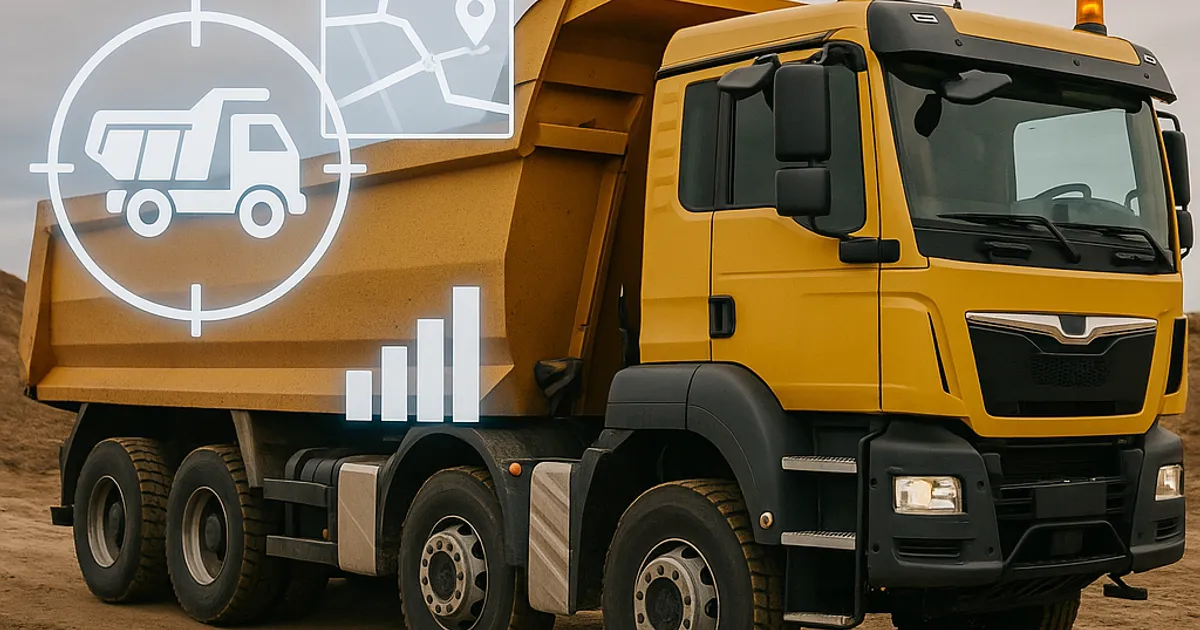
The earthmoving industry has never been more competitive. Fuel prices remain volatile, labor costs continue to climb, and project margins are razor-thin. For dump truck operators and earthwork contractors, the difference between a profitable haul cycle and a money-losing one often comes down to a few minutes of idle time, a suboptimal route, or a maintenance failure that could have been predicted weeks in advance.
That's exactly why telematics and fleet tracking have moved from a nice-to-have technology to an operational necessity. According to industry research, fleets that implement comprehensive telematics systems report fuel savings of 10–15%, maintenance cost reductions of up to 25%, and productivity gains of 20% or more on active haul routes. For a fleet of ten dump trucks running 200 days a year, those numbers translate to tens of thousands of dollars in recovered margin every single season.
This guide covers everything earthwork contractors need to know about telematics, GPS tracking, fuel monitoring, and haul route optimization for dump truck fleets in 2026 — including what systems are worth the investment, how to interpret the data, and how smarter material logistics can compound the gains even further.
What Is Telematics and Why Does It Matter for Dump Trucks?
Telematics is the integrated use of telecommunications and informatics to monitor, manage, and optimize vehicles and assets in real time. In practical terms, a telematics system combines a hardware device installed in your truck — typically hardwired into the OBD-II port or the vehicle's CAN bus — with cloud-based software that aggregates and analyzes data from that device.
For dump trucks specifically, telematics captures a rich stream of operational data including:
- GPS location updated every few seconds
- Engine diagnostics including fault codes, RPM, coolant temperature, and oil pressure
- Fuel consumption measured in real time against load and terrain
- Idle time broken out by driver, location, and time of day
- Payload data from integrated load sensors or body-up indicators
- Brake and throttle behavior for driver safety scoring
- Hours of service (HOS) for compliance with federal regulations
- Geofencing events triggered when trucks enter or leave defined zones
Modern telematics platforms synthesize all of this data into dashboards and alerts that fleet managers can access from any device. The shift from reactive fleet management — fixing problems after they happen — to proactive, data-driven operations is what makes telematics transformative for dump truck fleets.
Beyond the operational benefits, telematics directly addresses regulatory compliance requirements. The FMCSA's Electronic Logging Device (ELD) mandate requires most commercial motor vehicle operators to use certified ELD devices to automatically record hours of service data. Many modern telematics platforms include FMCSA-certified ELD functionality as a core module, eliminating the need for a separate compliance system.
GPS Tracking: The Foundation of Dump Truck Fleet Management
GPS tracking is the backbone of any telematics deployment. At its most basic level, GPS shows you where your trucks are right now. But for dump truck operations, real-time location data unlocks a cascading set of operational advantages that go far beyond simple asset visibility.
Real-Time Dispatch and Load Confirmation
Knowing where every truck is at every moment allows dispatchers to dynamically reassign loads when conditions change. If a truck breaks down mid-haul or a receiving site hits capacity, GPS visibility allows you to redirect other trucks in seconds rather than burning cell phone minutes trying to track down drivers. On large civil projects with 20 or more trucks cycling between a cut site and a fill site, this kind of real-time coordination can eliminate 30–45 minutes of productive time lost to miscommunication every single day.
Geofencing for Automated Tracking
Geofences are virtual perimeters drawn around job sites, material sources, disposal facilities, or maintenance yards. When a GPS-tracked truck crosses a geofence boundary, the telematics system automatically timestamps the event. This creates an automated, verifiable record of every load pickup and delivery — far more accurate and tamper-resistant than paper tickets.
For contractors billing by the load, geofence-based load tracking eliminates disputes with clients about how many loads were actually delivered. For project owners monitoring earthwork progress, it provides real-time visibility into cut and fill volumes without requiring a site inspector at every location.
Asset Security and Theft Prevention
Dump trucks are high-value assets. A standard tandem-axle dump truck costs $120,000–$180,000 new in 2026, and triaxle configurations can approach $220,000. GPS tracking with after-hours movement alerts is one of the most cost-effective theft prevention tools available. If a truck moves outside of geofenced operating hours, the system immediately alerts the fleet manager, and law enforcement can be provided with real-time location data.
Historical Route Playback
Most GPS tracking platforms retain historical location data for 90 days to two years. This playback capability is invaluable for investigating incidents, resolving billing disputes, and analyzing haul cycle efficiency over time.
Fuel Monitoring: Where the Big Dollars Are Hidden
Fuel is typically the second-largest operating cost for a dump truck fleet after labor, and it's the cost center where telematics delivers the fastest return on investment. A Class 8 dump truck averages 4–6 miles per gallon under load. At current diesel prices hovering around $3.80–$4.20 per gallon nationally, a single truck consuming 80 gallons per day generates $300+ in daily fuel expense. Across a 10-truck fleet running 200 days per year, that's $600,000 annually just in fuel.
Idle Time Reduction: The Lowest-Hanging Fruit
Industry data consistently shows that commercial trucks idle an average of 30–40% of engine-on time when telematics is not actively managing idle behavior. For a dump truck engine, every hour of unnecessary idle burns approximately 0.8–1.2 gallons of diesel and adds wear equivalent to 25–35 miles of driving.
Telematics systems that push idle time reports to drivers and managers — and that trigger in-cab alerts after defined idle thresholds — typically reduce idle time by 20–35% within the first 90 days of deployment. On a 10-truck fleet, that improvement alone can save $40,000–$70,000 per year in fuel costs.
Fuel Card Integration and Theft Prevention
Many telematics platforms integrate directly with fleet fuel card programs (WEX, Comdata, Fleetcor, and others). This integration matches fuel purchase records against GPS location data and engine-on/engine-off timestamps. If a fuel card transaction shows 100 gallons purchased at a location 50 miles from where the truck's GPS shows it was, the system flags the discrepancy immediately.
Fuel theft — including unauthorized fill-ups and fuel siphoning — costs the trucking industry an estimated $133 million annually. Telematics-linked fuel card integration is the most effective deterrent available.
Load-Based Fuel Efficiency Analysis
Advanced telematics systems that integrate with payload sensors can calculate fuel efficiency per ton-mile — the most accurate measure of haul cycle productivity. This data allows fleet managers to identify which trucks, routes, and drivers are producing the best fuel economy per unit of work delivered, enabling targeted coaching and route optimization decisions.
Haul Route Optimization: Turning Data Into Profit
Haul route optimization is where telematics transitions from a cost-control tool into a genuine profit driver. In earthwork operations, the haul cycle — the time from when a truck loads at the cut to when it returns empty and ready to load again — determines the total productivity of the operation. Shaving even five minutes off a haul cycle on a 10-truck fleet over a 10-hour shift adds 100 additional truck-cycles per day of potential capacity.
Cycle Time Analysis
Telematics platforms that log geofence entry/exit events at load and dump sites automatically calculate haul cycle times for every load. Over time, this data reveals:
- Average cycle time by route segment
- Queue time at loading and receiving sites
- Travel time variance by time of day
- Driver-to-driver cycle time differences
Fleet managers who actively monitor cycle time data and adjust dispatching accordingly consistently outperform those relying on estimates and gut feel.
Dynamic Route Adjustment
Integration between telematics platforms and traffic/routing data (via APIs from providers like HERE Technologies or Google Maps Platform) allows for dynamic route suggestions that avoid congestion, road closures, weight-restricted roads, and low-clearance structures. For dump trucks operating in dense urban environments — think infrastructure projects in cities like dirt exchange in Los Angeles or dirt exchange in Boston — routing around permit-restricted corridors and avoiding peak traffic windows can add 15–25% to daily haul productivity.
Weight and Load Optimization
Federal bridge weight laws limit axle loadings, and state-by-state oversize/overweight permit requirements add significant complexity to haul planning. Telematics systems integrated with on-board scales allow dispatchers to see real-time payload weights for every truck. This prevents both underloading (wasted capacity) and overloading (fines and liability), maximizing the payload value of every haul cycle.
Comparison: Telematics-Optimized vs. Unmanaged Dump Truck Operations
| Metric | Unmanaged Fleet | Telematics-Optimized Fleet |
|---|---|---|
| Average idle time per shift | 2.5–3.5 hours | 0.8–1.5 hours |
| Fuel cost per ton-mile | $0.28–$0.35 | $0.20–$0.26 |
| Cycle time (10-mile round trip) | 45–60 minutes | 35–48 minutes |
| Maintenance cost per truck/year | $18,000–$24,000 | $13,000–$17,000 |
| Unplanned downtime incidents/year | 6–10 per truck | 2–4 per truck |
| Annual fuel spend (10-truck fleet) | $600,000+ | $480,000–$525,000 |
Predictive Maintenance: Stopping Failures Before They Happen
Unplanned downtime is one of the most expensive events in dump truck operations. When a truck goes down mid-project, the cost isn't just the repair bill — it's the lost productivity, the idle labor waiting for material, the potential project delay penalties, and the expedited parts and service costs that come with emergency repairs.
Engine Diagnostic Integration
Modern telematics systems read live engine data directly from the truck's CAN bus, including:
- Diagnostic Trouble Codes (DTCs) — both active and pending
- Coolant temperature and oil pressure trending
- DEF (Diesel Exhaust Fluid) levels for emissions compliance
- Transmission fluid temperature
- Battery voltage and charging system performance
When the telematics system detects a pending fault code or a parameter trending outside normal range, it generates an alert that reaches the fleet manager before the driver even notices a symptom. This transforms maintenance from a reactive cost into a planned, schedulable event.
Oil Analysis Integration
Leading-edge fleets are now integrating telematics data with oil analysis programs. By correlating engine hours, load cycles, and operating temperatures with lab results from oil samples, predictive maintenance algorithms can recommend oil change intervals based on actual oil condition rather than arbitrary hour-based schedules — potentially extending drain intervals by 20–40% without increasing engine wear.
Tire Pressure Monitoring
For dump trucks operating over rough haul roads — a near-universal condition on active earthwork sites — tire wear and pressure management is critical. Telematics-integrated tire pressure monitoring systems (TPMS) provide real-time alerts when pressure drops below safe thresholds, preventing blowouts that can damage equipment, create safety hazards, and cost $1,500–$3,000 per incident in tire replacement and downtime.
Driver Behavior Monitoring and Safety Scoring
Telematics systems don't just track vehicles — they track driving behavior. This capability is one of the most powerful — and occasionally most controversial — aspects of fleet management technology.
Key Behavior Metrics
Modern telematics platforms score drivers on:
- Hard braking events (deceleration exceeding defined g-force thresholds)
- Rapid acceleration (throttle application patterns)
- Speeding (both over posted limits and over geofenced site speed limits)
- Harsh cornering
- Seatbelt compliance
- Cell phone use (via Bluetooth or camera-based detection)
Safety Outcomes
Fleets that actively use driver behavior data for coaching consistently demonstrate measurable safety improvements. The correlation between telematics-driven safety programs and reduced accident rates is well-documented — fleets implementing behavior-based coaching programs typically see 20–30% reductions in accident frequency within the first year.
For dump trucks specifically, safety monitoring is critically important. A loaded tandem-axle dump truck can weigh up to 80,000 lbs — the federal gross vehicle weight limit under bridge formula calculations per FMCSA regulations — making braking distances, turning radius limitations, and speed management life-or-death considerations.
Incentive Programs
Savvy fleet managers are using safety scores not just punitively but as the basis for driver incentive programs. Drivers who maintain high safety scores receive bonuses, recognition, or preferred route assignments. This approach tends to generate faster behavior change and less driver resistance than purely punitive monitoring.
ELD Compliance and Hours of Service Management
For dump truck fleets that cross state lines or operate under FMCSA jurisdiction, ELD compliance is non-negotiable. The ELD mandate requires that drivers log their hours of service electronically using a device that automatically records driving time based on engine data.
Who Is Subject to ELD Requirements?
Most operators of commercial motor vehicles with a GVWR over 10,001 lbs, or vehicles hauling hazardous materials requiring placarding, must comply with ELD requirements. Short-haul exemptions exist for drivers who operate within a 150 air-mile radius and return to their work reporting location each day — a provision that covers many local dump truck operations. Fleet managers should carefully evaluate their operations against the full exemption criteria published by the FMCSA.
Integrated HOS Management
Telematics platforms with integrated ELD functionality automatically calculate remaining drive time for each driver based on their logged hours, alerting dispatchers when drivers are approaching hours-of-service limits. This prevents both inadvertent violations and the operational disruption of a driver going out of hours mid-haul.
Documentation and Audit Defense
Digital HOS records stored in a telematics platform provide a defensible, tamper-evident record in the event of a DOT roadside inspection or audit. Fleets that transitioned from paper logs to integrated ELD systems report significant reductions in violation citations and improved audit outcomes.
Find or Post Dirt, Rock & Aggregate
Join thousands of contractors using DirtMatch to buy, sell, and exchange earthwork materials.
Try DirtMatch FreeChoosing the Right Telematics System for Your Dump Truck Fleet
The telematics market is crowded, and the range of options — from basic GPS trackers at $25/month per vehicle to fully integrated fleet intelligence platforms at $150+/month per vehicle — can make selection daunting. Here's a structured framework for evaluating options.
Tier 1: Entry-Level GPS Tracking ($20–$50/month per vehicle)
Best for: Small fleets (1–5 trucks), owner-operators, basic asset visibility needs
Features typically included:
- Real-time GPS location
- Basic geofencing
- Historical route playback
- Simple idle time reporting
Limitations: No engine diagnostics, no ELD integration, limited analytics
Tier 2: Mid-Market Fleet Management ($50–$100/month per vehicle)
Best for: Mid-size fleets (5–25 trucks), contractors needing compliance tools
Features typically included:
- Everything in Tier 1
- Engine diagnostic reading (DTCs, fault codes)
- Driver behavior scoring
- FMCSA-compliant ELD module
- Fuel card integration
- Basic maintenance scheduling
- API integrations with construction management software
Tier 3: Enterprise Fleet Intelligence ($100–$200+/month per vehicle)
Best for: Large fleets (25+ trucks), high-volume earthwork contractors, civil construction firms
Features typically included:
- Everything in Tier 2
- AI-powered predictive maintenance
- Payload/on-board scale integration
- Advanced haul route optimization with traffic integration
- Video telematics (dash cams with AI event detection)
- Custom reporting and business intelligence dashboards
- Integration with project management, ERP, and payroll systems
Key Questions to Ask Any Vendor
- Is your ELD FMCSA-certified? What is the certification number?
- Does your hardware work with my specific truck makes and model years?
- What is the contract length, and is hardware owned or leased?
- How does data transfer work in areas with poor cellular coverage?
- What integrations do you offer with construction software platforms?
- What is your customer support SLA for hardware failures?
Integrating Telematics with Material Logistics and Project Planning
The full value of telematics is realized when fleet data is integrated with broader project and material logistics systems. A dump truck that runs optimally but hauls to or from a suboptimal material source still represents a significant efficiency gap.
For earthwork contractors, one of the most impactful logistics decisions is where material originates and where excess material goes. Long hauls from distant sources or costly disposal sites can negate every efficiency gain from telematics. This is where platforms like DirtMatch add a powerful complementary layer — connecting contractors with nearby sources of fill dirt, clean rock, and aggregate materials, or helping them find receivers for excess spoil within their existing haul radius.
Consider a scenario where a contractor's telematics data reveals that 40% of haul cycle time is consumed in travel to a material source 22 miles away. By identifying a qualifying fill source or rock supplier 6 miles away through DirtMatch, the contractor can cut cycle times nearly in half — multiplying the productivity gains from GPS tracking and route optimization.
For contractors operating in growing markets like dirt exchange in Denver or dirt exchange in Seattle — where urban infill projects generate massive volumes of excess dirt while nearby development sites desperately need fill — the ability to match supply and demand locally is a force multiplier for any telematics investment.
The ROI Calculation: Making the Business Case for Telematics
For fleet owners still on the fence about telematics investment, a concrete ROI calculation can clarify the decision. Here's a representative example for a 10-truck dump truck fleet:
Assumptions
- 10 tandem-axle dump trucks
- 200 operating days per year
- Average fuel consumption: 75 gallons per truck per day
- Diesel price: $4.00/gallon
- Telematics system: Tier 2 platform at $75/truck/month
Annual Investment
- Software: $75 × 10 trucks × 12 months = $9,000
- Hardware (amortized over 3 years): ~$3,000/year
- Implementation and training: ~$2,000 (year 1 only)
- Total Year 1 Cost: ~$14,000
Projected Annual Savings
- Fuel savings (15% reduction): 75 gal × $4.00 × 200 days × 10 trucks × 15% = $90,000
- Maintenance savings (20% reduction from $20,000/truck baseline): $40,000
- Productivity gains from haul optimization (10% cycle time reduction): estimated $50,000–$80,000 in additional haul capacity value
- Idle time reduction savings: $20,000–$40,000
- Total Estimated Annual Savings: $200,000–$250,000
ROI Result
First-year net benefit after investment: $186,000–$236,000 Payback period: Less than 30 days
Even under conservative assumptions, the ROI case for telematics on a dump truck fleet is overwhelming. The question isn't whether to implement telematics — it's which platform to choose and how quickly to deploy.
Data Privacy, Driver Relations, and Adoption Challenges
No discussion of telematics is complete without addressing the human dimension. Driver monitoring technology can generate resistance, distrust, and even turnover if implemented without care.
Communicating the Why
The most successful telematics rollouts share one common element: transparent, early communication with drivers about what data is being collected, how it will be used, and what it will not be used for. Framing telematics as a tool that protects drivers (accurate HOS logs, exonerating data in accident investigations) rather than just a surveillance system significantly improves adoption.
Training and Onboarding
Drivers who understand how to read their own safety scores and fuel efficiency metrics — and who have clear targets to work toward — engage with telematics programs far more effectively than those who simply see a device installed in their truck. Investing in driver-facing training and making individual performance data accessible to drivers (not just managers) is a best practice that pays dividends in behavior change.
Union Considerations
For fleets operating under collective bargaining agreements, telematics implementation may require consultation with union representatives and may need to be addressed in contract negotiations. Fleet managers in unionized environments should engage labor counsel before deployment and establish written policies governing how monitoring data can and cannot be used in disciplinary proceedings.
Future Trends: Where Dump Truck Telematics Is Heading
The telematics space is evolving rapidly, and several emerging technologies will reshape how dump truck fleets are managed over the next three to five years.
AI-Powered Predictive Analytics
Machine learning models trained on millions of fleet data points are beginning to predict mechanical failures with accuracy that human mechanics cannot match. These systems correlate subtle patterns in engine data — micro-variations in oil temperature, injector timing, and coolant pressure — with failure events, generating alerts 2–4 weeks before a failure would occur.
Autonomous and Semi-Autonomous Operations
In controlled environments like quarries and large mining operations, fully autonomous dump trucks are already operating commercially. Semi-autonomous features — lane keeping, automatic emergency braking, and platooning — are beginning to appear in highway-capable configurations. While fully autonomous on-road dump trucks remain years away from widespread deployment, the sensor and data infrastructure being built by telematics systems today is the foundation on which autonomy will be built.
Integration with Machine Control
GPS machine control systems from providers like Trimble Construction are increasingly sharing data with fleet telematics platforms. This creates a unified operational picture where the excavator's dig data, the truck's load sensor data, and the project's design model are all integrated — enabling automated quantity tracking and real-time progress reporting without manual surveying.
Carbon Tracking and ESG Reporting
As ESG (Environmental, Social, and Governance) reporting requirements expand — particularly for contractors working on public infrastructure projects — telematics-derived fuel consumption data is becoming the primary input for carbon footprint calculation and reporting. Fleets that have telematics infrastructure in place will be significantly better positioned to meet emerging sustainability reporting requirements than those that do not.
Getting Started: A Practical Implementation Roadmap
For contractors ready to move forward with telematics, here is a practical implementation sequence:
Step 1: Audit Your Current Fleet (Week 1–2) Document every truck: year, make, model, GVWR, current maintenance status, and any existing tracking devices. Identify which trucks fall under ELD requirements.
Step 2: Define Your Priority Use Cases (Week 2–3) Rank your goals: Is fuel savings the top priority? Compliance? Maintenance? Route optimization? Your priority use cases should drive platform selection.
Step 3: Issue an RFP to 3–5 Vendors (Week 3–6) Request demonstrations, references from comparable fleets, and written specifications on ELD certification, hardware compatibility, and integration capabilities.
Step 4: Pilot on 2–3 Trucks (Week 6–10) Before committing the full fleet, run a 30–60 day pilot on a subset of trucks. Establish baseline metrics before installation so you can measure improvement accurately.
Step 5: Train Drivers and Managers (Week 8–10) Conduct training sessions with both drivers and fleet managers. Establish written policies on monitoring, data use, and performance expectations.
Step 6: Full Fleet Rollout (Week 10–14) Install hardware across the full fleet and activate all software modules. Begin generating baseline reports.
Step 7: Review and Optimize (Monthly) Schedule monthly performance reviews comparing KPIs against baseline. Adjust routes, coaching focus, and maintenance schedules based on data.
For contractors also managing material sourcing alongside fleet operations, it's worth exploring how DirtMatch Pro integrates with your logistics workflow — connecting you with verified material sources and receivers that can reduce haul distances and complement the efficiency gains from your telematics investment.
Conclusion: Telematics Is the Competitive Moat of 2026
In an earthwork market where project margins are under constant pressure and clients increasingly demand transparency and accountability, telematics and fleet tracking are no longer optional infrastructure — they are the foundation of competitive operations.
GPS tracking eliminates guesswork from dispatch. Fuel monitoring recovers tens of thousands of dollars in hidden waste. Haul route optimization multiplies the productivity of every truck in your fleet. Predictive maintenance prevents the unplanned downtime events that blow project schedules and budgets. And integrated driver behavior monitoring builds safer, more accountable teams.
The contractors who will dominate earthwork markets in the next decade are the ones building data-driven operations today. Telematics is the engine of that transformation.
And when your optimized trucks arrive at the job site, make sure the material is there waiting for them. Platforms like DirtMatch help earthwork contractors close the loop between fleet efficiency and material logistics — so every haul is the right load, from the right source, over the right route.
The data is in. The ROI is clear. The only question is how fast you get started.