
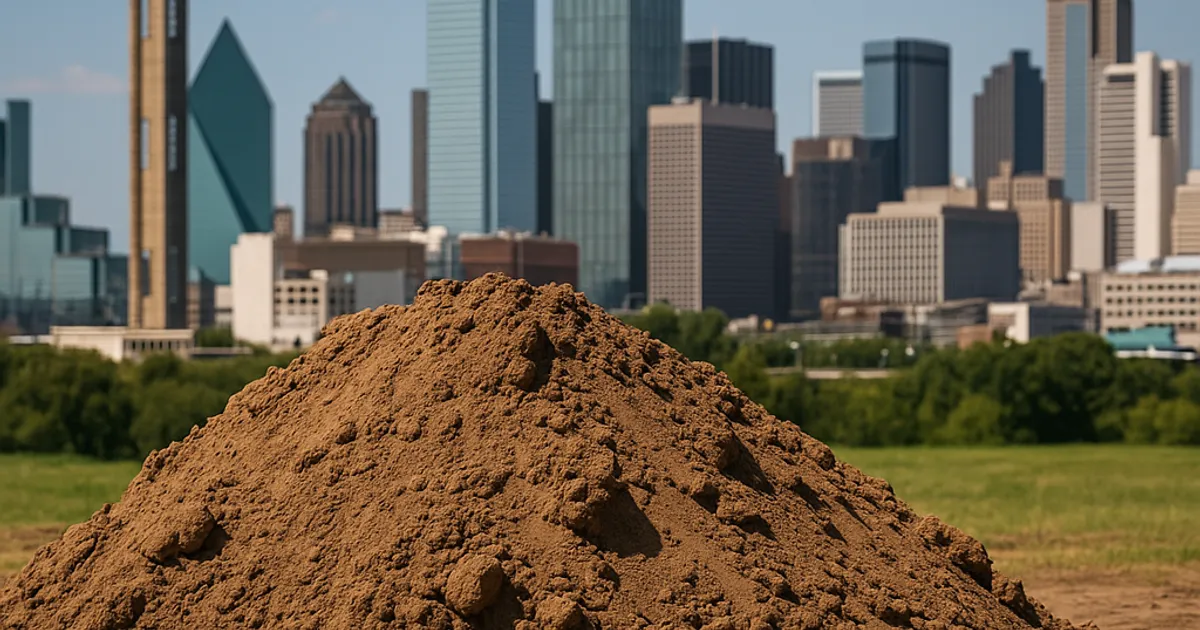
Dallas is booming. From luxury townhome developments in Uptown to massive infrastructure expansions along the DART corridors and new industrial parks in South Dallas, the DFW Metroplex is one of the most actively excavated regions in the entire United States. All that digging produces an enormous volume of surplus soil — and if you're a contractor, excavator, homeowner, or developer sitting on a pile of displaced dirt, you need to know exactly where it can go, how much it will cost, and how to stay on the right side of the law.
This guide is designed specifically for the Dallas, Texas market in 2026. We'll walk you through every legitimate option for dirt disposal — from licensed C&D landfills and municipal drop-off sites to free fill dirt exchanges and matchmaking platforms — while covering the local regulations, soil quality considerations, hauling costs, and practical logistics that every project manager needs to understand before the first dump truck rolls out.
Understanding What Kind of Dirt You Have (and Why It Matters)
Before you can decide where to take your excavated soil, you need to understand what you're actually dealing with. Not all dirt is created equal, and the type and condition of your soil will determine your disposal options, potential costs, and legal obligations.
Clean Fill Dirt vs. Contaminated Soil
Clean fill dirt is uncontaminated soil — typically subsoil (below the topsoil layer) that is free of organic material, construction debris, chemicals, and hazardous substances. In Dallas and throughout Texas, clean fill is broadly defined as soil that has not been exposed to petroleum products, industrial chemicals, heavy metals, or other regulated contaminants. Clean fill is the most versatile material: it can be legally deposited at fill sites, accepted at most landfills, shared with neighboring projects, or used in land-grading applications.
Topsoil — the dark, organic-rich upper layer — is different. While not hazardous, it's often rich enough to be repurposed for landscaping rather than wasted in a landfill. Many Dallas-area landscapers, nurseries, and homeowners actively seek quality topsoil.
Contaminated or suspect soil is an entirely different category. If your site has a history as a gas station, dry cleaner, auto repair shop, industrial facility, or former agricultural land where pesticides were used, you may be dealing with regulated material. The Texas Commission on Environmental Quality (TCEQ) governs the management of petroleum-contaminated soils under its Petroleum Storage Tank (PST) program. Dumping contaminated soil without proper testing and disposal protocols can expose you to serious civil and criminal liability under both state and federal law.
Soil Classification for Structural Use
If your dirt is going to a site where it will be used as structural fill — beneath a foundation, in an embankment, or as road base — the receiving contractor will likely require soil testing to verify it meets specifications. The ASTM International standard D2487 (Unified Soil Classification System) is the most commonly referenced framework for classifying soils by particle size and plasticity. Compaction testing under ASTM D698 (Standard Proctor) or D1557 (Modified Proctor) is typically required for engineered fills.
In practical Dallas terms: the Blackland Prairie clay that dominates much of the city's underlying geology is notoriously expansive. Heavy clay soils from Dallas excavations are often less desirable as structural fill because of their shrink-swell behavior, though they can be used appropriately in certain grading applications. Sandy loam from the eastern portions of the county moves more freely.
Quick Soil Assessment Checklist
- Is the soil free of debris, concrete chunks, wood, or trash?
- Does it have any unusual odor (petroleum, chemical smell)?
- What is the site's historical use?
- Is there visible staining or discoloration?
- Has any Phase I or Phase II Environmental Site Assessment been completed?
If you answered "no" to the first two positively and "yes" to any of the last three, you may need professional environmental testing before disposal.
Local Regulations Governing Dirt Disposal in Dallas
Texas takes a relatively contractor-friendly approach to clean fill disposal compared to many coastal states, but that doesn't mean there are no rules. Understanding the regulatory landscape in Dallas will protect you from fines, project delays, and environmental liability.
City of Dallas Regulations
The City of Dallas regulates construction and demolition (C&D) waste through its Development Services Department and Sanitation Services division. Clean earthen fill — soil, rock, and uncontaminated aggregate — is generally not classified as solid waste under Texas law as long as it is being beneficially reused (e.g., placed at a fill site, used for grading or land leveling). However, stockpiling large quantities of soil on a site without a grading permit or erosion control plan can trigger enforcement action.
Any earthwork disturbance of one acre or more in Dallas requires a Stormwater Pollution Prevention Plan (SWPPP) and a Construction General Permit (CGP) from TCEQ, which aligns with EPA's NPDES stormwater permitting requirements. Erosion controls including silt fencing, inlet protection, and stabilized construction entrances are mandatory on permitted sites.
TCEQ and Texas Solid Waste Rules
Under Texas Health and Safety Code Chapter 361 and 30 TAC Chapter 330, materials classified as municipal solid waste or industrial solid waste cannot be indiscriminately dumped. Clean fill dirt, however, is generally exempt from solid waste regulation when it is being used for legitimate fill purposes — not simply discarded. If you are running an unauthorized fill site (accepting dirt for a fee without proper registration), you could be in violation of TCEQ rules.
Registered fill sites that accept more than 1,440 cubic yards per year must obtain a Type IV Landfill permit or applicable authorization from TCEQ. This is why it's important to verify that any third-party fill site you use is properly authorized.
Dallas County Floodplain Regulations
Dallas County and the City of Dallas take floodplain management seriously. Depositing fill material within a FEMA-mapped Special Flood Hazard Area (SFHA) without a Floodplain Development Permit is illegal and can result in the property losing NFIP flood insurance eligibility. The Trinity River corridor and its many tributaries create extensive floodplain areas throughout the city. Always verify fill locations against FEMA Flood Insurance Rate Maps (FIRMs) before arranging delivery.
Where to Dump Dirt in Dallas: Your 8 Best Options
With the regulatory foundation in place, here are the most practical and legitimate options for disposing of excess dirt in the Dallas metropolitan area in 2026.
1. Licensed Construction & Demolition Landfills
The most straightforward option for contractors with significant volumes of spoil is a licensed C&D landfill. These facilities are permitted by TCEQ to accept clean fill, concrete, rock, brick, and other inert construction materials. Dallas has several operating C&D and Type IV facilities within reasonable hauling distance.
Key facilities serving the Dallas market include:
- Republic Services — Dallas/Fort Worth area facilities: Republic operates multiple C&D and MSW facilities in North Texas. Their Subtitle D facilities may accept inert fill for daily cover or fill operations at reduced or no cost depending on their operational needs.
- Waste Connections — Denton County Landfill (Denton, TX): Approximately 35 miles north of Dallas, this facility accepts clean C&D materials.
- Texas Lehigh Cement Company fill areas: Industrial operations in the Buda/Austin area, but some North Texas quarry sites affiliated with aggregates companies accept clean fill.
- Local quarry reclamation fill: Aggregate quarries throughout the DFW area (particularly limestone quarries in Tarrant County and rock quarries along the Balcones Escarpment) frequently need fill material for reclamation purposes and may accept clean dirt at low or no cost.
Typical tipping fees at Dallas-area C&D landfills range from $8 to $22 per ton for clean fill/inert material as of 2026, depending on the facility and material classification. Contaminated soils requiring special handling can run $45 to $120+ per ton.
Pro Tip: Always call ahead to confirm current tipping fees, accepted materials, hours of operation, and any minimum or maximum load requirements. Facilities change their acceptance criteria based on operational needs.
2. City of Dallas Brush and Bulky Item Drop-Off Centers
For very small quantities of clean soil (think homeowner-scale projects — a few cubic yards from a garden bed removal or small drainage project), the City of Dallas operates several convenience drop-off centers. However, these facilities are primarily designed for household waste, brush, and bulky items — not large quantities of construction soil. They are not appropriate for commercial contractor loads.
The McCommas Bluff Landfill at 5100 Youngblood Road is the city's primary solid waste facility. Small quantities of clean dirt may be accepted, but contractors should verify before hauling.
3. Private Fill Sites and Reclamation Projects
Across Dallas, Collin, Denton, Rockwall, and Kaufman counties, private landowners and developers frequently need large volumes of clean fill to raise grades, fill ponds, or prepare sites for development. These private fill arrangements — sometimes called "dirt handshakes" in the industry — can be genuinely free for the hauler: the landowner needs dirt, you need to get rid of it, and the material transfers at no cost other than hauling.
Finding these sites has traditionally required word-of-mouth or cold-calling, but technology has changed the game significantly. DirtMatch is a dedicated platform that connects contractors and excavators who have surplus soil with projects and landowners who need fill, making it easy to find these free or low-cost arrangements without spending hours on the phone.
In the Dallas fill dirt marketplace right now, the numbers tell the story: there are active listings showing demand for fill dirt all across the metro area, including a recent posting for 200 yards of clean fill dirt needed in Dallas, TX (75236) and another for 100 yards needed in Flower Mound, TX. Across the entire fill dirt market in Texas, DirtMatch currently shows 721,272 yards of material available and 1,570,872 yards needed — with 778 matches made in the last 30 days alone. The demand for clean fill is very real and very active.
4. Construction Sites Needing Fill Dirt
Active construction sites throughout Dallas frequently need clean fill to bring grades up before foundation work, utility trenching, or paving. General contractors on large residential subdivisions, commercial developments, and infrastructure projects are often in the market for delivered fill.
The challenge is timing and logistics: the receiving site needs the material when they need it, not when it's convenient for you. This is where a platform that matches supply and demand in real time — like DirtMatch — becomes genuinely valuable. Rather than calling every GC in your contact list, you can post your available material and let interested parties find you.
5. Landscaping Companies and Nurseries
If your excavated material includes quality topsoil, Dallas-area landscaping companies and plant nurseries may be interested. Topsoil is a commodity in this region — healthy, organic-rich topsoil from a residential site can be worth $15 to $35 per yard when purchased retail. If you're willing to let a landscaper haul it themselves, free topsoil listings on Craigslist, Facebook Marketplace, and Nextdoor routinely attract takers within hours in the Dallas market.
Note: Subsoil (the dense clay-heavy material below the topsoil layer) is less appealing to landscapers. Separate your materials if possible.
6. Gravel Pits and Aggregate Operations
Several aggregate producers and gravel pit operations in the greater DFW area operate mined areas that eventually need filling and reclamation. These sites can be excellent destinations for large volumes of clean fill — sometimes thousands of yards at a time. Operators in Denton, Parker, and Hood counties have historically been receptive to clean fill arrangements.
Always get a written agreement specifying that the material must be clean fill, the deposit location, access arrangements, and any liability terms before sending trucks.
7. Land Leveling and Agricultural Applications
North Texas has extensive agricultural land — particularly in Collin, Kaufman, and Ellis counties surrounding Dallas. Farmers and ranchers frequently need fill to level fields, fill stock ponds, and raise homesite pads. These rural landowners can absorb extraordinary volumes of clean fill, often for free, especially if you can arrange your own hauling. Ellis County alone has multiple ongoing agricultural fill needs at any given time.
8. Transfer Through Fill Dirt Brokers and Haulers
Full-service dirt hauling companies in Dallas will handle the entire logistics chain: they'll assess your material, arrange transportation, and deliver to an appropriate destination. Companies like Republic Hauling, Texas Dirt Works, and various local owner-operators provide this service. Expect to pay $45 to $95 per load (or more) for complete hauling and disposal services, depending on haul distance and material volume.
Dallas-Area Dump Site Comparison Table
| Option | Best For | Typical Cost | Accepts | Notes |
|---|---|---|---|---|
| Licensed C&D Landfill | Large commercial volumes | $8–$22/ton | Clean fill, inert C&D | TCEQ-permitted required |
| City Drop-Off Centers | Homeowner small loads | Free–low fee | Very small quantities only | Not for contractor loads |
| Private Fill Sites | Mid-to-large volumes | Free (haul only) | Clean fill only | Requires verification |
| Active Construction Sites | Clean fill any volume | Free or paid | Clean structural fill | Timing-dependent |
| Landscapers/Nurseries | Topsoil specifically | Free–$10/yd | Organic topsoil preferred | Subsoil less desirable |
| Aggregate/Quarry Ops | Very large volumes | Free–nominal | Clean inert fill | Written agreement advised |
| Agricultural Land | Rural/large volumes | Free (haul only) | Clean fill, rock | Best in surrounding counties |
| Full-Service Hauler | Any — turnkey solution | $45–$95+/load | Most materials | Costliest but easiest |
Hauling Costs for Dirt Removal in Dallas (2026 Pricing)
Understanding current hauling costs is essential for budgeting any Dallas excavation project. Dallas sits at the intersection of I-20, I-30, I-35, and I-45, making it a major logistics hub — but heavy traffic, rising diesel costs, and driver shortages continue to affect pricing.
Current Rate Benchmarks
Tandem axle dump trucks (12–14 cubic yard capacity) are the most common dirt hauling unit in Dallas. Day rates in 2026 range from $750 to $1,100 per truck per day depending on availability and operator. Per-load rates typically run $65 to $95 per load within a 20-mile radius.
Semi-end dump trailers (20–24 cubic yards) offer better cost-per-yard economics for longer hauls. Expect $85 to $140 per load within 30 miles.
Transfer trucks with 22-yard capacity are common for high-volume operations, typically priced at $110 to $160 per load.
Cost Factors to Consider
- Haul distance: Most cost estimates assume a 15–25 mile haul. Each additional 10 miles can add $15–$30 per load.
- Wait time: If trucks are waiting at the dig site more than 20–30 minutes per load, expect extra charges.
- Material type: Rock and heavy clay add weight, sometimes requiring weight-restricted routing.
- Fuel surcharges: As of early 2026, diesel prices in Texas average around $3.20–$3.60/gallon, factored into most hauler rates.
- Tipping fees: Separate from hauling — the cost to dump the material at a licensed facility.
How to Reduce Dirt Hauling Costs
The single most effective way to reduce hauling costs is to reduce haul distance. If your excavated soil can be matched with a receiving site nearby, you might eliminate tipping fees entirely and minimize fuel costs. This is the core value proposition of a fill dirt exchange: platforms like DirtMatch connect contractors with nearby fill dirt sources, reducing hauling costs by matching supply and demand within the same geographic market rather than sending material across the county or to a landfill.
Environmental Compliance: What Dallas Contractors Must Know
Environmental compliance isn't optional, and getting it wrong on a Dallas construction site can be expensive and time-consuming to remediate. Here's what every project manager should have on their checklist.
TCEQ Construction General Permit (CGP)
Any site disturbing one acre or more of land in Texas must obtain coverage under TCEQ's Construction General Permit (TXR150000). This permit requires development and implementation of a Stormwater Pollution Prevention Plan (SWPPP) before land disturbance begins. The SWPPP must include:
- Site map showing drainage patterns and discharge points
- Description of best management practices (BMPs)
- Erosion and sediment controls
- Procedures for inspecting and maintaining controls
Failing to have a SWPPP in place can result in TCEQ enforcement actions with penalties up to $25,000 per day per violation for significant dischargers.
Contaminated Soil Protocols
If Phase II Environmental Site Assessment sampling reveals contaminated soil at your Dallas site, you'll be dealing with TCEQ's Voluntary Cleanup Program (VCP) or the Petroleum Storage Tank program, depending on the source. Contaminated soil disposal in Texas must go to facilities specifically authorized to accept regulated waste — not a standard C&D landfill or private fill site.
Moving contaminated soil to an unauthorized location — even if you're a good-faith actor who didn't know — can create secondary cleanup liability at the dump site under CERCLA (Superfund) principles.
Wetland and Waterway Protections
Dallas has an extensive network of creek corridors, ponds, and Trinity River tributaries. Depositing fill material in waters of the U.S. without a Section 404 permit from the U.S. Army Corps of Engineers is a federal violation. The Fort Worth District of USACE has jurisdiction over the Dallas area. Even "dry" creek beds can qualify as jurisdictional waters depending on their hydrological connection to navigable waterways.
Find or Post Dirt, Rock & Aggregate
Join thousands of contractors using DirtMatch to buy, sell, and exchange earthwork materials.
Try DirtMatch FreeFree Dirt Disposal in Dallas: How Fill Dirt Exchange Actually Works
The concept of free dirt disposal is real — but it requires matching the right material with the right project at the right time. This is harder than it sounds, which is why organized platforms for dirt exchange have emerged as the most efficient solution for both sides of the transaction.
The Traditional Approach (and Its Limitations)
For decades, Dallas contractors found fill sites through informal channels: calling other GCs, posting signs at lumberyards, putting up ads in industry newsletters, or just knowing the right people. This approach works — occasionally — but it's inefficient, time-consuming, and unreliable. You might spend two weeks making calls and still end up paying tipping fees at a landfill because you couldn't find a match in time.
The Modern Fill Exchange Model
Dedicated fill dirt exchange platforms have fundamentally changed the economics of dirt disposal for contractors who are willing to use them. Instead of hoping the right person calls back, you post your available material — specifying volume in yards, soil type, location, availability dates, and whether you can deliver or need pickup — and the system surfaces your listing to contractors and landowners in the market who are actively looking for fill.
If you want to see exactly how the matching process works, the DirtMatch how-it-works page walks through the full workflow from listing to match. The platform has been particularly active in North Texas, with the fill dirt in Dallas market showing strong two-sided activity across the metro and surrounding suburbs.
What "Free" Actually Means in a Dirt Exchange
When we talk about free dirt disposal, we mean free of tipping fees — the material is accepted at no charge because the receiving party needs it. The hauling cost remains your responsibility. On a short haul (under 15 miles), even paying for three tandem loads can be cheaper than one day of landfill tipping fees plus longer hauls. For excavators with 500+ yards to move, the math can favor an exchange very quickly.
Not every match will be perfectly timed or exactly co-located. But in a metro area the size of Dallas-Fort Worth — with over 7.5 million people and billions of dollars in active construction at any given time — the probability of finding a nearby fill need is genuinely high.
Working With Dirt Haulers in Dallas: Tips for a Smooth Operation
Even with a great disposal destination lined up, the hauling operation itself requires careful coordination. Dallas's traffic patterns, weight restrictions, and permitting requirements add complexity that out-of-market operators sometimes underestimate.
Finding Reputable Dallas Dirt Haulers
Look for haulers who:
- Carry current TXDOT oversize/overweight permits where applicable
- Are registered with FMCSA and maintain current USDOT numbers
- Carry minimum $1 million commercial auto liability
- Have experience with your specific material type (clay, rock, sandy loam)
- Can provide proof of disposal (receipts from licensed facilities when required)
The Dallas Contractor Network, North Texas AGC chapter, and local subcontractor associations are good starting points for referrals. Verified hauler networks are also increasingly available through marketplace platforms.
Dallas Traffic and Scheduling Considerations
Dallas traffic is brutal. I-35E, I-30, LBJ Freeway (I-635), and Central Expressway (US-75) all experience severe congestion during peak hours. For large-volume hauls, scheduling truck movements during off-peak windows (5:00 AM–7:00 AM and 7:00 PM–10:00 PM) can meaningfully improve cycle times and reduce costs. Many Dallas-area contractors add a 15–20% contingency to haul schedules specifically for traffic delays.
Weight Limits and Road Restrictions
Texas allows standard gross vehicle weights of 80,000 lbs on interstate highways. Many Dallas-area residential streets, older bridges, and neighborhood collector roads have lower posted weight limits. Routing loaded dump trucks through restricted roads can result in municipal citations and damage claims. Always plan approved haul routes before trucks roll.
Load Documentation
For commercial disposal at licensed facilities, get a receipt or ticket for every load — specifying the date, truck ID, estimated yardage or tonnage, and material type. These records protect you if questions arise later about where your material went. For projects involving potential contamination, chain-of-custody documentation is legally required.
Special Considerations for Dallas Soil Types
Dallas sits at the intersection of three major geological formations, and understanding your local soil type affects both the disposal options available and the logistics of moving it.
Blackland Prairie Clay (Central and East Dallas)
The heavy, dark-gray to black clay (specifically the Houston Black and Ferco series soils) that underlies most of central and eastern Dallas is highly expansive — it swells significantly when wet and shrinks when dry, with a plasticity index often exceeding 40. This material is:
- Generally accepted at C&D landfills
- Less desirable for structural fill without amendment
- Useful for pond sealing and impoundment construction due to low permeability
- Heavy — typically 100–115 lbs per cubic foot, adding to hauling costs
The USDA Web Soil Survey is a free, powerful tool for identifying soil types at any location in the Dallas area before you start digging, which can help you predict how your material will be received by potential fill sites.
Sandy Loam and Alluvial Soils (River Bottoms and East County)
Along the Trinity River, Elm Fork, and East Fork corridors, you'll encounter alluvial sandy loam — much more workable than Blackland clay and more broadly desirable as fill. This material is typically:
- Easily compacted and well-graded
- Acceptable for most structural fill applications
- Lighter than clay (90–105 lbs/cf) — better economics per load
- Actively sought by construction projects needing good compactable fill
Rock and Caliche (Northern Dallas County and Collin County)
Moving north into Collin and Denton counties, contractors increasingly encounter caliche (a calcium carbonate-cemented soil layer) and shallow limestone. Broken rock and caliche can actually be valuable as road base material — don't automatically treat it as waste. Local aggregate dealers may purchase or accept quality crushed caliche.
Turning Surplus Dirt into a Business Asset
For busy Dallas earthwork contractors, excess soil can be more than just a disposal problem — it can be a revenue opportunity or at minimum a cost center to be minimized through smart logistics.
The Full Spectrum: From Paying to Dump to Getting Paid
Depending on your material, you might find yourself anywhere on this spectrum:
Paying to dispose → Breaking even on hauls → Getting paid for material delivered
Quality sandy loam and screened topsoil from Dallas-area excavations can command $8 to $18 per yard when delivered to the right buyer. Rock and caliche can fetch value as aggregate. Even clean subsoil can be moved for free rather than at a tipping fee cost. The difference between the worst and best outcomes for 500 yards of spoil can easily be $5,000 to $15,000 depending on material quality and match efficiency.
Building Your Dirt Network
Experienced Dallas earthwork contractors maintain an active network of contacts on both sides of the fill equation. They know which subdivision developers are currently raising grades, which quarries need reclamation fill, and which landscapers are hungry for topsoil. Building this network takes time — but platforms designed for this purpose can accelerate the process significantly. If you're looking to formalize your approach to material exchange, getting started with DirtMatch is one of the fastest ways to plug into an active marketplace of buyers and sellers across the Dallas metro.
Upgrading Your Logistics Operation
Contractors who handle high volumes of dirt exchange can benefit from GPS tracking, load counting technology, and route optimization tools. Modern telematics platforms integrated with job site management software can help you track material movement in real time, verify loads, and document disposal for compliance purposes.
Checklist: Before You Move a Single Yard of Dirt in Dallas
Use this practical checklist to make sure you're covered before the first truck rolls:
Material Assessment
- Identified soil type and estimated volume (cubic yards)
- Confirmed clean fill status (no contamination indicators)
- Separated topsoil from subsoil if applicable
- Completed any required environmental testing
Regulatory Compliance
- SWPPP in place if disturbing 1+ acre
- TCEQ CGP coverage obtained if required
- Verified receiving site is not in a FEMA floodplain (or has permits)
- Confirmed receiving facility is TCEQ-authorized
Logistics
- Haul route planned and weight restrictions verified
- Trucks have current USDOT numbers and appropriate insurance
- Receiving site access confirmed (hours, contacts, gate codes)
- Load tickets and documentation system in place
Cost Optimization
- Checked fill dirt exchange platforms for nearby receiving sites
- Compared tipping fees across multiple licensed facilities
- Considered off-peak hauling windows to reduce cycle time
- Explored whether material has resale value
Final Thoughts: Smarter Dirt Disposal in Dallas Starts with Better Information
Dallas's construction industry generates millions of yards of displaced soil every year, and the traditional approach to dealing with it — drive it to the nearest landfill and pay whatever they charge — is neither the cheapest nor the smartest option available to contractors in 2026.
The combination of an active private fill market, a regulatory environment that permits legitimate fill exchanges, diverse soil types with different use cases, and modern matching technology means that Dallas earthwork contractors have more options than ever before. The key is knowing those options, understanding what you have, and connecting with the right partner at the right time.
Whether you have 50 yards from a residential pool dig or 50,000 yards from a commercial site development, there is almost certainly a better destination for your material than a landfill — if you know where to look. Platforms like DirtMatch make finding that destination faster, cheaper, and more reliable than any other method currently available, matching Dallas contractors with active fill needs across the entire metro area and surrounding counties.
The dirt doesn't have to be a problem. With the right approach, it might just be someone else's solution.