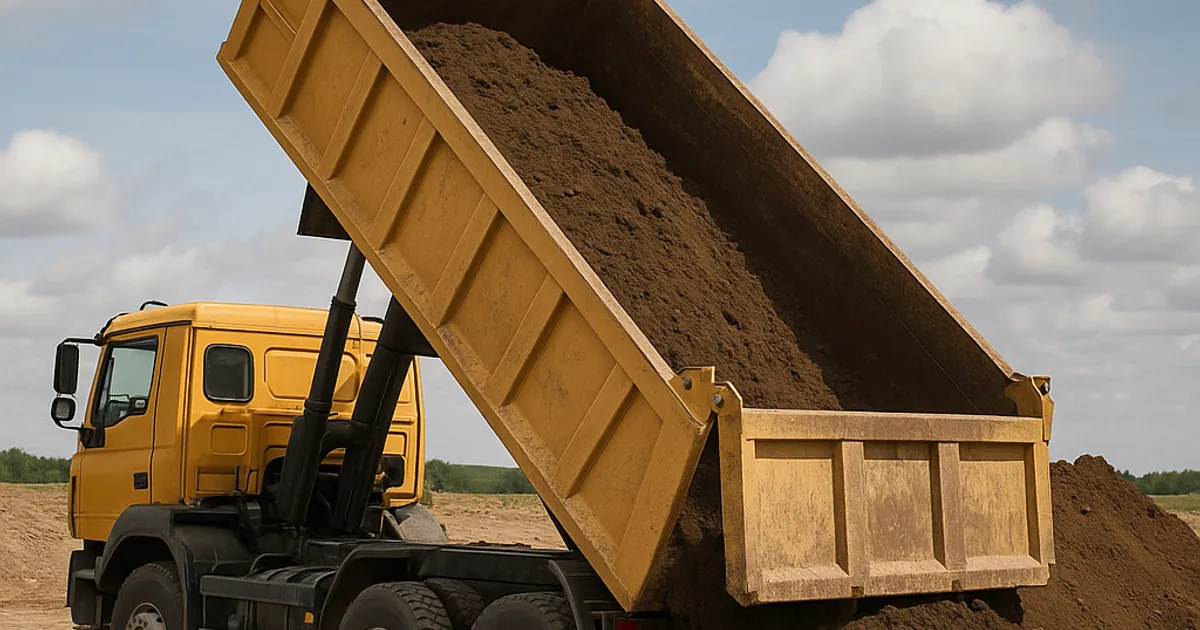
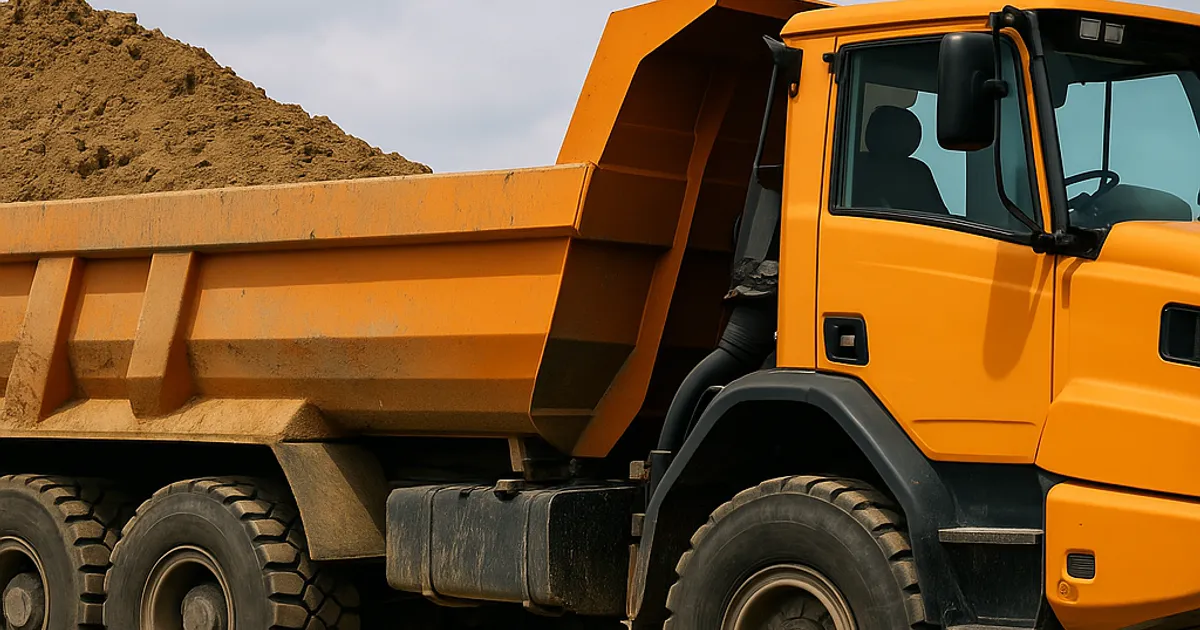
Whether you are bidding a grading contract, planning a residential cut-and-fill project, or trying to balance a large commercial excavation, dirt hauling cost per cubic yard is the number that makes or breaks your budget. Miscalculate it and you are either leaving money on the table or watching your profit margin evaporate load by load.
In 2026, average dirt transport pricing has shifted noticeably compared to prior years. Diesel fuel, driver wages, regulatory compliance costs, and regional supply-and-demand dynamics all feed into the final rate. Yet most project managers still rely on outdated rules of thumb that were calibrated for a different market. This guide gives you the current data, the formulas, and the decision framework you need to calculate and compare hauling rates with confidence.
Why the Cost Per Cubic Yard Metric Matters More Than You Think
Cost per cubic yard is the universal language of earthwork. It allows owners, contractors, and subcontractors to compare apples to apples regardless of the truck size, the haul distance, or the material type. Without anchoring your numbers to this single metric, it is easy to accept a quote that looks reasonable on its face but is dramatically overpriced once you convert it to a per-yard figure.
Consider a simple example. A contractor quotes you a flat rate of $1,800 to haul a load of clean fill. That sounds manageable. But if the truck carries 10 cubic yards, you are paying $180 per cubic yard. If a competitor can haul the same material for $95 per cubic yard, you just overpaid by nearly 90 percent.
The per-yard metric also allows you to build scalable project budgets. Once you know your cubic yard rate, multiplying by total volume gives you a reliable hauling line item regardless of whether you are moving 500 yards or 50,000 yards. It feeds directly into earthwork quantity takeoffs, bid packages, and schedule-of-values documents.
Finally, tracking cost per cubic yard over time gives you a benchmark database for future bids. Contractors who maintain historical rate data consistently win more profitable work than those who rely on memory or gut instinct.
What Drives Dirt Hauling Cost Per Cubic Yard in 2026
Several interconnected variables determine the cubic yard hauling rate you will actually pay or charge. Understanding each one lets you identify where savings are possible and where costs are largely fixed.
Fuel Costs and Diesel Volatility
Diesel fuel is the single largest variable operating cost for dump truck fleets. In 2026, national average diesel prices have stabilized in the range of $3.80 to $4.40 per gallon depending on region, but localized spikes tied to refinery capacity and seasonal demand still create significant price pressure. A standard tandem axle dump truck burns approximately 6 to 8 miles per gallon loaded, meaning a 20-mile round trip haul can consume 10 to 15 gallons of diesel per cycle. At $4.10 per gallon, that is $41 to $61.50 in fuel alone per load before you account for driver wages, insurance, or equipment depreciation.
Many hauling contractors now include fuel escalation clauses in their contracts, tying the per-yard rate to a diesel index. If you are comparing bids, confirm whether the quoted rate is fixed or fuel-indexed.
Haul Distance and Cycle Time
Haul distance is probably the most intuitive cost driver. Longer hauls mean more fuel, more driver hours, and more truck wear per cubic yard delivered. But the relationship is not purely linear. Beyond a certain distance threshold, hauling cost per cubic yard increases faster than distance because fixed cycle costs like loading time, spotting time, and dump site queuing are spread across fewer loads per shift.
The industry standard formula for evaluating haul efficiency is the cycle time calculation:
Cycle Time (minutes) = Load Time + Haul Time (loaded) + Dump Time + Return Time (empty)
Knowing your cycle time lets you calculate how many loads per truck per shift are realistic, which directly sets your cost per cubic yard.
Truck Type and Payload Capacity
Different trucks carry different volumes, and the mismatch between truck capacity and job conditions is one of the most common sources of hauling inefficiency.
| Truck Type | Typical Payload (CY) | Best Application |
|---|---|---|
| Tandem Axle Dump | 10 to 14 CY | Short to medium hauls, tight sites |
| Tri-Axle Dump | 14 to 16 CY | Medium hauls, higher volume jobs |
| Quad Axle Dump | 16 to 18 CY | High-volume earthwork, highway work |
| Semi-End Dump | 20 to 24 CY | Long hauls, large cut/fill projects |
| Super Dump (legal max) | 26 to 32 CY | Maximum legal payload applications |
| Bottom Dump / Belt Dump | 22 to 30 CY | Aggregate spreading, base courses |
Using a tandem axle truck on a high-volume long-haul job dramatically increases your cost per cubic yard compared to deploying a semi-end dump. Conversely, a super dump on a small residential site with tight access may not be able to maneuver safely, negating the capacity advantage.
Material Type and Density
The type of material being hauled directly affects both the legal payload and the practical volume per load. Trucks are rated by weight, not volume. A cubic yard of saturated clay can weigh 2,700 to 3,000 pounds, while a cubic yard of dry sandy loam weighs approximately 1,800 to 2,100 pounds. If you fill a 14-cubic-yard tandem axle truck with heavy wet clay, you may only be able to legally load 10 to 11 yards before hitting the weight limit.
This weight-versus-volume tension is especially important when material must cross public roads. Overweight violations under FMCSA regulations can result in fines that exceed hundreds of dollars per incident and put a contractor's operating authority at risk. Always confirm material density before setting your cubic yard rate.
Labor Costs and Driver Availability
CDL driver wages have climbed steadily in recent years. In 2026, experienced Class A CDL drivers in competitive markets command $30 to $52 per hour depending on region, with overtime and benefits adding another 25 to 35 percent on top of base pay. The Bureau of Labor Statistics tracks construction industry wages, and recent data confirms that driver compensation is one of the fastest-growing line items in earthwork operations.
Driver availability also affects pricing. In markets where CDL holders are scarce, hauling contractors charge premium rates simply because they have the workforce when competitors do not.
Regulatory and Compliance Costs
Trucking compliance costs are often invisible in a quoted rate but very real in the underlying cost structure. These include commercial vehicle insurance (typically $12,000 to $18,000 per truck annually), IFTA fuel tax reporting, DOT annual inspections, ELD mandate compliance hardware and subscription fees, and permit costs for oversize or overweight loads. Together, these fixed costs add $2 to $8 per cubic yard to the break-even rate depending on haul distance and volume.
Building an Earthwork Hauling Calculator: Step by Step
Rather than relying on a single quoted number, build your own earthwork hauling calculator so you can validate any rate you receive and generate your own benchmark.
Step 1: Establish Your Total Volume in Cubic Yards
Start with your earthwork takeoff. If your plans are in cubic feet, divide by 27 to convert to cubic yards. If your volumes are in tons, divide by the appropriate ton-per-yard factor for your material (typically 1.35 tons per CY for general fill, 1.5 tons per CY for compacted aggregate).
Also account for swell factor. When soil is excavated, it loosens and expands in volume. Sandy soils typically swell 10 to 15 percent. Clay soils swell 20 to 30 percent. Rock can swell 30 to 50 percent. Your haul volume in loose measure will be greater than your in-place volume.
Step 2: Define Your Haul Distance and Route
Measure the actual haul route, not straight-line distance. Account for speed limits, traffic patterns, road restrictions, and bridge weight limits. Calculate average loaded speed and average empty speed separately, as empty trucks typically travel 10 to 20 percent faster.
Step 3: Calculate Cycle Time
Use this formula with real numbers:
- Load time: 5 to 10 minutes for an excavator loading a dump truck
- Haul time loaded: (distance in miles / average loaded speed in mph) x 60
- Dump time: 3 to 8 minutes including spotting, raising body, lowering, and leaving site
- Return time empty: (distance in miles / average empty speed in mph) x 60
- Add 5 to 15 minutes for queuing, scale tickets, and miscellaneous delays
Total cycle time typically runs 30 to 90 minutes for most earthwork hauls. A 45-minute cycle allows roughly 10 to 11 loads per 8-hour shift.
Step 4: Determine Loads Per Shift and Yards Per Shift
Divide your effective working minutes per shift by cycle time to get loads per shift. Multiply loads per shift by cubic yards per load to get total yards per truck per shift.
Example: 420 effective minutes divided by 45-minute cycle equals 9.3 loads per shift. At 14 yards per load, that is 130 cubic yards per truck per shift.
Step 5: Calculate Total Hauling Cost
Sum all cost components per shift:
- Driver wages (including overtime and benefits)
- Fuel (gallons consumed x current diesel price)
- Truck ownership or rental cost per shift
- Insurance and compliance pro-rated per shift
- Disposal or tipping fees if applicable
Divide total shift cost by cubic yards moved per shift. That is your cost per cubic yard.
Step 6: Add Margin and Compare
If you are a contractor pricing work, add your desired margin on top of cost. If you are an owner comparing bids, use your calculated cost as the floor below which a quote is either unrealistically low (a red flag) or represents a highly efficient operation worth understanding better.
National Benchmarks: Dirt Hauling Cost Per Cubic Yard in 2026
Regional variation is significant, but national benchmarks give you a starting framework for sanity-checking quotes.
| Scenario | Low Range (CY) | Typical Range (CY) | High Range (CY) |
|---|---|---|---|
| Short haul under 5 miles, tandem axle | $8 | $12 to $18 | $28 |
| Medium haul 5 to 15 miles, tri-axle | $14 | $20 to $30 | $45 |
| Long haul 15 to 30 miles, semi-end dump | $22 | $30 to $48 | $65 |
| Very long haul over 30 miles | $35 | $50 to $80 | $110+ |
| Rock and hard material premium | +$10 | +$15 to $25 | +$40 |
| Contaminated or regulated material | +$20 | +$30 to $60 | +$120+ |
| Urban metro area premium | +$5 | +$8 to $15 | +$25 |
These figures reflect market conditions in 2026 and include driver wages, fuel, equipment, insurance, and reasonable profit margin. They do not include material purchase cost, permit fees, or engineering.
Urban markets like dirt exchange in Los Angeles and dirt exchange in San Francisco consistently see rates at the high end or above these ranges, driven by congestion, permitting complexity, and high operating costs. Markets in the Mountain West and inland regions tend to cluster near the midpoint.
Regional Cost Variations and What Drives Them
A one-size-fits-all benchmark misses important regional nuances. Understanding why rates differ by geography helps you calibrate expectations and negotiate more effectively.
West Coast and Major Metro Markets
California, Washington, and Oregon face some of the highest hauling costs in the country. Strict emissions regulations under California Air Resources Board (CARB) rules require newer, cleaner trucks, raising fleet costs substantially. Traffic congestion in metro areas like Los Angeles and San Francisco extends cycle times dramatically. A haul that takes 20 minutes in a rural market can take 60 to 90 minutes in dense urban traffic, cutting loads-per-shift nearly in half and more than doubling the effective cost per yard.
Contractors operating in the dirt exchange in Seattle market similarly contend with significant traffic delays, hills that reduce truck payload on steep grades, and wet soil conditions that add weight and complicate disposal options.
Mountain West and Intermountain Region
Denver, Boulder, and surrounding areas present a different cost profile. The dirt exchange in Denver and dirt exchange in Boulder markets benefit from relatively uncongested haul routes outside the urban core but face elevation challenges that increase fuel consumption on grades. Material density varies widely given the region's mix of clay, sandy loam, and decomposed granite soils.
Northeast and Mid-Atlantic
The Boston metro area and surrounding New England markets see high rates driven by dense urban conditions, historic road networks with weight restrictions, and high labor costs. The dirt exchange in Boston market is also shaped by strict environmental regulations governing fill material provenance, which limits the supply of acceptable material and elevates pricing.
Comparing Hauling Quotes: What to Look For and What to Watch Out For
Receiving multiple quotes is only valuable if you are comparing the same thing. Apples-to-apples comparison requires that you confirm several details with every bidder.
Confirm What the Rate Includes
Ask every bidder to specify whether the quoted rate includes loading, transport only, dumping fees, fuel surcharges, and permit costs. A low per-yard rate that excludes tipping fees at the disposal site can end up 20 to 40 percent higher than a higher headline rate that is all-inclusive.
Verify Truck Type and Payload
A contractor quoting a low rate may be planning to use smaller trucks with lower payload. Fewer yards per load means more trips, which means more wear and tear on your site roads, more traffic, and slower overall project schedule even if the per-yard rate looks competitive.
Assess Fleet Size and Availability
A single-truck operator bidding $16 per cubic yard may be excellent for small jobs. For large earthwork projects requiring 500 or more cubic yards per day, you need a fleet large enough to sustain that production rate. Ask bidders about truck count and whether they are using owner-operators or company trucks.
Check References and Compliance
Confirm that any hauling contractor holds a valid USDOT number and operates with current commercial vehicle insurance. Request a certificate of insurance showing at least $1,000,000 in auto liability coverage. Non-compliant operators may quote aggressively but create enormous liability exposure for owners and general contractors.
Watch for Low-Ball Bids
A bid that is more than 20 to 25 percent below the next lowest quote deserves scrutiny. Either the contractor has missed something in the scope, is planning to cut corners on compliance, or is quoting a rate they cannot sustain. Change orders and midproject rate disputes are common consequences of chasing unrealistically low hauling bids.
How Material Matching Reduces Your Effective Hauling Cost
One of the most powerful ways to reduce dirt hauling cost per cubic yard is to minimize haul distance by matching nearby supply with nearby demand. If you need clean fill and a site two miles away is excavating and needs to dispose of compatible material, both parties can eliminate long haul distances entirely, cutting costs dramatically.
This is the core value proposition behind platforms like DirtMatch, which connects earthwork contractors with nearby projects that have complementary material needs. Instead of hauling fill 25 miles from a distant source, you might find a match two miles away, cutting haul cost from $35 per yard to $12 per yard. The math speaks for itself.
For contractors managing large volumes on tight schedules, understanding how DirtMatch works can fundamentally change how you approach hauling cost budgets. Rather than accepting distance as a fixed constraint, you treat it as a variable that the right matching platform can compress.
Find or Post Dirt, Rock & Aggregate
Join thousands of contractors using DirtMatch to buy, sell, and exchange earthwork materials.
Try DirtMatch FreeSpecial Cost Considerations for Rock, Aggregate, and Regulated Materials
Rock Hauling Premiums
Rock requires specialized equipment for excavation and often demands reinforced truck bodies due to its abrasive nature. In blasted rock applications, irregular piece sizes can void warranties on standard dump bodies. Rock is also significantly heavier than soil, meaning legal payload volumes are substantially lower. All of these factors push rock hauling cost per cubic yard 30 to 80 percent above comparable soil hauls.
Aggregate and Base Course Materials
Gravel, crushed stone, and base course aggregates are often hauled from quarries or pits under long-term supply contracts. Pricing includes material cost plus hauling. When comparing aggregate delivered pricing to hauling-only quotes for on-site material, make sure you are isolating the transport component correctly.
Contaminated and Regulated Material
Soil contaminated with petroleum hydrocarbons, heavy metals, or other hazardous substances requires specialized handling, manifesting, and disposal at licensed facilities. The EPA Brownfields program and CERCLA regulations govern liability for contaminated soil movement. Hauling costs for regulated material can exceed $100 per cubic yard once you factor in the licensing requirements, manifest documentation, and disposal fees at approved facilities.
If your project involves potentially contaminated material, consult an environmental professional before soliciting hauling quotes. Discovering contamination midproject dramatically disrupts budgets and schedules.
Strategies to Reduce Dirt Hauling Cost Without Cutting Corners
Cost reduction in hauling is about efficiency, not just rate negotiation. These strategies have the most impact on your effective cost per cubic yard.
Optimize Truck Flow at Loading and Dump Sites
Idle time at loading and dump sites is pure cost with zero production. Every minute a truck sits waiting to be loaded is a minute of driver wages and equipment cost generating no yards. Use sufficient loading equipment to keep trucks moving. A single excavator loading multiple trucks should be sized so average truck wait time does not exceed three to four minutes.
Schedule Hauls to Avoid Traffic Windows
In metro markets, shifting haul windows by even one or two hours can dramatically reduce cycle times. Early morning hauls before peak traffic often yield 20 to 30 percent more production per truck than midday hauls on the same route.
Batch Similar Hauls to Maximize Fleet Utilization
If you have multiple hauling needs on a project, scheduling them consecutively allows the hauling contractor to sustain consistent truck utilization rather than mobilizing and demobilizing repeatedly. This reduces per-yard overhead spread across mobilization costs.
Use the Right Truck for the Distance
As covered earlier, matching truck type to haul distance is one of the highest-leverage decisions you can make. For hauls under five miles, smaller agile trucks often outperform large semi combinations when you factor in maneuverability and loading efficiency. For hauls over 20 miles, larger payload trucks almost always produce lower cost per yard.
Leverage Material Matching Platforms
For projects with significant fill import or export needs, finding a nearby match through DirtMatch can compress haul distances and unlock rates that traditional hauling contracts simply cannot achieve. Projects that successfully match material locally routinely report effective cost reductions of 30 to 50 percent on the hauling component.
Understanding the Difference Between Haul-Only and Turnkey Earthwork Pricing
When reviewing proposals for earthwork work, it is critical to understand whether you are looking at haul-only pricing or turnkey earthwork pricing that bundles excavation, loading, hauling, and disposal together.
Haul-Only Pricing
Haul-only pricing assumes material is already excavated, stockpiled, and ready to load. The hauling contractor is responsible only for loading (or accepting loaded trucks), transporting, and dumping. This is the most directly comparable pricing model for evaluating cubic yard hauling rates.
Turnkey Earthwork Pricing
A turnkey earthwork quote bundles equipment mobilization, excavation, loading, hauling, compaction at the receiving site, and disposal fees into a single per-yard or lump sum figure. This is more convenient but makes it harder to isolate and benchmark the hauling component. Always ask your turnkey contractor to break out the hauling cost separately so you can validate it against market rates.
Technology Tools That Improve Hauling Cost Accuracy
Modern earthwork projects benefit from a growing suite of technology tools that improve cost estimation accuracy and real-time production tracking.
GPS Fleet Tracking
Real-time GPS fleet tracking lets project managers monitor actual cycle times versus estimated cycle times, identify bottlenecks at loading or dump sites, and verify load counts for billing reconciliation. Most hauling contractors operating at scale use GPS fleet management systems that can generate cycle time reports on demand.
Machine Control and Grade Technology
GPS grade control systems from providers like Trimble Construction reduce over-excavation by allowing operators to cut precisely to grade rather than over-cutting and then re-importing fill. Every cubic yard of unnecessary over-excavation represents both additional excavation cost and additional hauling cost. Precision grading directly reduces total hauling volume and therefore total hauling cost.
Digital Quantity Takeoff Tools
Accurate earthwork quantity takeoffs are the foundation of accurate hauling cost estimates. Modern drone survey and digital elevation model tools can generate cut-fill analyses with volume accuracy within 1 to 2 percent when properly calibrated. Compare this to traditional survey methods that may carry 5 to 10 percent volume uncertainty, and the value of investing in accurate quantity data becomes clear.
Contractual Best Practices for Dirt Hauling Agreements
Whether you are an owner hiring a hauler or a contractor subcontracting hauling, well-structured agreements prevent disputes and protect all parties.
Define the Unit of Measure Precisely
Specify whether billing is by loose cubic yard (truck measurement), compacted cubic yard (in-place measurement), or tons measured at a certified scale. Each method produces different numbers for the same physical volume of material. Scale tickets are the most defensible measurement method for billing purposes.
Include Fuel Escalation Provisions
For contracts extending beyond 60 days, include a fuel escalation clause tied to the U.S. Energy Information Administration weekly retail diesel price index. Define a threshold (commonly plus or minus 10 percent from the baseline price) that triggers a rate adjustment.
Define Delay and Standby Rates
If trucks arrive at site and cannot load due to equipment breakdown or site conditions, define a standby rate in advance. Typical standby rates run 50 to 75 percent of the normal operating rate and are charged in 15-minute increments after an initial grace period of 15 to 30 minutes.
Specify Material Acceptance Criteria
If the hauler is also responsible for disposing of excavated material, define acceptable material specifications in advance. Surprises at the dump site regarding material type, contamination, or moisture content that cause rejection can result in costly remobilization and rate disputes.
Putting It All Together: A Sample Hauling Cost Calculation
Let us walk through a complete example to illustrate how all these variables interact.
Project Scenario: You need to import 3,000 cubic yards of clean fill to a residential development site. The nearest clean fill source is 12 miles away. You plan to use tri-axle dump trucks carrying 15 yards per load.
Cycle Time Calculation:
- Load time: 8 minutes
- Haul time loaded (12 miles at 35 mph): 20.6 minutes
- Dump time: 5 minutes
- Return time empty (12 miles at 45 mph): 16 minutes
- Queue and misc: 10 minutes
- Total cycle time: approximately 60 minutes
Production per Truck per Shift:
- 420 effective minutes divided by 60-minute cycle equals 7 loads per shift
- 7 loads x 15 yards equals 105 cubic yards per truck per shift
Cost per Shift per Truck:
- Driver wages: $38/hour x 8.5 hours (including 30 min prep): $323
- Fuel: 7 loads x 10 gallons per round trip x $4.10/gallon: $287
- Truck ownership/depreciation: $180 per shift
- Insurance and compliance: $65 per shift
- Total cost per shift: $855
Cost Per Cubic Yard:
- $855 divided by 105 yards equals $8.14 cost per yard
- Add contractor margin of 20 percent: $9.77 per yard
- Add disposal site tipping fee of $4 per yard: $13.77 per yard all-in
Total Project Hauling Cost:
- 3,000 yards x $13.77 equals $41,310
How Material Matching Changes the Numbers: If a nearby excavation project 2.5 miles away has 3,000 yards of compatible clean fill available, cycle time drops to approximately 25 minutes, production jumps to roughly 235 yards per truck per shift, and effective cost per yard falls to approximately $5.50 to $7.00 all-in. Total project savings: $20,000 or more. That is the power of proximity, and it is exactly the type of connection that DirtMatch facilitates every day across hundreds of active project markets.
Key Takeaways for Earthwork Professionals
Directors of earthwork operations, project managers, and field superintendents who internalize these principles will consistently produce more accurate estimates and more competitive bids.
First, always calculate your own cost per cubic yard before evaluating any quote. Knowing your internal benchmark makes you a much more informed buyer or negotiator.
Second, haul distance is the most controllable major cost driver. Reducing average haul distance by 50 percent can reduce cost per yard by 30 to 45 percent depending on other factors. Invest time in finding closer material sources before accepting default haul distances.
Third, truck selection matters enormously at scale. Mismatching truck type to job conditions is a silent budget killer that compounds load by load across thousands of cycles.
Fourth, regulatory and compliance costs are real and unavoidable. Factor them into your benchmark rates rather than being surprised when a low-ball bid fails to account for them and collapses midproject.
Fifth, material matching through platforms designed for the earthwork industry can transform hauling economics in ways that traditional subcontractor relationships cannot. If you have not yet explored what DirtMatch offers for connecting your projects with nearby material sources and disposal opportunities, you are leaving significant cost savings on the table.
The dirt hauling market in 2026 rewards those who calculate precisely, compare intelligently, and leverage every available tool to compress costs without compromising quality or compliance.