
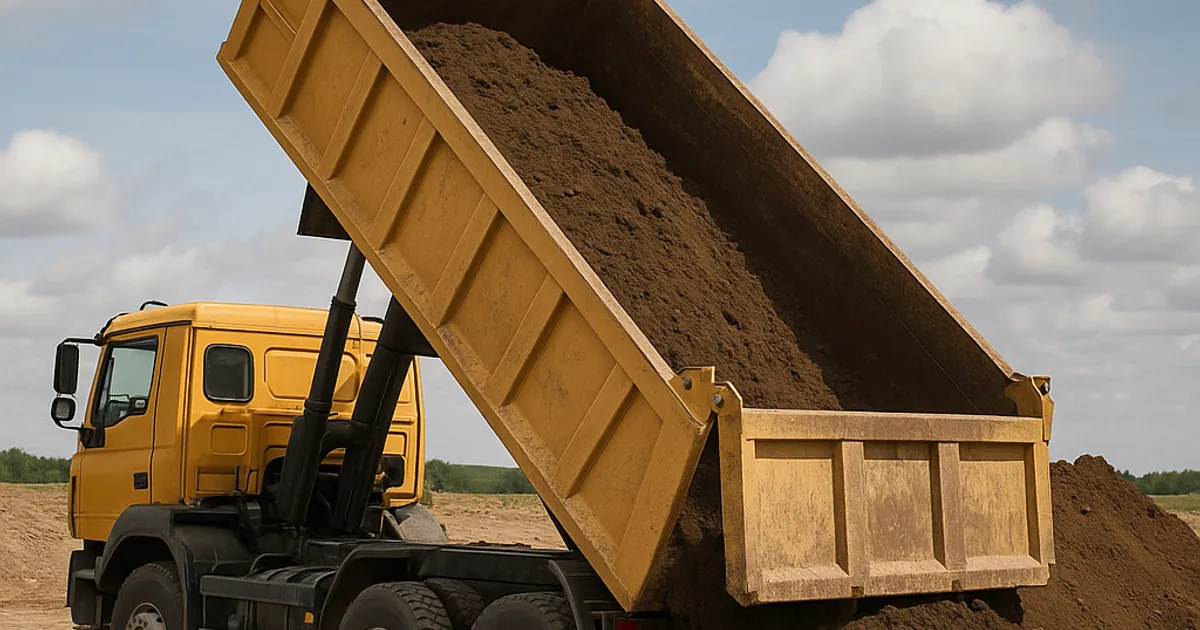
Dirt hauling is one of the largest line items in any earthwork budget, yet it is also one of the most misunderstood. Whether you are a general contractor estimating a residential subdivision, a civil engineer designing a cut-and-fill plan, or a landowner trying to move surplus soil off a property, the question of how to price trucking correctly is critical. Should you pay per ton or per load? How do you convert cubic yards to tons? What does a standard dump truck actually carry, and how does that change your per-unit cost?
This guide answers all of those questions with real numbers, practical formulas, and industry context drawn from current 2026 market conditions. By the end, you will be able to build accurate hauling estimates, negotiate rates with confidence, and avoid the budget surprises that sink earthwork projects every year.
Why the Ton vs. Load Distinction Matters So Much
At first glance, pricing dirt hauling seems straightforward. A truck carries material from point A to point B, and you pay for the service. The complexity emerges the moment you realize that the same physical truck can carry wildly different amounts of material depending on what is inside it. A load of wet clay weighs far more than a load of dry sandy fill, even when both loads fill the truck bed to the same visual level.
This is the core tension between per-ton and per-load pricing. Per-load pricing is simple to administer and easy to count on a job site. A gate person tallies trucks in and out, and the invoice reflects the number of trips. Per-ton pricing, by contrast, requires weighing every load, typically at a certified truck scale, but it gives both parties an accurate picture of how much material actually moved.
For material buyers, per-ton pricing protects against receiving short loads. For trucking companies, it protects against hauling dense material that fills the legal weight limit before the bed looks full. Each pricing method has legitimate use cases, and experienced contractors often switch between them depending on project type, material, and distance.
Understanding this distinction early in project planning can save tens of thousands of dollars. On a commercial grading project moving 50,000 cubic yards of mixed soil, a pricing error of even $0.50 per ton compounds into a $35,000 to $50,000 swing depending on actual material density. Those are not rounding errors. They are the kind of budget deviations that trigger change orders, delay projects, and damage contractor relationships.
Understanding Dump Truck Load Weight and Capacity
Before you can calculate hauling costs accurately, you need to know what a dump truck can legally and practically carry. This is where many estimators make their first mistake, conflating volumetric capacity with legal payload capacity.
Standard Dump Truck Types and Their Payloads
The trucking industry in the United States operates under federal weight limits governed by the Federal Highway Administration, with each state authorized to set additional restrictions. The federal gross vehicle weight (GVW) limit on interstate highways is 80,000 pounds for a standard five-axle semi configuration. State roads and local haul routes often have lower limits, and overweight permits are available for specific corridors at additional cost.
Here is a breakdown of common dump truck configurations used in earthwork:
| Truck Type | Number of Axles | Typical Payload (tons) | Typical Volumetric Capacity (cubic yards) |
|---|---|---|---|
| Single-axle dump | 2 | 5 to 8 | 5 to 8 |
| Tandem-axle dump | 3 | 12 to 15 | 10 to 14 |
| Tri-axle dump | 4 | 16 to 18 | 14 to 16 |
| Quad-axle dump | 5 | 18 to 20 | 16 to 18 |
| Semi end dump (5-axle) | 5 | 22 to 26 | 20 to 24 |
| Semi-bottom dump | 5 | 23 to 26 | 22 to 26 |
| Transfer dump (with pup) | 7 to 8 | 26 to 30 | 24 to 30 |
| Super dump (with trailing axle) | 6 to 7 | 26 to 32 | 24 to 28 |
The most common truck on mid-size earthwork projects is the tandem or tri-axle dump, carrying roughly 12 to 16 tons per load. On large highway or commercial grading projects, semi configurations and transfer dumps are standard because they maximize payload per trip, reducing total trip counts and fuel costs.
Why Payload Varies Even With the Same Truck
A truck rated for a 15-ton payload will not always carry 15 tons. The actual payload depends on the tare weight of the truck (which varies by manufacturer and configuration), tire ratings, road conditions, and material density. Overloading exposes drivers and carriers to substantial fines and liability, so experienced operators weigh loads carefully at the pit or quarry before leaving.
This is exactly why per-ton pricing, with certified weigh tickets from a legal truck scale, gives project owners the most accurate accounting of material delivered or removed.
Material Density: The Hidden Variable in Every Hauling Estimate
If you skip this section, you will make errors on every estimate you produce. Material density is the conversion factor between volumetric measurements (cubic yards) and weight measurements (tons), and it varies enormously across the materials common to earthwork projects.
Common Material Densities for Earthwork
The following table shows approximate densities for materials frequently hauled on earthwork projects. These figures represent bank measure (in-place material before excavation), which is the standard reference point for estimating.
| Material | Approximate Density (lbs per cubic yard) | Approximate Density (tons per cubic yard) |
|---|---|---|
| Dry sandy loam | 2,400 to 2,700 | 1.20 to 1.35 |
| Moist topsoil | 2,700 to 3,000 | 1.35 to 1.50 |
| Dense clay (moist) | 3,000 to 3,500 | 1.50 to 1.75 |
| Wet clay | 3,200 to 3,800 | 1.60 to 1.90 |
| Gravel (dry) | 2,800 to 3,200 | 1.40 to 1.60 |
| Crushed rock / limestone | 2,600 to 3,000 | 1.30 to 1.50 |
| Decomposed granite | 2,400 to 2,800 | 1.20 to 1.40 |
| Rip rap / shot rock | 2,800 to 3,400 | 1.40 to 1.70 |
| Concrete rubble | 3,600 to 4,000 | 1.80 to 2.00 |
| Asphalt millings | 2,400 to 2,700 | 1.20 to 1.35 |
Notice the spread. Wet clay can weigh nearly twice as much per cubic yard as dry sandy loam. A tandem dump truck rated for 14 cubic yards of sandy material might only legally carry 9 to 10 cubic yards of wet clay before hitting its weight limit. This is why per-load pricing benefits the trucking company when hauling dense materials, while per-ton pricing is more equitable for both parties.
Swell Factor and Its Effect on Load Counts
Another complication is swell. When you excavate material from the ground, it loosens and expands in volume. Sandy soil typically swells 10 to 15 percent. Clay swells 20 to 30 percent. Rock can swell 30 to 50 percent or more. This means a project requiring the removal of 1,000 bank cubic yards of clay will generate 1,200 to 1,300 loose cubic yards of material to haul, requiring more truck trips than the original volume suggests.
Accurate estimating requires applying both a density conversion and a swell factor. Failing to account for swell is one of the most common causes of truck count underestimation on grading projects.
Step-by-Step Hauling Cost Calculation: Per Ton Method
The per-ton method starts with verified weight and applies a rate that accounts for distance, time, and market conditions. Here is a step-by-step process for building a per-ton estimate.
Step 1: Determine the total volume to be moved. Start with your survey data or plans. If you have 5,000 bank cubic yards of soil to remove, that is your starting volume.
Step 2: Apply the appropriate density factor. If the material is moist topsoil at approximately 1.4 tons per cubic yard: 5,000 cubic yards x 1.4 tons per cubic yard = 7,000 tons total.
Step 3: Apply the swell factor for trip counting. 5,000 bank cubic yards x 1.20 (20 percent swell for topsoil) = 6,000 loose cubic yards to load.
Step 4: Determine the per-ton hauling rate. Per-ton rates in 2026 vary significantly by region and haul distance. A common baseline for local hauls under 10 miles is $8 to $15 per ton. Longer hauls of 20 to 50 miles typically run $15 to $30 per ton. Remote or difficult-access sites can push rates to $35 per ton or higher.
Step 5: Calculate total hauling cost. 7,000 tons x $12 per ton (assuming a 7-mile local haul) = $84,000 total hauling cost.
Step 6: Verify with trip count. Using tandem dumps at 14 tons per load: 7,000 tons divided by 14 tons per load = 500 truckloads. 500 loads x average cycle time of 30 minutes = 250 truck hours. At a market rate of $125 to $160 per truck hour, this cross-check produces $31,250 to $40,000 per truck, which should be compared against your per-ton calculation to verify reasonableness.
Step-by-Step Hauling Cost Calculation: Per Load Method
The per-load method is simpler to administer but requires careful verification that loads are actually full and that you understand what a full load means for your specific material.
Step 1: Confirm the load definition. Establish clearly whether a "load" means a legal weight load, a full volumetric load, or a specified number of cubic yards. This should be in writing before any hauling begins.
Step 2: Determine the number of loads needed. Using the same 5,000 bank cubic yard example with 20 percent swell: 6,000 loose cubic yards divided by 14 cubic yards per tandem dump load = approximately 429 loads.
Step 3: Apply the per-load rate. Per-load rates in 2026 for local earthmoving on common soil materials typically range from $150 to $400 per load depending on truck size, haul distance, and market. For a tandem dump with a 7-mile haul, expect $175 to $250 per load.
Step 4: Calculate total cost. 429 loads x $210 per load = $90,090 total hauling cost.
Step 5: Compare to the per-ton estimate. Notice that the per-load estimate ($90,090) is higher than the per-ton estimate ($84,000) in this example. The difference reflects the fact that per-load pricing assumes full loads, but some variance in load size is inevitable. If even 10 percent of loads run slightly light, you pay the same per-load rate for less material, increasing your effective cost per ton.
This comparison illustrates why verifying both methods before signing a trucking contract is worth the extra hour of calculation.
Regional Rate Variations in 2026
Hauling rates are not uniform across the United States. Fuel prices, labor costs, permitting requirements, traffic congestion, and local market competition all drive regional differences that can be substantial.
In high-cost metro markets like the dirt exchange in San Francisco area, local trucking rates for common fill dirt hauls can run $20 to $35 per ton even on short hauls, driven by high fuel costs, congestion, permit requirements, and CDL driver wages that reflect the regional cost of living. Similar conditions exist in the dirt exchange in Los Angeles region, where freeway congestion extends cycle times significantly and effectively reduces the number of loads a driver can complete per day.
By contrast, rural markets in the interior West and Midwest often see rates 30 to 50 percent lower. A contractor moving fill dirt on a short local haul in a less-congested market might pay $8 to $12 per ton for the same service that costs $25 per ton in a dense urban corridor.
For projects in growing mountain markets like the dirt exchange in Denver or dirt exchange in Boulder, rates often fall in a middle range of $12 to $22 per ton, with significant variation based on whether haul routes cross high-traffic corridors or require special permits for oversized loads on mountain roads.
Understanding regional context is essential before finalizing any earthwork budget. Contractors who move between markets without adjusting their rate assumptions often find themselves upside down on hauling budgets within the first week of a project.
Fuel Surcharges, Accessorial Fees, and Hidden Costs
The per-ton or per-load base rate is rarely the complete picture. Experienced estimators account for a range of additional charges that frequently appear on hauling invoices.
Common Accessorial Charges
Fuel surcharges: Most trucking contracts include a fuel surcharge provision that adjusts rates when diesel prices move beyond a baseline. In 2026, with diesel averaging $3.80 to $4.40 per gallon nationally depending on region, surcharges add $0.50 to $2.00 per ton on many contracts.
Standby or waiting time: If trucks are delayed at the loading site or dump site, carriers charge standby rates, typically $100 to $175 per hour per truck. On projects with poor traffic flow or slow excavation equipment, standby charges can easily add 10 to 20 percent to the total invoice.
Overweight permit fees: When project logistics require hauling above standard weight limits on state or county roads, permit costs range from $50 to $500 per permit depending on the state and route, and these costs are typically passed through to the project owner.
Weekend or after-hours premiums: Night pours, weekend deliveries, or hauls during restricted traffic hours (common in urban areas) typically carry a 15 to 25 percent rate premium.
Environmental fees and tipping fees: At disposal sites, tipping fees for clean fill typically run $5 to $25 per ton. Contaminated material, classified material, or debris-mixed soil can cost $50 to $200 per ton or more to dispose of legally.
Building all of these into your estimate requires knowing your specific haul routes, site conditions, and material classification before bidding. The Bureau of Labor Statistics tracks construction industry wages and employment data through its BLS Construction Occupations resources, which can help contractors understand CDL driver wage trends that directly influence trucking rates in their region.
Find or Post Dirt, Rock & Aggregate
Join thousands of contractors using DirtMatch to buy, sell, and exchange earthwork materials.
Try DirtMatch FreeHow to Negotiate Better Hauling Rates
Rate negotiation is an underutilized tool in earthwork contracting. Many project owners and GCs simply accept the first quote they receive, not realizing that hauling rates are often negotiable, especially at scale.
Strategies That Actually Move the Needle
Commit to volume. Trucking companies price individual loads at a premium because of scheduling uncertainty. If you can guarantee 20 or more loads per day over a multi-week project, you are essentially offering a guaranteed revenue stream, and carriers will discount accordingly. Volume commitments of 500 or more tons often produce rate reductions of 10 to 20 percent.
Optimize your haul window. Carriers prefer to keep trucks rolling during productive daytime hours. If your project allows loading to begin at 6:00 a.m. and continue without major interruption through mid-afternoon, you become a preferred customer. Projects with unpredictable loading schedules are harder to manage and are often priced at a premium.
Minimize truck waiting time. Excavation equipment that keeps pace with truck arrival rates keeps trucks turning and maximizes driver efficiency. A well-coordinated loading zone can reduce per-load cost meaningfully because carriers can fit more loads per shift.
Source material closer to the project. This is where platforms like DirtMatch directly reduce hauling costs. By connecting contractors with nearby fill dirt sources or disposal sites, the platform shortens haul distances and reduces trip times, which is the single most powerful lever in controlling per-ton costs.
Bundle import and export. On projects that both need to bring in fill and remove excavated material, coordinating backhauls with trucking companies means trucks are carrying loads in both directions, reducing the effective empty miles and often producing lower rates for both movements.
Per Ton vs. Per Load: Which Pricing Method Should You Choose?
After working through the calculations above, the logical question is which method is better. The honest answer is that it depends on several project-specific factors.
When Per-Ton Pricing Makes More Sense
Per-ton pricing is generally preferable when:
- Material density varies or is uncertain (such as mixed soils or wet clay)
- The project is large enough to justify certified scale operations
- You are buying or selling a specific quantity of material where accuracy matters
- You are dealing with a new hauling vendor whose load consistency is unproven
- The material is classified or regulated and documentation of exact tonnages is required
When Per-Load Pricing Makes More Sense
Per-load pricing is generally preferable when:
- Material density is consistent and well-understood (such as clean crushed limestone from a single source)
- The project is small and scale costs are not justified
- You need simple, easy-to-audit billing with no scale tickets
- The haul is very short and per-trip costs are more meaningful than per-weight costs
- Local market conditions mean per-load rates are genuinely competitive with per-ton options
Hybrid Approaches
Many experienced contractors use a hybrid approach: they price by the load for budgeting and scheduling purposes (because load counts are easy to track on-site), but they verify material quantities using spot weigh tickets at regular intervals throughout the project. This gives the administrative simplicity of per-load counting with enough data to catch systematic short-loading if it occurs.
Building a Complete Hauling Cost Estimate: Summary Framework
Pulling all of the above together, here is a practical framework you can use to build any dirt hauling estimate from scratch.
Phase 1: Characterize the material. Identify material type, moisture condition, and density range. Apply swell factor to convert bank measure to loose measure.
Phase 2: Determine truck configuration. Select the appropriate truck type based on payload requirements, road access, and regional availability. Identify legal payload limits for your specific haul routes.
Phase 3: Calculate trip counts. Divide total loose volume by per-load capacity. Add a 5 to 10 percent contingency for partial loads, scale adjustments, and operational inefficiency.
Phase 4: Establish cycle time. Estimate round-trip time including loading, travel, dumping, and return. Account for traffic, scale stops, and site-specific delays.
Phase 5: Determine the base rate. Collect at least three competitive quotes from local carriers. Understand regional market conditions and the specific rate drivers for your project.
Phase 6: Add accessorial costs. Layer in fuel surcharges, standby time estimates, permit fees, and tipping fees.
Phase 7: Cross-check with both methods. Calculate total cost using both per-ton and per-load methods. If the results diverge significantly, investigate why before committing to either.
Phase 8: Build contingency. A 10 to 15 percent contingency on hauling costs is standard practice for projects where material characterization is uncertain or haul routes are subject to change.
For contractors who need to coordinate both material sourcing and hauling across multiple projects, learning how DirtMatch works can reveal significant cost-saving opportunities, particularly on the material sourcing side, which directly reduces the total haul distance and volume that needs to be priced.
Common Estimating Mistakes and How to Avoid Them
Even experienced earthwork contractors make predictable errors when estimating hauling costs. Knowing the most common pitfalls helps you avoid them before they become budget problems.
Mistake 1: Using volumetric capacity as payload capacity. A truck's 16-cubic-yard bed does not mean it can legally carry 16 cubic yards of every material. Dense materials will hit the weight limit before the bed is geometrically full. Always verify legal payload against actual material weight.
Mistake 2: Ignoring swell. Bank cubic yards and loose cubic yards are not the same number. Forgetting swell leads to underestimating trip counts by 15 to 30 percent, which cascades into underestimated hauling costs and compressed schedules.
Mistake 3: Using average rates without checking local conditions. National average rates are useful for orientation but dangerous for bidding. Regional rate conditions in 2026 vary enough that using a national average could leave you 30 percent high or low depending on your market.
Mistake 4: Not accounting for waiting time. Projects that slow down truck cycle times are far more expensive than the base haul rate suggests. If trucks are waiting 20 minutes at the loading zone on a 40-minute total cycle, productivity drops by 33 percent and effective per-ton costs rise accordingly.
Mistake 5: Failing to verify scale ticket accuracy. On per-ton contracts, weigh tickets from the hauling company's preferred scale should be verified periodically against an independent scale. Discrepancies of 3 to 5 percent, which add up to meaningful money on large projects, are not unheard of.
Mistake 6: Underestimating haul route impacts. A route that looks short on a map but involves stop-and-go traffic, low bridges, weight-restricted roads, or school zone restrictions may take twice as long as a direct-distance estimate suggests. Always drive the route before finalizing estimates.
How DirtMatch Helps Contractors Control Hauling Costs
One of the most effective ways to reduce total hauling cost is to source fill dirt or find disposal sites as close to your project as possible. Every mile of haul distance adds cost, and in dense metro markets those costs accumulate quickly. Yet finding nearby material sources or receivers has traditionally required extensive phone calls, broker relationships, and guesswork.
DirtMatch changes that dynamic by creating a transparent marketplace where contractors can find fill dirt sources, disposal sites, and material receivers in their specific geography. Rather than defaulting to a distant supplier because they are the only one you know, you can discover nearby options that cut haul distance in half or more. For a 10,000-ton project, reducing haul distance from 15 miles to 5 miles might save $3 to $8 per ton, translating to $30,000 to $80,000 in direct savings before even negotiating the hauling rate.
Contractors working in markets from dirt exchange in Seattle to dirt exchange in San Diego have used DirtMatch to find proximate material connections that were simply invisible through traditional sourcing methods. If you are building a hauling cost estimate and the haul distance is a significant cost driver, get started with DirtMatch to explore whether nearby material connections can change your project economics.
Understanding Regulatory Compliance in Hauling Operations
Hauling costs are not purely a market function. Regulatory compliance requirements shape operating costs for carriers, and those costs are ultimately reflected in the rates you pay. The Federal Motor Carrier Safety Administration (FMCSA) governs CDL requirements, hours of service rules, and vehicle safety standards for commercial trucks. Carriers operating in compliance with FMCSA regulations carry the cost of driver qualification, vehicle inspection, and log management, which legitimate operations price into their rates.
Contractors who are tempted by very low-rate carriers should understand that rates far below market often reflect carriers cutting corners on compliance, insurance, or both. A carrier without proper insurance coverage creates significant liability exposure for the project owner if an incident occurs during hauling operations. Always verify carrier credentials, including their FMCSA Motor Carrier (MC) number, current operating authority, and insurance certificates, before executing a hauling contract.
Putting It All Together: Sample Project Budget
To illustrate a complete real-world application of these principles, consider a residential subdivision grading project with the following parameters:
- Total cut volume: 8,000 bank cubic yards of moist clay and loam mix
- Material density: 1.55 tons per cubic yard (weighted average)
- Swell factor: 25 percent
- Total weight: 8,000 x 1.55 = 12,400 tons
- Loose volume: 8,000 x 1.25 = 10,000 loose cubic yards
- Truck type: tri-axle dumps at 15 tons payload / 14 cubic yards loose volume
- Haul distance: 8 miles one-way to a permitted fill site
- Cycle time: approximately 35 minutes per round trip
- Base rate: $14.50 per ton (competitive local bid)
- Fuel surcharge: $0.85 per ton
- Tipping fee at fill site: $4.00 per ton
- Estimated standby: $2,500 total for first week ramp-up
Per-ton calculation: 12,400 tons x ($14.50 + $0.85 + $4.00) = 12,400 x $19.35 = $239,940 plus $2,500 standby = $242,440 total.
Per-load cross-check: 10,000 loose cubic yards divided by 14 cubic yards per load = 715 loads. 715 loads x $230 per load (local competitive rate, all-in) = $164,450. This lower figure reflects why per-load pricing at a fixed rate favors the trucking company when material is dense: 715 loads x 15 tons per load = 10,725 tons, which is less than the 12,400 tons calculated by weight, demonstrating that some loads will exceed the volumetric estimate once weight is verified.
This sample illustrates a practical reason why the per-ton method with verified scale tickets often produces more accurate and equitable billing on large mixed-soil projects.
Final Thoughts on Mastering Dirt Hauling Cost Calculation
Calculating dirt hauling costs accurately is a skill built from understanding material properties, truck capabilities, regional market conditions, and the operational realities of moving heavy material at scale. Neither per-ton nor per-load pricing is universally superior. The right choice depends on your material, your project size, your vendor relationships, and your tolerance for administrative complexity.
What separates the best earthwork estimators from average ones is not access to secret rates. It is the discipline to account for every variable: density, swell, cycle time, accessorial fees, regional conditions, and compliance costs. It is also the awareness that material sourcing and haul distance are levers you can pull before you ever call a trucking company.
Platforms like DirtMatch are reshaping how contractors approach this problem by making nearby material connections visible and accessible, reducing one of the largest cost drivers before the first truck ever rolls. Combined with the calculation frameworks in this guide, that combination of market intelligence and analytical discipline gives earthwork professionals the tools to build estimates they can stand behind and projects they can deliver on budget.