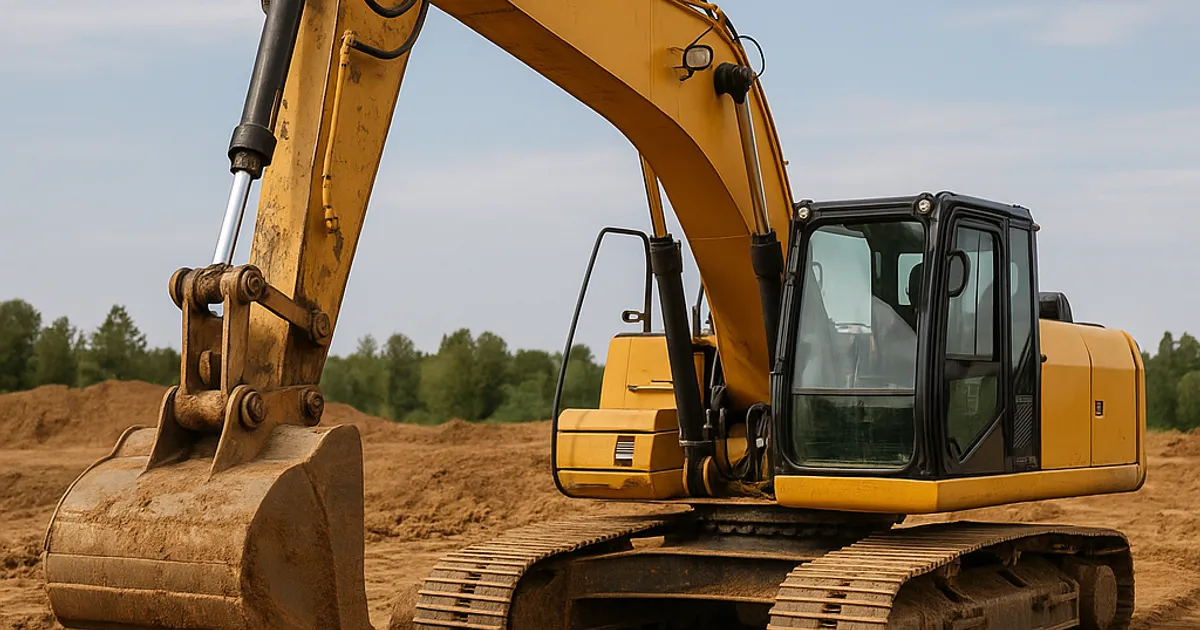

Accurate dirt volume calculations are the foundation of every profitable earthwork project. Whether you are estimating excavation for a basement, grading a commercial site, or managing a large cut-fill operation, knowing exactly how to calculate cubic yards of dirt can mean the difference between a winning bid and a costly overrun. Miscalculations as small as 10 percent on a mid-size commercial project can translate to tens of thousands of dollars in unexpected hauling, disposal, or material costs.
This guide covers every formula, correction factor, and real-world consideration you need to calculate dirt volumes with confidence, from simple rectangular pads to complex cut-fill operations across irregular terrain.
Why Cubic Yards Are the Industry Standard for Dirt Volume
The cubic yard is the universal unit of measure for earthwork in North America, used by contractors, engineers, material suppliers, and dump truck operators alike. One cubic yard equals 27 cubic feet, which works out to a 3-foot by 3-foot by 3-foot cube of material. For reference, a standard tandem-axle dump truck carries roughly 10 to 14 cubic yards per load depending on payload ratings and material weight.
The reason the industry settled on cubic yards rather than cubic feet or cubic meters comes down to practicality. Most earthwork projects involve thousands to hundreds of thousands of cubic feet of material, so working in cubic yards keeps numbers manageable. Truck capacities, material pricing, and contract language are all structured around cubic yards, so fluency with this unit is non-negotiable for any earthwork professional.
According to data from the US Census Bureau's construction spending reports, total construction spending in the United States surpassed 2.1 trillion dollars in 2026, with site preparation and earthwork representing a significant share of that investment. Accurate volume takeoffs feed directly into bid accuracy, schedule planning, equipment selection, and material sourcing decisions.
The Basic Volume Formula: Length x Width x Depth
The simplest and most widely used earthwork volume calculation applies to rectangular or square excavations and fill areas. The formula is straightforward:
Volume (cubic yards) = (Length x Width x Depth) / 27
All measurements must be in feet before dividing by 27 to convert to cubic yards.
Step-by-Step Example
Suppose you need to excavate a rectangular area for a building pad that is 60 feet long, 40 feet wide, and 3 feet deep.
- Multiply: 60 x 40 x 3 = 7,200 cubic feet
- Divide by 27: 7,200 / 27 = 266.67 cubic yards
Round up to 267 cubic yards. At an average disposal cost of $15 to $30 per cubic yard for hauling and tipping fees in most U.S. markets in 2026, this single excavation could cost between $4,000 and $8,000 just for dirt removal, before any equipment or labor costs.
Converting Mixed Units
Field measurements often come in mixed units. Use these conversions before plugging numbers into the formula:
- Inches to feet: divide by 12
- Centimeters to feet: divide by 30.48
- Meters to feet: multiply by 3.281
For example, if your depth is 18 inches, convert to 1.5 feet before calculating.
Calculating Volume for Irregular Shapes
Real job sites rarely present perfectly rectangular areas. Driveways curve, lots have odd angles, and grading projects follow natural contours. Several techniques handle irregular shapes accurately.
The Average End Area Method
The average end area method is one of the most common approaches used in highway and site grading work. You divide the project into cross-sections, calculate the area of each cross-section, then average adjacent cross-sections and multiply by the distance between them.
Volume = ((Area1 + Area2) / 2) x Distance
This gives volume in cubic feet; divide by 27 for cubic yards. The method is accurate when cross-sections do not vary dramatically, which makes it ideal for road subgrades and linear earthwork.
The Prismatoid Formula
For higher accuracy on complex shapes, the prismatoid formula accounts for the variation in cross-sectional area more precisely:
Volume = (L / 6) x (A1 + 4Am + A2)
Where:
- L = length between end sections (feet)
- A1 = area of first end section (square feet)
- A2 = area of second end section (square feet)
- Am = area of middle cross-section (square feet)
The prismatoid formula is the basis for many professional earthwork software tools and is referenced in highway engineering specifications from organizations like AASHTO, whose standards govern road construction practices across all 50 states.
Grid Method for Site Grading
For general site grading, the grid method divides the project area into a uniform grid, typically 10-foot or 25-foot squares. You record the existing grade elevation and the proposed finish grade elevation at each grid corner, calculate the average cut or fill depth across each grid cell, and multiply by the cell area.
This method is exceptionally practical for large commercial or industrial sites and is the foundation for how most earthwork estimating software, including tools integrated with GPS machine control systems, computes mass haul volumes.
The Swell and Shrinkage Factor: The Number Most Estimators Get Wrong
This is where many contractors lose money on earthwork bids. Dirt does not stay the same volume when you move it. The relationship between in-place material, loose (hauled) material, and compacted material is governed by swell and shrinkage factors, and getting these wrong can throw off your truck count, your cost, and your grade by a meaningful margin.
Understanding the Three States of Soil
| Soil State | Description | Example Volume || |---|---|---| | Bank (In-Place) | Native soil before disturbance | 1.00 cubic yard | | Loose | After excavation, loaded in truck | 1.10 to 1.40 cubic yards | | Compacted | After placement and compaction | 0.85 to 0.95 cubic yards |
Swell Factor by Soil Type
| Soil Type | Typical Swell Factor | Shrinkage Factor |
|---|---|---|
| Sandy Loam | 10 to 15% | 5 to 10% |
| Clay | 20 to 30% | 10 to 15% |
| Gravel | 8 to 12% | 2 to 5% |
| Solid Rock | 30 to 50% | 0 to 5% |
| Topsoil | 15 to 25% | 10 to 20% |
For example, if you excavate 1,000 bank cubic yards of clay, you will load approximately 1,250 loose cubic yards onto trucks. That same material, when spread and compacted to 95 percent Standard Proctor density (per ASTM D698), may compact down to only 875 cubic yards in place.
This means that 1,000 cubic yards of bank cut may only satisfy about 875 cubic yards of fill requirement after compaction. If your cut-fill balance sheet ignores shrinkage, you will be short on fill and forced to import material at a significant cost.
The Cut-Fill Volume Formula for Grading Projects
Cut-fill analysis is the backbone of site grading. The goal is to balance the volume of material excavated (cut) against the volume needed for fill so you minimize hauling off-site or importing borrow material. Both outcomes cost money, so achieving balance is a major objective in design and estimating.
Basic Cut-Fill Balance Calculation
- Calculate total cut volume (bank cubic yards)
- Apply shrinkage factor to determine compacted fill cubic yards available from cut
- Calculate total fill volume required (compacted cubic yards)
- Subtract available fill from required fill
- Positive result means you need to import material; negative result means you have excess dirt to haul away
Formula: Net Import or Export = Fill Required (compacted CY) - (Cut Volume (bank CY) x (1 - Shrinkage Factor))
Example Calculation
A site grading plan shows:
- Total cut: 2,500 bank CY of sandy loam (swell factor 12%, shrinkage factor 8%)
- Total fill required: 2,000 compacted CY
Available compacted fill from cut: 2,500 x (1 - 0.08) = 2,500 x 0.92 = 2,300 compacted CY
Net result: 2,300 - 2,000 = 300 CY surplus. You have 300 compacted cubic yards more material than you need, which translates to approximately 326 bank cubic yards (300 / 0.92) that must be hauled off site.
Platforms like DirtMatch connect contractors who have surplus excavated material with nearby projects that need fill dirt, which can dramatically reduce or eliminate the cost of hauling excess material to a landfill.
Calculating Dirt Volume for Common Project Types
Residential Foundation Excavation
For a full basement foundation, you typically excavate to a depth of 8 to 10 feet below finish floor. Add 2 feet on each side for working room around the footings. If the house footprint is 50 feet by 30 feet:
Excavation dimensions: 54 x 34 x 9 = 16,524 cubic feet / 27 = 612 bank CY
With a clay soil swell factor of 25 percent, you will need approximately 765 loose CY of truck capacity to haul it away. At 12 CY per truck load, that is roughly 64 truck loads.
Swimming Pool Excavation
Swimming pools are often roughly kidney-shaped or rectangular with a variable depth from shallow end to deep end. Use the average depth for a simplified calculation:
A 16 x 32-foot pool averaging 5.5 feet deep: 16 x 32 x 5.5 = 2,816 cubic feet / 27 = 104.3 CY
Add 15 percent for working room around the shell: 104.3 x 1.15 = 120 CY of excavation.
Road Subgrade and Linear Earthwork
For a road subgrade cut that runs 500 feet with an average cross-section of 24 feet wide and 1.5 feet deep:
500 x 24 x 1.5 = 18,000 cubic feet / 27 = 666.7 CY
Linear projects benefit most from the average end area method when the cut depth varies along the alignment, which is almost always the case in real conditions.
Trench Excavation for Utilities
For a trench 300 feet long, 2 feet wide, and 4 feet deep:
300 x 2 x 4 = 2,400 cubic feet / 27 = 88.9 CY
Note that not all of this material will be hauled away. Depending on soil conditions and project requirements, a portion will be used as trench backfill after the pipe is installed. However, native material used for backfill must still be calculated for compaction requirements and potential over-excavation needs.
Using a Dirt Volume Calculator: Digital Tools and Software
While manual formulas are essential to understand, most professional earthwork estimators in 2026 use software tools to accelerate takeoffs on complex projects. The range of available tools spans simple online calculators to full-featured mass haul analysis platforms.
Online Cubic Yard Calculators
Free online dirt volume calculators handle rectangular, circular, and triangular areas. You input dimensions and the tool returns cubic yards, often with options for swell factor adjustments. These are appropriate for simple residential or small commercial jobs.
Estimating Software
Platforms such as AGTEK, B2W Estimate, and Earthwork Pro allow you to import survey data, aerial topography, or design files (DWG/DXF) and perform automated cut-fill analysis across an entire site. These tools apply ASTM D2487 soil classification data and project-specific swell factors to generate highly accurate volume reports.
GPS Machine Control Integration
Modern GPS-equipped excavators and dozers from manufacturers like Caterpillar and Komatsu continuously track blade and bucket position relative to design grade. The onboard systems calculate real-time cut and fill volumes as work progresses, allowing operators and project managers to monitor mass haul balance live. This technology has reduced earthwork re-grading costs by 15 to 25 percent on large projects according to industry benchmarks from equipment technology providers.
For contractors managing multiple sites with varying material needs, understanding how DirtMatch works as a marketplace to connect dirt buyers and sellers can be the difference between paying disposal fees and recovering value from surplus material.
Find or Post Dirt, Rock & Aggregate
Join thousands of contractors using DirtMatch to buy, sell, and exchange earthwork materials.
Try DirtMatch FreeMoisture Content and Soil Density: Hidden Variables That Affect Volume
Two factors that estimators frequently overlook are moisture content and in-situ density, both of which directly affect how soil behaves when excavated and compacted.
Moisture Content Effects
Soil at its optimum moisture content compacts most efficiently and achieves maximum dry density per ASTM D698 (Standard Proctor) or ASTM D1557 (Modified Proctor) test methods. Soil that is too wet or too dry requires additional passes for compaction, and wet soil weighs significantly more per cubic yard, affecting truck payload capacity.
Wet clay can weigh up to 2,800 pounds per cubic yard compared to 2,000 pounds for dry sandy material. A 14-ton payload-rated truck carries approximately 28,000 pounds, which means:
- Dry sandy material: approximately 14 CY per load
- Wet clay: approximately 10 CY per load
This 28 percent reduction in per-load capacity has a direct impact on trucking cost estimates.
Using the USDA Web Soil Survey
Before finalizing volume calculations on any project, smart estimators consult the USDA Web Soil Survey to identify the dominant soil series on the site. This free tool provides engineering properties including estimated shrink-swell potential, drainage class, and typical density values that feed directly into volume correction factors. Knowing whether you are dealing with expansive Vertisols or stable Entisols before you break ground can prevent significant estimation errors.
Applying Volume Calculations to Trucking and Logistics
Converting cubic yard volumes to truck loads is the next step after volume calculation, bridging the gap between the office and the field.
Truck Capacity Reference Table
| Truck Type | Typical Capacity (CY) | Notes |
|---|---|---|
| Single Axle Dump | 5 to 7 | Light residential work |
| Tandem Axle Dump | 10 to 14 | Most common for site work |
| Tri-Axle Dump | 14 to 18 | Highway and heavy grading |
| Semi End Dump | 20 to 25 | Large commercial projects |
| Bottom Dump (Belt) | 22 to 28 | High-volume highway work |
Calculating Truck Loads
Divide total loose cubic yards by truck capacity to determine the number of loads:
Number of Loads = Loose CY / Truck Capacity (CY)
For the 612 bank CY foundation example with clay soil: 612 x 1.25 (swell) = 765 loose CY 765 / 12 (tandem truck) = 63.75, rounded up to 64 truck loads
For larger projects in markets like the dirt exchange in Los Angeles or dirt exchange in Denver, coordinating dozens of trucks per day requires logistics planning that accounts for cycle time, queuing, and site access constraints in addition to raw volume numbers.
Common Mistakes in Dirt Volume Calculations and How to Avoid Them
Even experienced estimators make volume calculation errors that cost real money. Here are the most frequent mistakes and how to prevent them.
Mistake 1: Forgetting to Convert Units
Mixing feet and inches without converting first is the most common arithmetic error. Always confirm all dimensions are in the same unit before applying any formula.
Mistake 2: Ignoring Over-Excavation
Design drawings show finished grades, not excavation limits. Footings require working room, pipe trenches need bedding material below the pipe, and unstable soils often require over-excavation and replacement. Add 10 to 20 percent to theoretical volumes as an over-excavation buffer depending on soil conditions.
Mistake 3: Using Compacted Volume for Truck Count
Always use loose volume (bank CY x swell factor) to calculate truck loads, not compacted or bank volumes. Using bank or compacted volumes for trucking estimates will result in under-ordering trucks or over-estimating truck counts.
Mistake 4: Not Accounting for Topsoil Stripping
Most site grading projects begin with topsoil stripping of 4 to 12 inches. This material is often stockpiled separately and spread at the end of the project. Failing to account for topsoil strip volume in the mass haul balance leads to errors in both the strip and final grading phases.
Mistake 5: Assuming Uniform Depth
Site topography is rarely flat. Assuming a uniform excavation depth across a sloped site without accounting for grade changes can produce volume errors of 15 to 30 percent on sloped terrain. Use the grid method or average end area method whenever the site has meaningful grade variation.
Cut-Fill Mass Haul Diagrams and Project Optimization
On large grading and infrastructure projects, mass haul diagrams are essential tools for optimizing earthwork logistics. A mass haul diagram plots cumulative cut and fill volumes along a project alignment, allowing project managers to identify where material needs to move and over what distance.
Reading a Mass Haul Diagram
The horizontal axis represents station or distance along the project. The vertical axis represents cumulative volume. Where the diagram rises, you are in a cut section; where it falls, you are in a fill section. The horizontal distance between corresponding cut and fill volumes represents the haul distance for that material.
Free Haul vs. Overhaul
Contracts typically specify a free haul distance (often 500 to 1,000 feet) within which earthwork moving is included in the base unit price. Movement beyond this distance triggers overhaul charges, typically priced per cubic yard-station (one station = 100 feet). Understanding this pricing structure requires accurate volume takeoffs at the section level, not just project totals.
Waste and Borrow Planning
When the cut-fill balance shows excess material, it must be disposed of in designated waste areas. When it shows a deficit, borrow material must be imported. Both conditions add cost, and minimizing them through good design and accurate volume calculations is a primary goal of earthwork engineering.
Contractors managing borrow and waste logistics on active projects benefit from tools that streamline material sourcing. DirtMatch Pro gives earthwork contractors access to verified material listings, connecting teams that need to source fill with nearby sites that have verified surplus material, which reduces both cost and idle truck time.
Regulatory Considerations That Affect Volume Calculations
Volume calculations do not exist in a vacuum. Several regulatory requirements influence how, where, and in what quantities you can move dirt.
Stormwater and SWPPP Requirements
Projects that disturb one or more acres of soil are typically required to obtain a stormwater permit and prepare a Stormwater Pollution Prevention Plan (SWPPP) under EPA NPDES regulations. Volume calculations feed directly into the erosion and sediment control measures required under these plans. The amount of disturbed area, the volume of cut and fill, and the duration of exposure all influence the controls required.
Wetlands and Section 404 Permits
Placing fill in jurisdictional wetlands requires a permit from the U.S. Army Corps of Engineers under Section 404 of the Clean Water Act. Fill volumes in wetlands must be precisely documented and often require compensatory mitigation at ratios of 1:1 to 3:1 depending on wetland type and regulatory district. Accurate volume calculation is not just good practice in these situations; it is a legal requirement.
Landfill Tipping Fees and Waste Tracking
Most jurisdictions in 2026 require documentation of fill dirt disposal at licensed facilities. Tipping fees at construction and demolition landfills range from $15 to $65 per ton depending on the region and material type. Since dirt is sold and tracked by the cubic yard but landfills often charge by the ton, you need to convert using material density:
Tons = (CY x Density in lbs/CY) / 2,000
For average native soil at 2,200 lbs/CY: 267 CY x 2,200 / 2,000 = 293.7 tons
Practical Tips for More Accurate Field Measurements
Calculation accuracy starts with measurement accuracy. Even the best formulas produce wrong answers if the input dimensions are wrong.
Use a Laser Level or Total Station
For projects where grade is critical, a laser level or surveyor's total station provides far more accurate elevation data than a tape measure and eyeball. Grade differences of 0.1 feet across a large site can represent hundreds of cubic yards of volume error.
Conduct a Pre-Construction Survey
A pre-construction topographic survey establishes the baseline for all volume calculations. On any project over 2,000 square feet, investing in a drone survey or traditional topo survey is cost-justified by the accuracy it provides. Drone-based photogrammetry surveys in 2026 typically cost $500 to $2,500 for a standard commercial site and can produce sub-inch accuracy topographic data.
Document Conditions in the Field
Observed soil conditions in the field may differ from what is shown on geotechnical reports or boring logs. When field conditions show unexpected soil types, wet conditions, or rock, update your swell and shrinkage factors immediately and recalculate affected volumes before continuing excavation.
Reconcile Calculations with Truck Tickets
As trucks haul material off site, use weight tickets and load counts to reconcile actual hauled volumes against calculated volumes. If significant discrepancies appear early in the job, it is far easier and cheaper to investigate and correct the source than to discover a major error when the job is nearly finished.
Building a Reliable Earthwork Estimate: Putting It All Together
A professional earthwork volume estimate integrates every element covered in this guide. Here is a checklist for building a reliable estimate from scratch:
- Obtain accurate site topography (survey, drone data, or LiDAR)
- Identify soil types and obtain swell/shrinkage factors per ASTM D2487 classification
- Calculate cut volumes by area using appropriate methods (grid, average end area, prismatoid)
- Calculate fill volumes required per design grades
- Apply shrinkage factors to determine compacted yield from cut material
- Determine net import or export volume
- Convert bank CY to loose CY for trucking estimates
- Calculate truck loads based on material weight and truck payload ratings
- Identify mass haul distances and apply overhaul pricing if applicable
- Add contingency (typically 5 to 15 percent) for over-excavation, design changes, and field conditions
- Price material sourcing or disposal using current market rates
For contractors in high-activity markets like the dirt exchange in Seattle or dirt exchange in San Francisco, current market pricing for fill dirt and disposal fees changes seasonally and with project volume, making a live material marketplace an invaluable resource alongside your volume calculations.
Mastering the calculation of cubic yards of dirt is a skill that compounds over time. The contractors who invest in understanding these formulas, correction factors, and practical field techniques consistently produce tighter bids, run more predictable projects, and build reputations for reliability that win repeat work. Every ton of material that lands in the right place at the right time starts with a number calculated accurately in an office or on a job site months before the first bucket breaks ground.