The Foundation Beneath the Foundation: Understanding Subbase Material
When most people think about a road, driveway, or concrete slab, they picture the visible surface. Asphalt, concrete, pavers, these get all the attention. But the material that actually determines whether that surface survives a decade of freeze-thaw cycles, heavy truck traffic, and seasonal moisture changes sits completely out of sight. That material is the subbase, and getting it right is one of the most consequential decisions in any earthwork or paving project.
Subbase material is a layer of granular aggregate placed between the native soil (subgrade) and the base course or finished surface. Its primary job is load distribution. When a loaded dump truck rolls over a road, the stress of that weight radiates downward and outward through each layer. A properly specified subbase spreads that force across a wide area so that no single point of soil beneath the structure carries more pressure than it can handle. Without an adequate subbase, even the highest-quality asphalt or concrete surface will crack, rut, and fail prematurely.
In 2026, with construction spending in the United States continuing to exceed $2 trillion annually according to Census Bureau tracking, the stakes around material selection have never been higher. Labor costs are up, materials are expensive, and owners demand longevity. Understanding subbase material construction is not a niche specialty, it is a core competency for any contractor working in civil, residential, or commercial construction.
This guide covers the full picture: what subbase material is, how it differs from subgrade and base course, the specific aggregate types and their applications, compaction standards, cost benchmarks, and the situations where skipping a subbase will cost you far more than installing one.
Subbase vs Subgrade: Clearing Up the Most Common Confusion
The terms subbase and subgrade are used interchangeably on job sites every day, but they describe completely different things. Getting this distinction wrong leads to specification errors, budget miscalculations, and structural failures.
Subgrade is the native or prepared soil at the bottom of an excavation. It is the earth itself, shaped and compacted to support everything above it. The quality of a subgrade is measured primarily by its California Bearing Ratio (CBR), a test developed in the 1930s by the California Division of Highways and still widely used today. A subgrade CBR of 3 is typical of soft clay; a CBR of 15 or higher indicates a strong, well-draining granular soil. State DOTs typically require a minimum subgrade CBR before any pavement layers are applied.
Subbase is the engineered granular layer placed directly on top of the subgrade. It is not native soil. It is imported, tested, and specified aggregate material. Its job is to compensate for subgrade weakness, provide drainage, distribute loads, and create a stable working platform for placing the base course and surface layer above.
Base course sits above the subbase and below the surface. It is typically a higher-quality, more precisely graded aggregate and is the layer that directly supports the asphalt or concrete surface.
Here is a simplified layer diagram for a typical road or pavement section:
| Layer | Material | Primary Function |
|---|---|---|
| Surface course | Asphalt or concrete | Traffic-wearing surface |
| Base course | Dense-graded aggregate | Direct pavement support |
| Subbase | Granular aggregate | Load distribution, drainage |
| Subgrade | Native or improved soil | Foundation bearing capacity |
| Natural ground | Undisturbed earth | Ultimate load transfer |
The critical insight is that subbase and subgrade work together as a system. A strong subgrade may require little or no subbase. A weak, expansive, or poorly draining subgrade may require 12 to 24 inches of engineered subbase to achieve the same structural result. This is why a geotechnical investigation is not optional on serious projects, it is the diagnostic tool that tells you what the subgrade can do and how much engineered subbase you need to make up the difference.
Types of Subbase Material: Choosing the Right Aggregate Base
Not all aggregate is created equal, and the wrong subbase material can be just as damaging as no subbase at all. The selection depends on load requirements, drainage conditions, local availability, freeze-thaw exposure, and budget. Here are the primary fill material types used as subbase:
Crushed Stone and Crushed Gravel
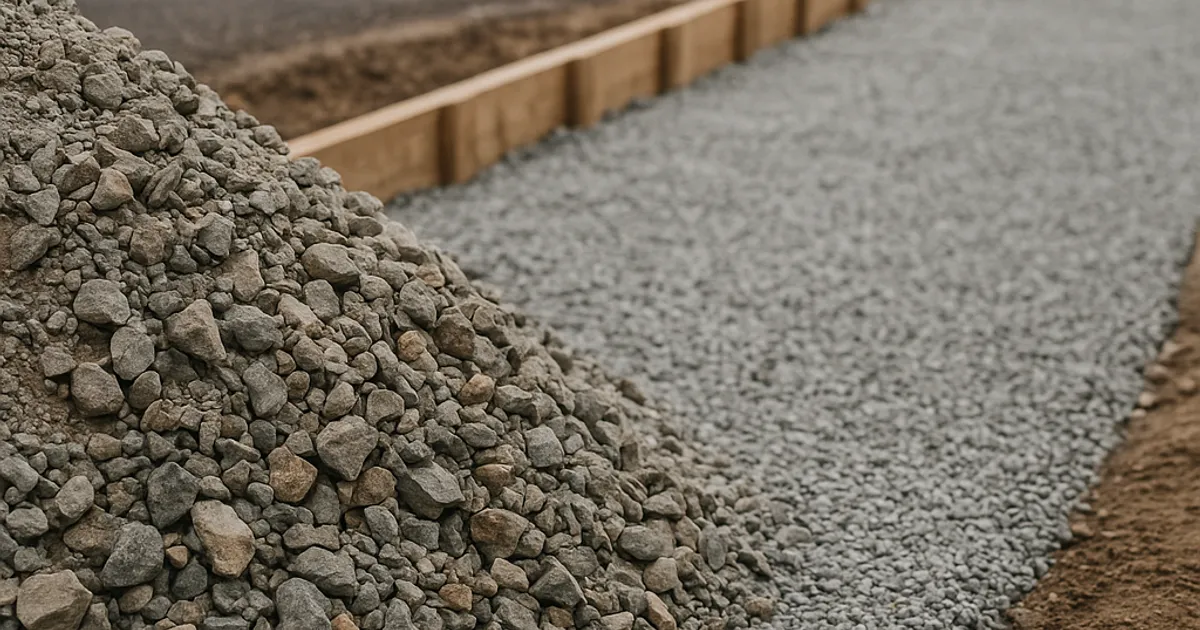
Crushed stone is the most widely specified subbase material in North American construction. It is produced by mechanically fracturing larger rock into angular particles with rough, fractured faces. Those angular edges interlock under compaction, creating a matrix with high internal friction and excellent load-bearing capacity. Common gradations used for subbase include AASHTO No. 57, No. 2, and various state DOT-specific gradations.
Crushed limestone, granite, traprock, and recycled concrete are all used depending on regional geology and cost. Prices in 2026 range from roughly $18 to $45 per ton depending on material type, haul distance, and regional market conditions. Crushed limestone is often the most economical option in the Midwest and Southeast, while traprock and granite dominate in the Northeast.
Dense-Graded Aggregate (DGA)
Dense-graded aggregate, sometimes called crusher run or road base, contains a blend of particle sizes from coarse stone down to fine dust. When compacted, the fines fill the voids between larger particles, creating a dense, stable mass with very low permeability. This makes DGA excellent as a base course but less ideal as a subbase in situations where drainage is critical, because the low void ratio limits water movement. It is widely used for driveways, parking areas, and light-duty roads.
Open-Graded Aggregate
Open-graded subbase material is intentionally gap-graded to maximize void space. Because there are few fines, water passes through the aggregate layer quickly, draining away from the pavement structure. This makes open-graded subbase the preferred choice in climates with significant rainfall or frost penetration. Many state DOTs in northern states specifically require open-graded subbase beneath heavily trafficked roads to prevent frost heave and moisture buildup.
Recycled Concrete Aggregate (RCA)
Recycled concrete aggregate has become a significant player in the subbase market, particularly in urban markets where concrete demolition generates large volumes of material. RCA performs well as subbase when properly processed and tested, often achieving CBR values of 80 to 100 or higher after compaction. It is frequently less expensive than virgin stone and reduces landfill demand. However, RCA can contain residual cement paste that causes long-term volume change, so quality testing is essential before specification.
Gravel and Bank-Run Gravel
Naturally occurring gravel from river deposits or glacial outwash can serve as subbase material when it meets gradation and cleanliness requirements. Bank-run gravel is excavated directly from a pit without processing. It is the most economical option where available but requires testing to confirm it is free of excessive clay or organic material. Many projects in areas like the Denver region rely heavily on the abundant gravel deposits left by ancient glacial activity across the Rocky Mountain front range.
Recycled Asphalt Pavement (RAP)
Milled or crushed asphalt pavement is increasingly used as subbase or base material. RAP contains residual asphalt binder that activates under compaction and heat, adding cohesion to the layer. Studies by state DOTs have shown RAP base layers achieving structural coefficients comparable to virgin aggregate in many applications. It is typically priced 20 to 40 percent below virgin crushed stone, making it attractive for budget-sensitive projects.
When Do You Actually Need Subbase Material?
This is the question project managers, general contractors, and owners wrestle with constantly. Subbase material costs money, takes time to source and place, and adds to project schedules. So when is it genuinely necessary, and when can it be safely omitted?
High-Traffic Roads and Highways
Any road designed to carry significant truck traffic needs a proper subbase. The Federal Highway Administration's pavement design guidance and the AASHTO Pavement Design Guide both treat subbase as a standard structural layer for collector roads, arterials, and highways. On these applications, skipping subbase is simply not an option.
Weak or Expansive Subgrade Soils
This is probably the most common driver of subbase requirements in practice. When a geotechnical report comes back showing high plasticity clay (PI greater than 20), organic soils, or CBR values below 5, you need subbase. Expansive clays like those common in Texas, Colorado, and parts of California can swell 10 percent or more in volume as moisture content changes. Subbase creates a buffer layer that limits moisture access to the subgrade and distributes loads so the swelling soil cannot damage the surface.
For projects anywhere in these challenging soil regions, connecting with local material suppliers early is critical. DirtMatch connects contractors with vetted local aggregate suppliers so you can get subbase material priced and scheduled before the excavation is even complete.
Freeze-Thaw Climates
In northern states, frost depth can reach 36 to 72 inches or more. When water in subgrade soil freezes, it expands by roughly 9 percent. Worse, ice lenses form as capillary water is drawn up from below, creating localized heave that can lift pavement sections several inches. A properly designed subbase, particularly an open-graded drainage layer, interrupts capillary rise and keeps the subgrade drier, dramatically reducing frost heave.
Parking Lots and Commercial Paving
Commercial parking lots typically require 6 to 10 inches of aggregate base or subbase depending on subgrade conditions and design load. A parking lot serving delivery trucks and heavy vehicles needs more subbase than one serving passenger cars. Skimping here is a false economy. A parking lot failure that requires full-depth reclamation costs 3 to 5 times what adequate subbase would have cost originally.
Residential Driveways and Slabs
For residential applications, the need for subbase depends on local soil conditions. A house in sandy well-drained soil may need only 4 inches of compacted gravel beneath a concrete driveway. The same house built on expansive clay in suburban Denver or the Dallas-Fort Worth area may need 8 to 12 inches of engineered subbase plus a vapor barrier. Local building codes and your soil report drive this decision.
Sports Fields and Recreational Facilities
Synthetic turf fields, running tracks, and hard-court sports facilities all require engineered subbase layers that are often more stringent than road standards. Drainage performance, compaction tolerances, and long-term settlement limits are tighter in these applications.
Key Standards and Specifications Governing Subbase Material
Subbase material construction does not happen in a vacuum. There are well-established standards and specifications that govern material quality, gradation, and compaction. Knowing these helps you write specifications, evaluate bids, and hold subcontractors accountable.
AASHTO Standards
The American Association of State Highway and Transportation Officials publishes material specifications used by virtually every state DOT in the country. AASHTO M 147 covers the gradation requirements for base and subbase aggregate. Most state DOT specifications are derived from or closely based on AASHTO standards, with local modifications for regional conditions.
ASTM Standards
ASTM International publishes the test methods used to evaluate subbase materials. Key standards include ASTM D698 (Standard Proctor compaction test), ASTM D1557 (Modified Proctor compaction test), ASTM D1883 (CBR test), and ASTM D2487 (soil classification). These tests establish the benchmark values that specifications are written around and that field inspection relies on.
State DOT Specifications
Every state has its own standard specifications for road and bridge construction. These documents define acceptable subbase materials by gradation, plasticity index, LA abrasion resistance, and other quality metrics. If you are building anything that connects to or is funded by public roads, you are working under state DOT specs. Know them before you write your first purchase order.
Local Building Codes
For commercial buildings and residential construction, local building codes (typically based on the International Building Code) govern subbase requirements beneath concrete slabs, foundations, and flatwork. These codes set minimum compaction requirements, maximum organic content limits, and thickness guidelines based on load and soil conditions.
Compaction Requirements: Getting Subbase to Perform
Selecting the right material is only half the battle. Proper compaction transforms a pile of gravel into a structural layer. Improperly compacted subbase settles, shifts, and allows water to pond, leading to surface failures that arrive faster than anyone expects.
Proctor Compaction and Relative Density
Most specifications require subbase to be compacted to 95 to 100 percent of Modified Proctor Maximum Dry Density (ASTM D1557). The Proctor test determines the maximum density achievable for a given material at its optimal moisture content. Field compaction is then measured using a nuclear density gauge or sand cone test, and the result is expressed as a percentage of that maximum.
Lift Thickness
Subbase material should be placed and compacted in lifts, typically 6 to 8 inches of loose material compacting to 4 to 6 inches of finished depth. Thicker lifts do not compact uniformly because the energy from compaction equipment does not penetrate deeply enough to densify the lower portion of the lift. This is a common shortcut that leads to inconsistent density and long-term settlement.
Equipment Selection
Vibratory rollers are the standard tool for compacting granular subbase. Smooth drum vibratory rollers work well for crushed stone. For mixed or cohesive subbase materials, a pad-foot or sheepsfoot roller may perform better. The number of passes required depends on material, lift thickness, and roller weight. Typically 4 to 8 passes are needed, confirmed by density testing.
Moisture Control
Compaction efficiency is strongly moisture-dependent. Most granular subbases compact best near their optimum moisture content, which for crushed stone is often in the 4 to 8 percent range. If material is too dry, it does not respond to compaction energy effectively. If it is too wet, pore water pressure builds up and prevents densification. Field crews should monitor moisture and adjust with water addition or aeration as needed.
Subbase Thickness Design: How Much Do You Need?
Thickness design for subbase is not guesswork. It flows from a structured process that considers traffic loading, subgrade strength, and desired pavement life.
The AASHTO Pavement Design Approach
The AASHTO Guide for Design of Pavement Structures treats each layer of a pavement section as having a structural coefficient, a number reflecting how effectively each inch of material contributes to overall structural capacity. Subbase aggregate typically has a structural coefficient of 0.10 to 0.14, compared to 0.20 to 0.34 for base course and 0.40 to 0.44 for dense-graded asphalt. This means you need more inches of subbase to achieve the same structural contribution as base or surface material, which is why subbase layers are often the thickest in the section.
Typical Thickness Ranges by Application
| Application | Typical Subbase Thickness |
|---|---|
| Residential driveway (good subgrade) | 4 to 6 inches |
| Residential driveway (poor subgrade) | 8 to 12 inches |
| Parking lot (passenger vehicles) | 6 to 8 inches |
| Parking lot (mixed truck traffic) | 8 to 12 inches |
| Local road | 8 to 15 inches |
| Collector or arterial road | 12 to 24 inches |
| Highway (high CBR subgrade) | 6 to 12 inches |
| Highway (low CBR subgrade) | 18 to 36 inches |
These ranges are starting points. Always confirm with a pavement design engineer using project-specific subgrade data.
Subgrade Improvement as an Alternative
When subgrade soil is extremely weak, adding more subbase is not always the most economical solution. Subgrade stabilization using lime, cement, or fly ash can increase the CBR significantly and reduce the required subbase thickness. Lime stabilization of high-plasticity clay, for example, can raise CBR from 3 to 30 or higher, potentially cutting required subbase thickness in half. The economic crossover point depends on local material costs and haul distances.
Find or Post Dirt, Rock & Aggregate
Join thousands of contractors using DirtMatch to buy, sell, and exchange earthwork materials.
Try DirtMatch FreeSourcing Subbase Material: Cost, Logistics, and Local Markets
Subbase aggregate is a bulk commodity, and haul distance is the dominant cost variable. The material itself may cost $15 to $30 per ton at the quarry gate, but transportation can add another $15 to $50 per ton depending on distance. A 30-mile haul versus a 5-mile haul can double your delivered cost.
This is why sourcing subbase material locally is not just a preference, it is a significant financial decision on large projects. A road project requiring 5,000 tons of subbase aggregate could see $75,000 to $200,000 in difference between near and distant supply based solely on haul distance.
For contractors navigating these logistics, DirtMatch provides a platform where you can connect with nearby quarries, recycled material processors, and other contractors who may have surplus aggregate available from recent projects. Finding a local source for recycled concrete aggregate or crushed stone that meets your spec can dramatically reduce your material costs while keeping trucks off the road.
Regional material markets vary considerably. In urban areas like Los Angeles and San Francisco, recycled aggregate is abundant and often competitively priced compared to virgin stone. In markets like Boston and the broader Northeast, crushed granite and traprock dominate because local glacial geology produces high-quality aggregate. Understanding your regional market before bidding helps you price more accurately and win more work.
Evaluating Material Suppliers
Not all quarries or aggregate suppliers provide consistent quality. Before purchasing large volumes of subbase material, request certified test results showing gradation, plasticity index, LA abrasion, and soundness values. Reputable suppliers provide this documentation routinely. If a supplier cannot provide test data, that is a red flag worth taking seriously.
For projects where contamination risk is a concern, particularly sites with a history of industrial use, verify that recycled aggregate sources have been tested for hazardous materials. The EPA Brownfields Program provides resources on contamination testing and remediation for sites with potential legacy issues.
Drainage Considerations: Why Subbase Is Also a Drainage Tool
One of the most underappreciated functions of subbase material is drainage. Water is the number one enemy of pavement. It weakens subgrade, promotes frost heave, and creates pressure that accelerates structural fatigue. A well-designed subbase layer addresses water at three levels.
Drainage Layer Function
An open-graded subbase with high void content (typically 15 to 25 percent air voids after compaction) allows water that penetrates the surface or enters from the sides to drain laterally to collection pipes or daylight at the edge of the pavement. This keeps the subgrade drier and dramatically extends pavement life. Many state DOTs require a separate drainage layer beneath heavily trafficked pavements.
Geotextile Separation Fabric
On projects where the subgrade soil is fine-grained (silt or clay), placing a non-woven geotextile fabric between the subgrade and subbase prevents the migration of fine particles upward into the aggregate. Without separation, the subbase becomes contaminated with fines over time, losing void space and drainage capacity. Geotextile fabric typically costs $0.30 to $0.80 per square foot installed and pays for itself many times over in extended pavement life.
Perforated Edge Drains
For roads, parking lots, and other large paved areas, perforated pipe edge drains installed at the low side of the subbase layer collect water and carry it to a discharge point. These systems work in conjunction with the drainage layer and geotextile to actively remove water from the pavement structure. Proper outlet design and maintenance are essential, a clogged edge drain is nearly as bad as no edge drain.
Common Mistakes in Subbase Construction (and How to Avoid Them)
Even experienced contractors make mistakes with subbase material construction. Here are the most frequent and most costly errors.
Using the Wrong Material
Specifying or purchasing aggregate that does not meet gradation, plasticity, or hardness requirements is surprisingly common, particularly on smaller projects where testing feels like an unnecessary expense. A plasticity index above 6 in subbase material indicates enough fine clay content to cause problems under wet conditions. LA abrasion values above 50 indicate stone that will break down under traffic and compaction, losing its structural properties quickly. Test your material. The testing cost is always less than the repair cost.
Inadequate Lift Thickness Control
Dumping and spreading subbase in 18-inch lifts when the specification requires 6-inch lifts is a shortcut that creates poorly compacted zones. The surface may test well because the nuclear density gauge reads shallow, but the deeper portion of the lift is loose and will settle. This is a classic cause of longitudinal cracking along the edges of new pavement within the first year or two of service.
Ignoring Subgrade Preparation
Placing high-quality subbase on an unprepared subgrade is like installing a new floor on a rotten subfloor. The subgrade must be proof-rolled (typically with a loaded tandem dump truck) to identify soft spots, stripped of organic topsoil, brought to consistent moisture, and compacted to spec before any aggregate is placed. Skipping or shortcutting subgrade prep is the single most common root cause of premature pavement failures.
Allowing Contamination During Construction
Subbase aggregate that gets mixed with topsoil, clay, or other unsuitable material during construction loses its structural value. This happens when equipment tracking mud onto a prepared subbase layer, or when aggregate is stockpiled on unsuitable ground without a hard surface beneath it. Protecting the subbase layer from contamination requires discipline, tarps on stockpiles, clean equipment, and vigilant inspection.
Neglecting Drainage Outlet Maintenance
A drainage system that is installed but never maintained will eventually fail. Edge drains clog with sediment, outlet pipes get crushed by traffic, and geotextile fabric can blind over time. Building a maintenance inspection schedule into your project handover documents is professional practice that protects both your client and your reputation.
Subbase Material for Specific Project Types
Concrete Slabs on Grade
Concrete flatwork, including warehouse floors, building slabs, sidewalks, and driveways, requires a compacted granular subbase for two reasons. First, it provides a uniform bearing surface so the concrete slab does not experience differential settlement. Second, it acts as a capillary break and drainage layer that prevents moisture migration through the slab. ACI 302.1R, the American Concrete Institute's guide for concrete floor construction, recommends a minimum 4-inch granular subbase for slabs on grade. For industrial floors carrying heavy forklift or racking loads, 6 to 12 inches of engineered subbase is common.
Utility Trench Backfill
Trenches for water, sewer, gas, and electrical utilities are typically backfilled with select granular material in the pipe zone and above, then compacted in lifts to match surrounding subgrade density. The granular backfill around the pipe serves a structural function, providing bedding and haunching support for the pipe barrel. Above the pipe zone, crushed stone or dense-graded aggregate subbase backfill restores structural integrity and prevents surface settlement over the trench.
Retaining Wall Base and Drainage
Retaining walls require a compacted aggregate base beneath the footing or base course, plus a drainage aggregate behind the wall to relieve hydrostatic pressure. Poorly drained walls fail at dramatically higher rates than well-drained ones. The aggregate behind retaining walls is typically open-graded crushed stone wrapped in filter fabric, with perforated pipe at the bottom to carry water to daylight.
Rural and Agricultural Roads
Low-volume rural roads and farm access roads are often built with a simple layer of aggregate subbase directly on the graded native soil, with no asphalt or concrete surface. In this application, the aggregate serves as both the structural layer and the wearing surface. Aggregate surface roads require periodic regrading and material replacement as material migrates to the edges under traffic. Using locally available crushed limestone, caliche, or gravel is standard practice and drives down construction costs significantly.
Environmental and Regulatory Considerations
Subbase material construction intersects with environmental regulations in ways that trip up contractors who are not paying attention.
Stormwater management is the most immediate regulatory concern. Disturbing more than one acre of ground triggers stormwater permit requirements under the EPA's NPDES Construction General Permit. Your Stormwater Pollution Prevention Plan (SWPPP) must address how aggregate stockpiles are managed to prevent sediment from washing into drainage systems. The EPA's stormwater construction permitting program provides detailed requirements and resources for compliance.
Wetland and waterway impacts require Army Corps of Engineers review under Section 404 of the Clean Water Act before placing fill material, including aggregate subbase, in or near jurisdictional waters. Violations carry severe penalties and can result in mandatory removal of all placed material at the contractor's expense.
For projects in urban infill locations, the source of recycled aggregate matters. Recycled concrete or asphalt from industrial sites may contain trace contaminants that require documentation and sometimes remediation before use as subbase. Always request chain-of-custody documentation and test data when sourcing recycled aggregate for projects in environmentally sensitive locations.
How to Source the Right Subbase Material for Your Next Project
Pulling all of this together for an actual project requires a clear process. Here is a practical sequence that experienced contractors follow:
Commission a geotechnical investigation. Get soil borings, CBR testing, and a geotechnical report before designing the subbase section. This is the foundation of every decision that follows.
Determine the subbase specification. Work with a civil or geotechnical engineer to translate the geotechnical report into a subbase specification: material type, gradation, plasticity limits, compaction requirement, and thickness.
Identify local material sources. Contact quarries, recycled material processors, and aggregate suppliers within a reasonable haul distance. Request certified test data and pricing for materials meeting your specification.
Compare material and delivered costs. Virgin stone versus recycled aggregate, near versus distant sources, truck versus belt conveyance. Total delivered cost per ton is the number that matters.
Schedule deliveries to match installation. Aggregate sitting on site for weeks before installation creates contamination risk and can compact or degrade under weather exposure. Coordinate deliveries to arrive just ahead of placement.
Inspect and test during installation. Compaction testing at each lift, gradation verification on delivered loads, and proof-rolling before placing subsequent layers are essential quality control steps.
For steps 3 and 4, platforms like DirtMatch simplify the search for local aggregate suppliers by connecting contractors with a network of material sources and allowing quick comparison of options by location, material type, and volume. Whether you are working on a road project near Boulder or a commercial development in Seattle, finding nearby subbase material is faster when you are not making cold calls to every quarry in the region.
Contractors looking to access a wider network of material sources and project opportunities should also explore DirtMatch Pro, which provides enhanced matching tools and priority access to the platform's growing supplier network.
The Long-Term Economics of Getting Subbase Right
Subbase material is a cost center that many owners try to minimize. This is almost always a mistake when evaluated over the life of a project. Consider a parking lot serving a retail center. If the project budget cuts subbase thickness from 8 inches to 4 inches to save $40,000 in material and installation costs, but the pavement fails 7 years into a projected 20-year life requiring $200,000 in rehabilitation, the net present value of that shortcut is deeply negative.
Published pavement life cycle data consistently shows that structures built with adequate subbase outlast those without by factors of 2 to 3 in low-traffic applications and by even larger factors in heavy-traffic situations. The additional cost of proper subbase at initial construction is almost always less than 15 to 20 percent of the cost of a premature rehabilitation.
In a construction market where labor costs have risen steadily and material prices remain volatile, doing the job right the first time is not idealism. It is economics. Every dollar invested in quality subbase material construction returns multiple dollars in avoided future cost.
For contractors ready to source subbase material efficiently for their next project, getting started with DirtMatch takes minutes and connects you with the local material network that can make the difference between a profitable project and a costly do-over.