Clay soil shows up on job sites across North America every single day, and how a crew handles it often determines whether a project finishes on budget or blows past it. From expansive subgrade failures beneath residential slabs to erosion control applications in dam embankments, clay is simultaneously one of construction's most useful and most problematic materials. Understanding the science behind clay behavior, the conditions that make it dangerous, and the practical strategies for managing it can save contractors tens of thousands of dollars and prevent serious structural failures down the road.
This guide covers the full picture: what clay soil actually is at a mineralogical level, how it behaves under load and moisture change, where it can be used effectively, where it should never go, and how modern earthwork contractors are sourcing, moving, and managing clay fill dirt more efficiently than ever before.
What Is Clay Soil? Mineralogy and Classification
Clay is not simply fine-grained dirt. It is a specific category of soil mineral defined by particle size and, more importantly, by its crystalline structure. Clay particles are smaller than 0.002 millimeters in diameter, which makes them roughly 1,000 times smaller than a grain of sand. That extreme fineness gives clay an enormous surface area relative to its volume, and that surface area is the root cause of nearly every behavior that makes clay challenging to work with.
The dominant clay minerals found in construction soils are kaolinite, illite, montmorillonite (also called smectite), and chlorite. Montmorillonite is the troublemaker. It is the primary mineral in bentonite and in expansive clays found across Texas, Colorado, California, and the Gulf Coast states. A single gram of montmorillonite can have a surface area exceeding 800 square meters, and it can absorb water molecules between its crystal layers, swelling to several times its original dry volume.
Kaolinite, by contrast, is far more stable. Kaolin clays common in the Southeast United States absorb far less water and exhibit minimal shrink-swell behavior, making them considerably easier to work with as structural fill.
ASTM and USCS Classification
The Unified Soil Classification System (USCS), standardized under ASTM International designation D2487, divides fine-grained soils into silts and clays based on their plasticity characteristics measured through Atterberg limits testing. The two key measurements are the Liquid Limit (LL) and Plastic Limit (PL). The difference between them is the Plasticity Index (PI).
Clays with a PI above 20 are considered highly plastic and are flagged immediately by geotechnical engineers as potential shrink-swell hazards. In the USCS, these soils fall into the CH category (clay of high plasticity). CH soils require special handling, amendment, or complete removal on most structural projects.
The AASHTO classification system, used widely by state departments of transportation, designates highly plastic clays as A-7-6 soils, the worst-performing category for pavement subgrade. Understanding which classification system your project specifications reference is an essential first step before any earthwork begins.
How Expansive Clay Causes Structural Damage
Expansive clay is the single most destructive soil type in the United States. According to the American Society of Civil Engineers, expansive soils cause more property damage annually than earthquakes, floods, and hurricanes combined, with estimates exceeding $15 billion per year. Residential foundations, buried utilities, highways, and retaining walls are all vulnerable.
The mechanism is straightforward but powerful. When clay absorbs water, it swells. When it dries, it shrinks. If a structure sits on or is surrounded by expansive clay, those volume changes translate into differential movement. A slab that heaves unevenly by even half an inch can crack, doors can bind, tile can pop, and in severe cases, structural framing can be compromised.
The Shrink-Swell Cycle in Practice
The soil shrink-swell cycle is seasonal in most climates. During wet winters or rainy seasons, clay swells and pushes upward against foundations. During dry summers, it contracts and pulls away, sometimes leaving visible gaps along the perimeter of a slab. In cities like Denver, where montmorillonite-rich soils are widespread, foundation repair is a multi-hundred-million-dollar industry. The dirt exchange in Denver market reflects this reality, with contractors actively seeking engineered fill materials that can replace native expansive clay beneath footings and slabs.
Similarly, in the Bay Area and greater Los Angeles region, the combination of expansive clays and seasonal dry/wet cycles has driven some of the highest foundation repair costs in the country. Contractors working on projects in those markets understand that simply building over native clay without treatment is not an option. Those involved in the dirt exchange in Los Angeles regularly seek select fill or crushed aggregate to replace problem subgrade before construction begins.
Moisture as the Variable
The degree of swelling a clay soil undergoes is directly related to its change in moisture content. A clay that sits at a stable moisture level, whether wet or dry, will not move much. The problem occurs during transition. This is why irrigation, plumbing leaks, and altered drainage patterns around existing structures can trigger foundation movement years after construction is complete. Geotechnical engineers often specify a "moisture conditioning" requirement before compaction, targeting a specific moisture content that balances compactability with long-term volume stability.
Uses of Clay Soil in Construction
Despite its risks, clay is a legitimate and valuable construction material in many applications. The key is matching the material to appropriate uses rather than treating all clay as either universally good or universally bad.
Compacted Clay Liners
One of clay's most valuable engineered applications is as an impermeable liner. Compacted clay liners (CCLs) are used in landfill cells, retention ponds, wastewater lagoons, stormwater basins, and mine tailings impoundments. When properly compacted to at least 95 percent of standard Proctor density at or slightly above optimum moisture content, clay achieves permeability values as low as 1x10⁻⁷ centimeters per second, meeting regulatory requirements for containment in many jurisdictions.
This application actually takes advantage of clay's water-retaining properties. Landfill operators, environmental engineers, and civil contractors actively seek suitable clay fill dirt for these applications. Because natural clay sources near urban project sites are increasingly difficult to find, platforms like DirtMatch have become valuable tools for connecting contractors who have surplus clay excavated from site prep with those who need it for liner applications just miles away.
Earth Embankment and Dam Construction
Engineered earth dams and flood control levees rely heavily on clay cores for their impermeability. The clay zone in the center of a zoned earth dam prevents seepage through the structure. This application requires careful quality control, including laboratory testing of the clay's Atterberg limits, gradation, compaction characteristics, and permeability. The USACE (Army Corps of Engineers) maintains detailed specifications for embankment clay materials on federally funded flood control projects.
Road Base and Subgrade Stabilization
While high-plasticity clay is a poor subgrade material on its own, treated clay can serve as a stable road base. Lime stabilization, discussed in detail later in this article, converts high-PI clay into a material with significantly improved load-bearing capacity. State DOTs across Texas, Oklahoma, and the Southeast routinely specify lime-treated clay subgrade on highway projects, achieving California Bearing Ratio (CBR) values that would be impossible with untreated native clay.
Erosion Control and Slope Stabilization
Low-plasticity clays are used as topsoil amendments and erosion control materials on disturbed slopes. Their cohesive nature helps bind soil particles and reduce surface erosion when rainfall hits a bare cut slope. This is common in highway corridor construction and large grading projects where cut slopes expose raw subsoil that needs to be stabilized before revegetation takes hold.
The Real Risks of Using Clay as Structural Fill
Using expansive or high-plasticity clay as structural fill under buildings, pavements, or utilities is one of the most common and costly mistakes in residential and light commercial construction. The consequences can take years to appear, which is part of what makes the problem so insidious.
Foundation Movement and Slab Failure
Poor fill selection is behind a significant percentage of post-construction foundation claims. When contractors use locally excavated clay as fill to raise grade around a building pad, they introduce a material that will behave differently under the slab than native undisturbed soils. Improperly compacted clay fill can consolidate under load, while poorly managed moisture can cause heave. Either way, the slab moves non-uniformly.
The National Association of Home Builders (NAHB) has documented expansive soil damage as a leading driver of builder warranty claims in clay-heavy states. In Texas alone, the insurance and repair costs associated with expansive clay foundation damage run into the billions annually.
Pavement Failures
Clay subgrade that pumps, heaves, or consolidates under repeated traffic loading is a primary cause of premature pavement failure. The Federal Highway Administration estimates that subgrade soil problems contribute to tens of billions of dollars in annual pavement maintenance costs. Rutting, cracking, and potholing that appears within the first few years of a road's life can often be traced back to inadequate subgrade preparation, including the presence of unmodified high-PI clay beneath the pavement section.
Slope Instability
Clay-rich fill slopes are highly susceptible to shallow rotational landslides, particularly after sustained rainfall. When clay absorbs water and its shear strength drops, fill slopes can fail suddenly. This is a significant safety concern on graded residential lots, highway embankments, and anywhere that clay fill has been placed without adequate drainage and compaction control.
Identifying Clay Soil on Your Job Site
Field identification of clay soil is a practical skill every experienced earthwork foreman should have, but it is not a substitute for laboratory testing on any structural project.
Field Tests
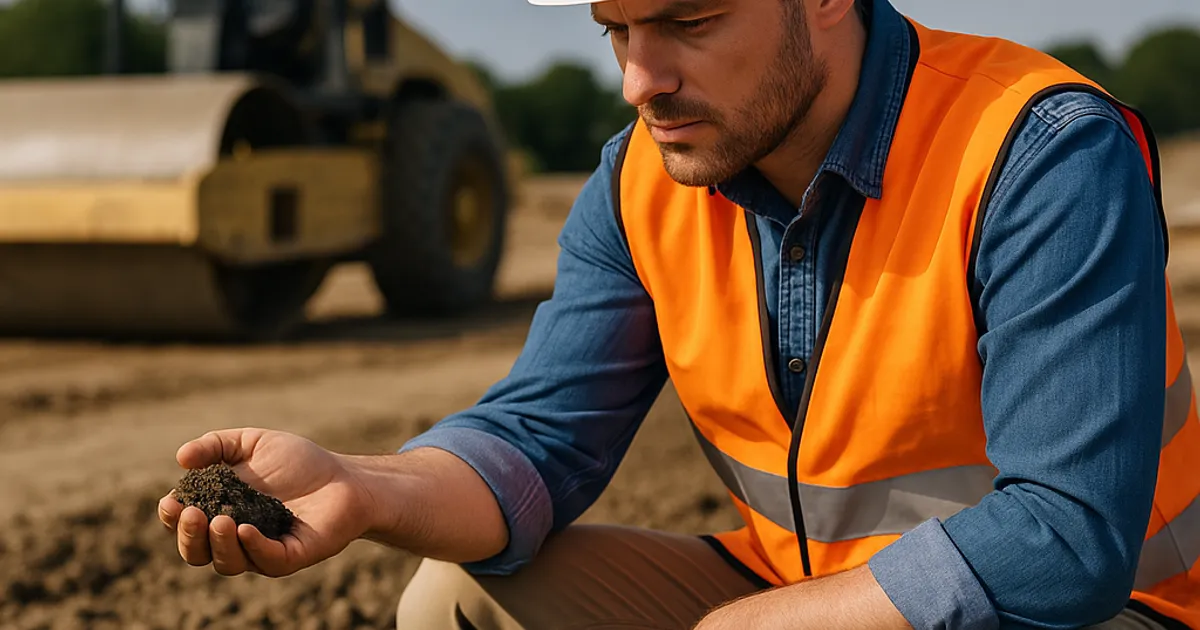
The ribbon test is the most common field method. Wet a sample of soil and roll it between your palms. If it forms a long, thin ribbon without crumbling, it has significant clay content. A ribbon longer than 5 centimeters without breaking indicates a PI likely above 15 to 20, flagging it as a potential shrink-swell material.
The dry strength test involves drying a small ball of soil and then trying to crush it between your fingers. Clay dries to a very hard, brittle solid. Silt dries to a softer, more crumbly state. If you cannot crush a dried soil ball with moderate finger pressure, it has significant clay content.
The shine test is simpler still. Rub a piece of moist clay against a flat surface. Clay will produce a smooth, shiny smear. Silt produces a dull, matte surface.
Laboratory Testing
Field tests are informative, but laboratory Atterberg limits testing under ASTM D4318 is the standard of practice for any project where soil performance matters. Your geotechnical engineer will also likely specify a standard Proctor compaction test (ASTM D698) or modified Proctor (ASTM D1557) to establish the material's optimum moisture content and maximum dry density, both critical for compaction specifications in the field.
The USDA Web Soil Survey is a free online tool that provides mapped soil data for any location in the country. It can give a project team a useful preliminary picture of soil types on a site before any borings are drilled, though it does not replace a site-specific geotechnical investigation.
Managing and Amending Clay Soil
When clay cannot be avoided or removed, amendment and treatment are the next line of defense. Several well-established techniques can transform problem clay into a usable material.
Lime Stabilization
Lime stabilization is the most widely used method for treating high-plasticity clay subgrade. Adding 3 to 8 percent hydrated lime (by dry weight of soil) triggers two chemical reactions. The first is a rapid ion exchange that reduces plasticity almost immediately. The second is a slower pozzolanic reaction in which calcium silicates form over days and weeks, creating a cemented matrix that dramatically increases the soil's strength and reduces its shrink-swell potential.
A properly designed lime-treated clay subgrade can see CBR values increase from as low as 2 to 3 percent in the untreated state to 20 to 40 percent after treatment. State highway departments across the South and Midwest rely on this technique extensively. Treatment depths typically range from 6 to 12 inches depending on the pavement design requirements.
Portland Cement Stabilization
Cement stabilization works similarly to lime but achieves strength gain more quickly and is often preferred for lower-plasticity soils. Typical treatment rates range from 4 to 10 percent cement by dry soil weight. Cement-stabilized subgrade is common on airport projects and industrial pavements where high early strength is a priority.
Fly Ash Amendment
Class C fly ash (a coal combustion byproduct with self-cementing properties) can be used alone or in combination with lime to stabilize clay. It is particularly common in the Midwest where power plant proximity makes fly ash relatively inexpensive. Using fly ash also provides an environmental benefit by diverting industrial byproduct from landfills.
Overexcavation and Select Fill Replacement
On many residential and light commercial projects, the most practical solution is simply to remove the problem clay and replace it with engineered structural fill. This might be crushed aggregate base, imported sandy gravel, or select fill meeting a specified plasticity limit. The depth of overexcavation depends on the geotechnical recommendations, but typically ranges from 2 to 5 feet below finish grade for residential slabs in heavily expansive areas.
This creates a significant material logistics challenge. You have excavated clay that needs to go somewhere, and you need a source of select fill to bring in. This is exactly the problem that DirtMatch was built to solve, connecting contractors who have excess clay or other excavated soils with projects that can use them, while also helping those who need quality select fill find nearby sources without the cost and hassle of long-haul trucking.
Find or Post Dirt, Rock & Aggregate
Join thousands of contractors using DirtMatch to buy, sell, and exchange earthwork materials.
Try DirtMatch FreeCompaction Requirements for Clay Fill
If clay fill must be placed, proper compaction is non-negotiable. The goal is to achieve a stable, uniform density that minimizes future settlement and controls moisture infiltration.
Lift Thickness and Moisture Control
Clay fill should never be placed in lifts thicker than 8 inches (loose measure) when using standard compaction equipment. Sheepsfoot or pad-foot rollers are the appropriate equipment for cohesive clay soils because their feet penetrate the surface and compact the underlying material more effectively than smooth drum rollers.
Moisture control is equally critical. Clay compacted on the wet side of optimum will be more susceptible to future shrinkage cracking. Clay compacted on the dry side of optimum will be more susceptible to future swelling when it takes on moisture. Most specifications target compaction at optimum to 2 percent wet of optimum for subgrade applications under pavements, and at 0 to 2 percent wet of optimum for embankment fill.
Density Requirements
For most structural applications, clay fill is specified to 95 percent of standard Proctor maximum dry density (ASTM D698) or 90 to 95 percent of modified Proctor (ASTM D1557) depending on the load demands. Pavement subgrade under heavy traffic may require 98 to 100 percent of modified Proctor in the upper 12 inches.
Quality Assurance Testing
Nuclear density gauge testing or, increasingly, light weight deflectometer (LWD) testing is performed in the field to verify compaction is meeting specification. A typical specification requires one test per 5,000 to 10,000 square feet per lift, or per 500 to 1,000 cubic yards of fill placed.
Clay Soil, Drainage, and Stormwater Compliance
Clay's low permeability has major implications for site drainage design. A site with clay-heavy soils does not drain the way sandy or gravelly sites do. Rainfall ponds on the surface, runoff concentrates quickly, and erosion risk is high during construction.
The EPA's National Pollutant Discharge Elimination System (NPDES) requires any construction site disturbing one or more acres to have a Stormwater Pollution Prevention Plan (SWPPP). On clay-soil sites, this plan needs to account for the additional runoff volume generated by low infiltration rates. Silt fences, sediment basins, fiber wattles, and erosion control blankets are common BMPs (best management practices) that must be maintained throughout grading operations. You can review stormwater requirements for construction activities through the EPA Stormwater Construction program resources.
Properly managing clay-site drainage during construction also protects the surrounding environment from sediment-laden runoff, which carries regulatory and reputational consequences if not handled correctly.
Regional Clay Soil Hotspots Across the United States
Clay soil problems are not evenly distributed geographically. Certain regions face far more significant clay-related challenges than others, and contractors working in those areas need to be especially informed.
Texas and the Gulf Coast
Texas is ground zero for expansive clay problems in the United States. The Eagle Ford shale and associated Vertisol soils that stretch across the Blackland Prairie from Dallas to San Antonio contain some of the most expansive montmorillonite clays in the world. The Dallas-Fort Worth metroplex alone reports hundreds of millions of dollars in annual foundation damage. Nearly every residential builder in the region uses pier-and-beam or post-tensioned slab designs specifically to accommodate clay movement.
Colorado Front Range
The Denver metropolitan area sits on marine shale-derived soils that are highly expansive. Bentonite-containing formations close to the surface create constant challenges for residential construction, basement design, and highway maintenance. The dirt exchange in Denver market is actively shaped by this reality, with a strong demand for non-expansive structural fill imported from aggregate sources in the Front Range foothills.
Pacific Northwest and Northern California
The Puget Sound lowlands and the California Coast Range both contain deep clay deposits. Seattle's till-and-clay stratigraphy creates slope stability challenges and drainage issues that contractors must navigate carefully. In the dirt exchange in Seattle market, managing excavated clay from urban projects is a constant logistical consideration.
The Southeast
From Georgia and the Carolinas through Alabama and Mississippi, the ancient sea floor sediments and weathered shale deposits have left a legacy of plastic clay soils. While many Southeast clays are kaolinite-dominant (less expansive), they still present consolidation and drainage challenges that require careful engineering.
Comparison: Clay Fill vs. Select Fill vs. Crushed Aggregate
Choosing the right fill material for a project involves balancing material cost, availability, performance requirements, and long-term risk. The table below summarizes key characteristics.
| Property | Expansive Clay | Low-PI Clay | Select Sandy Fill | Crushed Aggregate |
|---|---|---|---|---|
| Plasticity Index (PI) | Greater than 20 | Less than 12 | Less than 6 | Non-plastic |
| Shrink-Swell Risk | High | Low to Moderate | Very Low | None |
| Compactability | Difficult | Moderate | Easy | Easy |
| Permeability | Very Low | Low | Moderate | High |
| Load Bearing (CBR) | 2 to 5 (untreated) | 5 to 15 | 15 to 30 | 40 to 100 |
| Approximate Cost (per CY) | $0 to $8 (surplus) | $5 to $15 | $12 to $25 | $20 to $45 |
| Best Use Case | Liners, embankments | General fill (non-structural) | Structural fill, backfill | Subbase, drainage layers |
Costs will vary significantly by region and market conditions. In many urban markets, surplus clay from excavation projects is essentially free if you can take delivery, while select fill and aggregate carry premium prices. Matching surplus clay sources with appropriate end uses is where significant cost savings are available to both sides of the transaction.
How to Source and Move Clay Efficiently
For contractors who need to dispose of excavated clay or who are seeking clay fill for liner or embankment applications, logistics is the major cost driver. Trucking costs for dirt and aggregate typically run $8 to $18 per ton-mile depending on region, truck type, and fuel costs. Minimizing haul distances has an outsized impact on total project economics.
Traditionally, finding a home for excavated clay meant cold-calling local contractors, posting on Craigslist, or paying tipping fees at a fill site. Today, digital platforms have changed this equation. DirtMatch connects earthwork contractors, developers, and project owners with nearby sources and receivers of clay, select fill, rock, and other earthwork materials, reducing average haul distances and helping projects avoid unnecessary disposal costs.
Whether you're a contractor in the Pacific Northwest trying to move 10,000 yards of expansive clay off a residential development, or a dam contractor in the Southwest looking for a tested clay source for a retention pond liner, connecting with the right counterpart nearby is the fastest way to control material costs. Getting started is straightforward through the DirtMatch platform, where you can post available material or search for what you need by soil type, volume, and location.
Safety Considerations When Working with Clay
Clay soils present specific safety risks during excavation that every crew member needs to understand. Cohesive clay soils can stand vertically for short periods, which creates a false sense of security. Many trench collapses happen in clay soils precisely because workers assume that a clay cut face that has stood for hours or days will continue to stand.
Under OSHA 29 CFR 1926 Subpart P, all excavations greater than 5 feet deep require a protective system unless the excavation is in stable rock. Clay soils are classified as Type A when uncracked and undisturbed, but any fissuring, cracking, or vibration can downgrade them to Type B or Type C. Saturated clay is never classified higher than Type C. A competent person must evaluate soil conditions before and during any excavation. The federal regulations for excavation safety at OSHA 29 CFR 1926 Subpart P provide the full framework for protective system selection based on soil type.
Clay's tendency to crack as it dries is another hazard. A clay trench wall that was safe Monday morning may have developed tension cracks by Thursday afternoon after several days of dry weather. Daily visual inspection of trench conditions is not just good practice, it is a legal requirement.
Key Takeaways for Contractors Working with Clay
Clay soil will show up on nearly every earthwork project at some point. Treating it as an afterthought is expensive. Here is a practical summary of what separates successful clay management from costly mistakes.
First, always conduct laboratory Atterberg limits testing on any clay soil before deciding how to use or treat it. Field observation is not sufficient for structural applications. Second, never use high-PI clay as structural fill under buildings, slabs, or pavements without amendment or full replacement. The short-term cost savings are always outweighed by long-term repair and liability costs. Third, design drainage with clay's low permeability in mind from the start. Flat grades, poor outlet design, and inadequate subdrains are a recipe for saturated subgrade and failure. Fourth, use lime or cement stabilization aggressively when clay subgrade is unavoidable on pavement projects. The cost of chemical stabilization is nearly always less than the cost of overexcavation and import fill. Fifth, manage excavated clay as a resource, not a waste product. Properly tested clay with a PI under 20 may be exactly what a nearby contractor needs for a liner project or embankment. Connecting surplus clay with the right buyer saves money for everyone and keeps material out of landfills.
The contractors who build the best reputations in clay-heavy markets are the ones who invest in soil knowledge up front, plan their material movements strategically, and use every available tool to reduce cost and risk across the project lifecycle.