
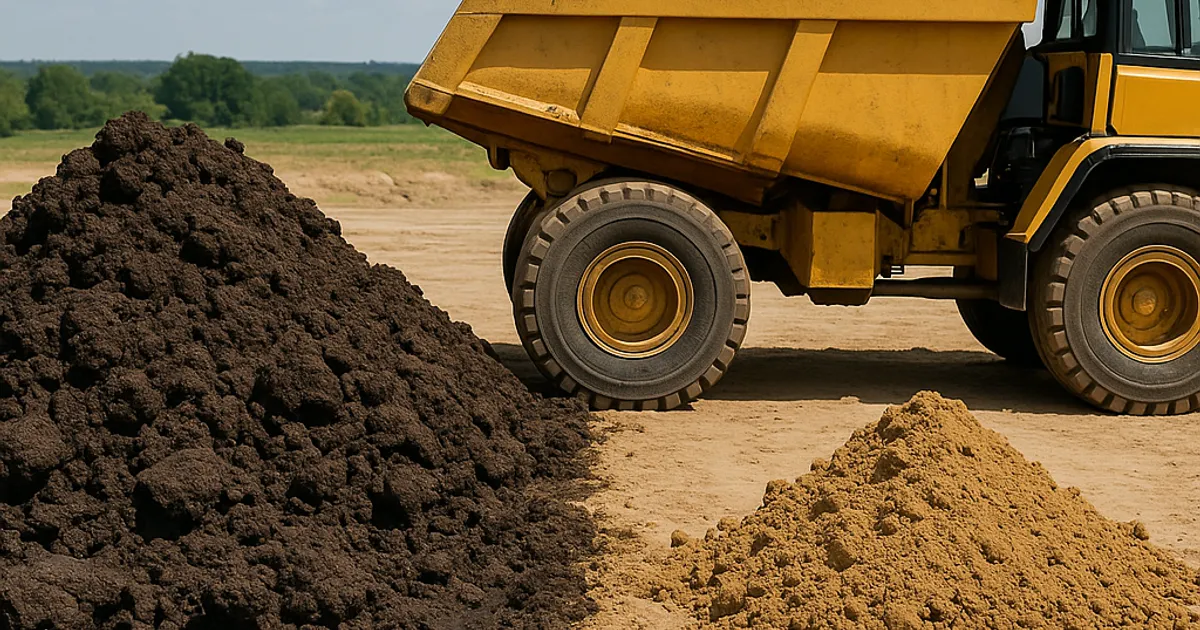
Why Moisture Content Is the Hidden Variable in Every Haul
Every experienced earthwork contractor has felt the sinking feeling of watching a loaded dump truck roll across a scale and flash a number that should not be possible. The material looked the same as last week. The truck was loaded the same way. But somewhere between the excavator bucket and the weigh station, the numbers stopped making sense.
The culprit is almost always moisture. Soil moisture content is the single most volatile variable in haul weight calculation, yet it is routinely underestimated or ignored entirely during project bidding and daily field operations. A cubic yard of dry sandy loam might weigh around 1,700 pounds. That same cubic yard, saturated after three days of rain, can tip the scale at 2,700 pounds or more. Multiply that 1,000-pound-per-yard difference across a 14-cubic-yard dump truck load and you have added nearly seven tons to a load that was calculated as legal.
For earthwork contractors managing dirt removal, fill placement, or aggregate hauling, understanding the relationship between soil moisture and haul weight is not optional. It is a core operational competency that affects regulatory compliance, equipment longevity, fuel consumption, subcontractor billing, and project profitability.
This article walks through the science behind soil moisture weight gain, the math required to calculate wet soil haul weights accurately, the regulatory stakes of getting it wrong, and the field strategies that top contractors use to stay compliant and profitable regardless of weather conditions.
The Basic Science: What Water Does to Soil Weight
Soil is a three-phase system made up of solid particles, air voids, and water. When soil is completely dry, only the solid particles and air exist in the matrix. As moisture is introduced, water replaces the air in those voids. Because water weighs approximately 8.34 pounds per gallon, or roughly 62.4 pounds per cubic foot, every void filled with water instead of air adds measurable mass to the material.
The key measurement used in geotechnical and earthwork engineering to quantify this is the gravimetric moisture content, typically expressed as a percentage. The formula is straightforward:
Moisture Content (w%) = (Mass of Water / Mass of Dry Soil) x 100
So if a soil sample weighs 110 pounds wet and 100 pounds dry, the moisture content is 10 percent. This sounds simple, but the implications for haul weight are significant at scale.
Different soil types hold water differently based on their particle size distribution and mineralogy:
- Sandy soils drain relatively quickly and have low plasticity. They typically hold 5 to 15 percent moisture content under normal conditions.
- Silty soils retain more water due to finer particle sizes and can range from 15 to 35 percent moisture content.
- Clay soils are highly absorbent and can hold 30 to 60 percent or more moisture content, particularly expansive clays like montmorillonite.
- Organic soils and peat are extreme cases, capable of holding moisture content exceeding 100 percent of dry weight in saturated conditions.
ASTM International publishes the standard test methods for determining soil moisture content, most notably ASTM D2216 for laboratory oven drying and ASTM D4643 for microwave oven drying in field conditions. These standards are the foundation of accurate moisture content measurement across the industry.
Calculating Wet Soil Haul Weight: Step-by-Step
Understanding the concept is one thing. Doing the math in the field before trucks are loaded is another. Here is a practical step-by-step process for calculating wet soil haul weight with accuracy.
Step 1: Determine the Dry Unit Weight of the Soil
The dry unit weight of a soil is its mass per unit volume with all moisture removed. Common reference values for planning purposes:
| Soil Type | Dry Unit Weight (lbs/cy) | Typical Moisture Content Range |
|---|---|---|
| Dry Sand | 1,600 to 1,800 | 5 to 12% |
| Moist Sandy Loam | 1,700 to 2,000 | 10 to 18% |
| Silty Soil | 1,500 to 1,900 | 15 to 30% |
| Lean Clay | 1,400 to 1,800 | 20 to 40% |
| Fat Clay (saturated) | 1,200 to 1,600 | 40 to 70% |
| Gravel (dry) | 2,200 to 2,800 | 2 to 8% |
| Organic Soil | 900 to 1,400 | 50 to 150% |
Step 2: Apply the Moisture Factor
The wet unit weight formula is:
Wet Unit Weight = Dry Unit Weight x (1 + w/100)
Where w is the moisture content percentage. So a silty soil with a dry unit weight of 1,700 lbs/cy at 25 percent moisture content would have a wet unit weight of:
1,700 x (1 + 0.25) = 1,700 x 1.25 = 2,125 lbs/cy
Step 3: Calculate the Total Load Weight
Take the wet unit weight and multiply by the struck capacity of the truck body in cubic yards. A standard tandem-axle dump truck carries approximately 10 to 14 cubic yards. A tri-axle typically handles 14 to 16 cubic yards.
Using the example above with a 14-cy load:
2,125 x 14 = 29,750 pounds of material
Add the truck's tare weight (typically 26,000 to 33,000 pounds for a tandem dump truck) and you are looking at a gross vehicle weight approaching 60,000 to 63,000 pounds. Federal bridge law under the Federal Highway Administration sets the general legal limit at 80,000 pounds gross vehicle weight on interstate highways, but many state roads and county roads have significantly lower limits. At 25 percent moisture, a clay haul could easily breach those limits.
Step 4: Adjust for Swell Factor
Excavated soil swells when removed from its natural state. A bank cubic yard of clay might become 1.25 to 1.40 loose cubic yards once disturbed. This means the truck body fills faster volumetrically than expected, and operators may heap material without realizing the weight implications. Always factor in a swell coefficient alongside moisture content.
Overweight Load Risks: Regulatory and Financial Consequences
Ignoring wet soil haul weight calculations is not just a budgeting mistake. It is a regulatory and legal exposure. The Federal Motor Carrier Safety Administration enforces weight compliance through weigh stations and mobile enforcement units nationwide. Overweight violations carry consequences that compound quickly.
Typical civil penalties for overweight loads:
- First offense (minor overage, 1 to 5 percent): $150 to $500 in most states
- Moderate overage (5 to 10 percent over limit): $500 to $2,000 per axle
- Severe overage (greater than 10 percent): $2,000 to $10,000 per occurrence, plus potential permit requirements
- Repeat violations: Commercial vehicle out-of-service orders, potential CDL impact for the driver
Beyond fines, overweight hauls cause accelerated wear on truck frames, suspension components, tires, and brake systems. A fleet running consistently overloaded wet loads may see maintenance costs increase 20 to 35 percent compared to properly loaded operations. Insurance claims tied to overweight-related accidents can be denied based on negligence in load management.
Local road damage liability is another growing concern. Several municipalities have pursued civil claims against contractors for pavement damage caused by overweight hauls on roads with posted limits. In California, Texas, and Florida, enforcement has become increasingly aggressive as infrastructure budgets tighten in 2026.
The Moisture Factor in Action: Real-World Scenarios
To make the math tangible, consider these contrasting scenarios that play out on job sites every week.
Scenario 1: Residential Excavation After Heavy Rain
A contractor in the Pacific Northwest is excavating a foundation in a dense urban neighborhood. The soil is silty clay. Three inches of rain fell over the weekend. Monday morning, the excavator starts loading trucks.
The estimator had budgeted based on a dry unit weight of 1,800 lbs/cy. But the actual field moisture content is 38 percent after the rain event. The real wet unit weight is:
1,800 x 1.38 = 2,484 lbs/cy
A 12-yard load now weighs 29,808 pounds of material instead of the estimated 21,600 pounds. That is an 8,208-pound difference per truck. The contractor scheduled 20 truck loads. The actual material haul is completing in roughly 15 loads by volume, but each load is dramatically heavier. Two trucks are flagged at the regional scale house. The project loses half a day to administrative delays and ticket processing.
Contractors moving material in the Pacific Northwest can explore how the dirt exchange in Seattle marketplace connects excavators with fill recipients, often reducing haul distances and the number of trips required when moisture conditions complicate load management.
Scenario 2: Summer Grading in an Arid Climate
A grading contractor in the Denver foothills is moving native fill during a dry August stretch. The sandy loam soil has a measured moisture content of 6 percent. The dry unit weight is 1,750 lbs/cy. Wet unit weight:
1,750 x 1.06 = 1,855 lbs/cy
A 14-yard truck load weighs 25,970 pounds. The truck is well under legal limits, and the foreman can push loads slightly larger for efficiency. The operation runs smoothly, and bid quantities align closely with actual haul counts. This is the best-case scenario for productivity and compliance.
For contractors coordinating fill placement in the Front Range, the dirt exchange in Denver platform helps match excavators generating material with grading operations that need it, streamlining logistics in both wet and dry conditions.
How Weather and Seasons Compound the Problem
Moisture content is not static. It changes based on rainfall, groundwater levels, evaporation rates, and seasonal freeze-thaw cycles. Contractors who rely on a single moisture assumption at project startup are setting themselves up for mid-project surprises.
Key seasonal moisture dynamics to anticipate:
- Spring thaw: Frozen soils that melt rapidly can become temporarily saturated as drainage lags behind ice melt. Moisture contents can spike 15 to 25 percentage points above summer norms.
- Summer drought: Extended dry periods can reduce surface moisture content significantly, but deep cuts into subgrade may still encounter elevated moisture at depth.
- Fall rain events: Early-season rains on compacted summer soils produce high runoff and rapid saturation of the top 12 to 18 inches, affecting the material most accessible to excavating equipment.
- Winter excavation: Below-freezing conditions can actually reduce effective haul weight temporarily because frozen soil is denser and less fluid, but it also creates unpredictable handling behavior.
Smart contractors track weather forecasts at least 72 hours ahead and adjust truck loading strategies accordingly. Some operations have shifted to real-time moisture monitoring using field probes placed at the active excavation face, especially on large earthwork contracts where a 5-percent swing in moisture content can change profitability by tens of thousands of dollars.
Payload Management Strategies for Wet Conditions
Knowing that moisture adds weight is useful. Having a system to manage it is what separates profitable operations from ones that lose money to overweight fines and wasted trips.
Reduce Load Volume Proactively
When field moisture content is measured above 20 percent, experienced operators reduce the struck volume loaded per truck by a calculated percentage. Using the moisture factor formula, determine the safe load volume before trucks are positioned. If your truck's legal payload is 22,000 pounds of material and your wet unit weight is 2,400 lbs/cy, maximum safe load is 9.2 cubic yards, not the standard 12 to 14.
Use On-Board Weighing Systems
Modern dump trucks can be equipped with on-board load scales that give real-time payload readings as the excavator loads each bucket. Systems from providers integrated with Caterpillar and Komatsu equipment can communicate directly between the excavator and the truck, flagging overloads before the vehicle moves. The upfront cost of these systems is typically recovered within one to two seasons of avoided fines and maintenance savings.
Time Hauls Strategically
Even in rainy regions, surface moisture content drops meaningfully during sunny afternoon hours as evaporation takes effect. Scheduling heavier, wetter loads early in the morning when moisture is highest and lighter loads later in the afternoon is a field-level optimization that seasoned operators apply without formal calculation.
Communicate with Dispatch and Scale Houses
If conditions are unusually wet and legal loads are significantly smaller than normal, communicate proactively with your dispatch team and any third-party hauling subcontractors. Mismatched expectations between the field and the office about load counts versus tonnage are a frequent source of billing disputes and schedule conflicts.
Find or Post Dirt, Rock & Aggregate
Join thousands of contractors using DirtMatch to buy, sell, and exchange earthwork materials.
Try DirtMatch FreeSoil Testing Methods for Field Moisture Determination
Accurate moisture content measurement does not always require a laboratory. Several field-expedient methods are available depending on accuracy requirements and project scale.
Oven Drying (ASTM D2216)
The gold standard for accuracy. Samples are weighed wet, dried at 105 degrees Celsius for 24 hours, and reweighed. Accuracy is within 0.1 percent moisture content. Impractical for daily field decisions due to time requirements, but essential for formal specification compliance.
Speedy Moisture Tester
A calcium carbide gas pressure device that produces results in two to three minutes. Accuracy is within 1 to 2 percent moisture content. Widely used on earthwork projects for real-time load management decisions. Cost is approximately $300 to $600 for a quality unit.
Nuclear Density Gauge
Provides simultaneous measurement of soil density and moisture content using radioactive isotopes. Highly accurate and fast (results in about one minute). Requires licensing and safety training per federal regulations. Common on highway and airport construction projects where precision is critical.
Electrical Resistance and Capacitance Probes
Inserted directly into the soil face at the excavation zone. Some systems provide continuous wireless readings to a field tablet. Accuracy varies with soil type and calibration but is generally within 3 to 5 percent moisture content. Increasingly popular on large earthwork projects in 2026 as sensor costs have dropped substantially.
Weight Tables: Common Soil Types Across Moisture Ranges
The table below provides estimated wet unit weights in pounds per cubic yard across common soil types and moisture conditions. These are reference values for planning purposes. Field testing should always confirm actual conditions.
| Soil Type | Dry (5%) | Low Moisture (15%) | Moderate (25%) | High (40%) | Saturated (60%) |
|---|---|---|---|---|---|
| Clean Sand | 1,785 | 1,955 | 2,125 | 2,380 | 2,720 |
| Sandy Loam | 1,785 | 1,955 | 2,125 | 2,380 | 2,720 |
| Silt | 1,575 | 1,725 | 1,875 | 2,100 | 2,400 |
| Lean Clay | 1,470 | 1,610 | 1,750 | 1,960 | 2,240 |
| Fat Clay | 1,260 | 1,380 | 1,500 | 1,680 | 1,920 |
| Gravel (clean) | 2,310 | 2,425 | 2,540 | 2,695 | 2,905 |
| Sandy Clay Mix | 1,680 | 1,840 | 2,000 | 2,240 | 2,560 |
Note: All values in lbs/cy. Base dry unit weights assumed at mid-range for each soil type. Add 10 to 15 percent for swell adjustment when calculating excavated (loose) volumes.
Moisture Content and Bidding: Protecting Your Margins
The financial impact of moisture miscalculation extends well beyond overweight fines. Bid pricing for dirt removal or fill placement typically references a cost-per-ton or cost-per-cubic-yard model. When moisture content is higher than assumed, every metric in that model shifts.
Consider a dirt removal contract priced at $18 per ton for 5,000 tons. The estimator assumed an average unit weight of 1,800 lbs/cy (0.9 tons/cy) based on summer soil conditions, projecting approximately 5,555 cubic yards of excavation. If actual field conditions produce a wet unit weight of 2,200 lbs/cy (1.1 tons/cy), the same 5,000-ton job now represents only 4,545 cubic yards. The contractor has been paid for 5,000 tons of work but only moved 4,545 yards of material. That seems favorable until you account for the additional fuel, wear, and time consumed hauling heavier loads in fewer trips.
The more dangerous scenario runs the other direction. When bidding fill placement priced by the cubic yard but purchasing fill material by the ton, wet soil means you are buying more tonnage than expected to fill a given volume, eroding margin on every load.
Building a moisture contingency factor into bids is standard practice among experienced earthwork estimators. A common approach is to add a 10 to 15 percent weight buffer to any project scheduled during rainy seasons or in regions with high groundwater tables.
For contractors looking to source fill or place excess material more efficiently regardless of moisture conditions, DirtMatch connects earthwork contractors with vetted buyers and sellers of dirt, rock, and aggregate materials, making it easier to right-size haul logistics when wet conditions change your load calculations mid-project.
Regional Considerations: Moisture Varies by Geography
Moisture content norms vary dramatically across the United States, and contractors working in multiple regions need to calibrate their assumptions accordingly.
High-moisture regions to watch:
The Pacific Northwest, Gulf Coast, and Southeast receive heavy annual precipitation and have consistently high groundwater tables in many areas. Clay-rich soils in these zones routinely test at 30 to 50 percent moisture content during active rain seasons. Contractors operating in these markets should treat wet soil haul weights as the default assumption rather than the exception.
In coastal California, the rainy season (November through April) brings rapid saturation of native clay soils in the Bay Area and Los Angeles Basin. The dirt exchange in San Francisco and dirt exchange in Los Angeles marketplaces see significant shifts in material availability and pricing as wet season logistics complicate haul management for local contractors.
Lower-moisture regions:
Arizona, Nevada, New Mexico, and inland portions of Colorado and Utah operate in semi-arid to arid conditions where surface moisture content is frequently in the 5 to 12 percent range for sandy and gravelly soils. These regions present fewer overweight risks from moisture but still require attention during monsoon season (July through September) when intense convective storms can rapidly saturate surface soils.
Building a Moisture-Aware Load Management Protocol
The most effective way to address wet soil haul weight risk is to institutionalize a load management protocol at the company level, rather than leaving each project manager or field supervisor to improvise.
A strong moisture-aware load protocol includes the following elements:
Pre-mobilization soil assessment: Before excavation begins, obtain soil borings or review existing geotechnical reports to identify soil types and baseline moisture content. The USDA Web Soil Survey is a free resource that provides soil type mapping and basic physical properties for any location in the United States, giving contractors a head start on expected moisture behavior before setting foot on the site.
Weather trigger thresholds: Define in writing the rainfall accumulation or forecast conditions that trigger a load reduction protocol. A common threshold is any 24-hour rainfall event exceeding 0.5 inches. Above that threshold, reduce truck volumes by a calculated moisture-adjusted percentage and require field moisture testing before resuming standard loads.
Driver briefing requirements: Truck drivers are the last line of defense before a load leaves the site. Drivers should be briefed daily on current moisture conditions and authorized load limits. When moisture conditions shift mid-day, dispatchers need a defined process to update drivers in real time.
Documentation and ticketing: Record daily moisture field tests with timestamps, soil locations, and results. This documentation protects the contractor if overweight allegations arise and also creates a historical record that improves future bid accuracy on similar soil types in the same region.
Subcontractor flow-down: If third-party haulers are used, moisture-adjusted load limits must be clearly communicated in the subcontract scope and daily operational briefs. The contractor of record cannot assume that subcontract drivers are aware of wet condition restrictions.
Platforms like DirtMatch Pro give earthwork contractors access to project management tools and material matching features designed specifically for the realities of dirt hauling, including coordination across multiple haul subcontractors where moisture-driven load adjustments need to flow consistently across all parties.
The Cost of Getting It Right vs. the Cost of Getting It Wrong
To bring the financial stakes into sharp focus, consider the total cost difference between a properly managed wet haul operation and one that ignores moisture content.
Properly managed operation (20 truck loads, 25% moisture condition):
- Loads adjusted from 14 cy to 11 cy based on moisture factor
- 20 loads complete legal hauls with no fines
- Fuel consumption slightly lower per mile due to proper loading
- Truck maintenance within normal parameters
- Project finishes on schedule with accurate tonnage billing
Unmanaged operation (same 20 truck loads, 25% moisture ignored):
- 7 of 20 trucks flagged at scale for overweight
- Average fine per overweight event: $1,200 (moderate overage)
- Total fines: $8,400
- Two trucks issued out-of-service orders: half-day production loss valued at $4,500
- One insurance incident due to overloaded braking performance: $2,800 deductible
- Accelerated tire wear across fleet: $900 additional cost
- Total unmanaged cost: $16,600 above baseline
For a mid-size earthwork contractor running 15 to 30 trucks, the annual exposure from moisture-blind load management can easily exceed $100,000 in preventable costs. The investment in field testing equipment, driver training, and load management protocols typically pays back within the first season of implementation.
Conclusion: Make Moisture Part of Every Haul Calculation
Moisture content is not a footnote in earthwork operations. It is a primary variable that affects every ton moved, every truck dispatched, and every dollar earned on a dirt haul contract. The good news is that the tools, formulas, and field protocols to manage it are well established and accessible to any contractor willing to build them into standard operating procedure.
From understanding the basic science of how water adds mass to soil, to applying the wet unit weight formula before trucks are loaded, to building seasonal moisture contingencies into bid pricing, the discipline of moisture-aware haul management separates contractors who run profitable dirt operations from those who consistently get surprised by overweight fines and blown budgets.
Whether you are moving saturated clay in the Gulf Coast, sandy loam in the Southwest, or glacial till in the Pacific Northwest, the fundamentals remain the same: test, calculate, adjust, and document. Every time.
For contractors looking to streamline how they connect with fill recipients, material sources, and hauling partners across changing moisture conditions, get started with DirtMatch to see how the platform simplifies dirt matching and haul logistics for earthwork operations of every size.