Why Earthwork Contractors Can't Afford to Skip a Website Anymore
For decades, the earthwork and excavation industry ran almost entirely on relationships. A handshake with a GC, a referral from a developer, a reputation built over years of showing up on time with the right equipment. That system still matters, but it is no longer enough on its own.
In 2026, buyers of earthwork services, including developers, general contractors, municipalities, and homeowners, begin their search online. According to data from the Associated General Contractors of America, digital procurement and online vendor research have accelerated significantly across construction verticals since 2022. A project manager looking for a dirt hauling subcontractor in Denver or Los Angeles is going to Google first. If your business does not show up, you are invisible.
The good news is that you do not need a $10,000 custom website to compete. The earthwork niche is still underserved online, which means a simple, well-structured website with the right content can rank quickly and generate consistent leads. This guide will walk you through every step: from picking a domain name to writing copy that converts, from local SEO basics to how to pair your website with platforms like DirtMatch to maximize inbound project flow.
The contractors who invest a few weekends into building a proper web presence right now are going to own their local search results for years. Let's get started.
Step 1: Choosing the Right Domain Name for Your Excavation Business
Your domain name is your digital address. It needs to be memorable, professional, and ideally contain a keyword that signals what you do. This is one of the most straightforward decisions you will make, but it sets the tone for everything that follows.
What Makes a Good Contractor Domain Name
The best domain names for earthwork and excavation contractors tend to follow one of two formulas:
Formula A: Brand Name + Service Keyword Examples: HillcrestExcavation.com, PinnacleDirtHauling.com, RedRockGrading.com
Formula B: Location + Service Keyword Examples: DenverDirtHauling.com, SeattleExcavationPro.com, ColoradoGradingCo.com
Formula B has a clear local SEO advantage because the location is baked directly into your domain, which sends relevance signals to Google from day one. However, if you plan to expand beyond one city, Formula A gives you more room to grow.
Practical Domain Name Tips
- Keep it under 20 characters if possible
- Use .com exclusively. Other extensions like .biz or .contractor still carry less trust with consumers
- Avoid hyphens in domain names. They look spammy and are hard to say aloud
- Register your domain through a reputable registrar like Namecheap or Google Domains. Expect to pay between $10 and $15 per year
- Check social media handles at the same time so your branding stays consistent across platforms
Once your domain is registered, you own that piece of digital real estate. Do not wait until you have a perfect website to lock it in. Register it today.
Step 2: Picking the Right Website Platform for Earthwork Contractors
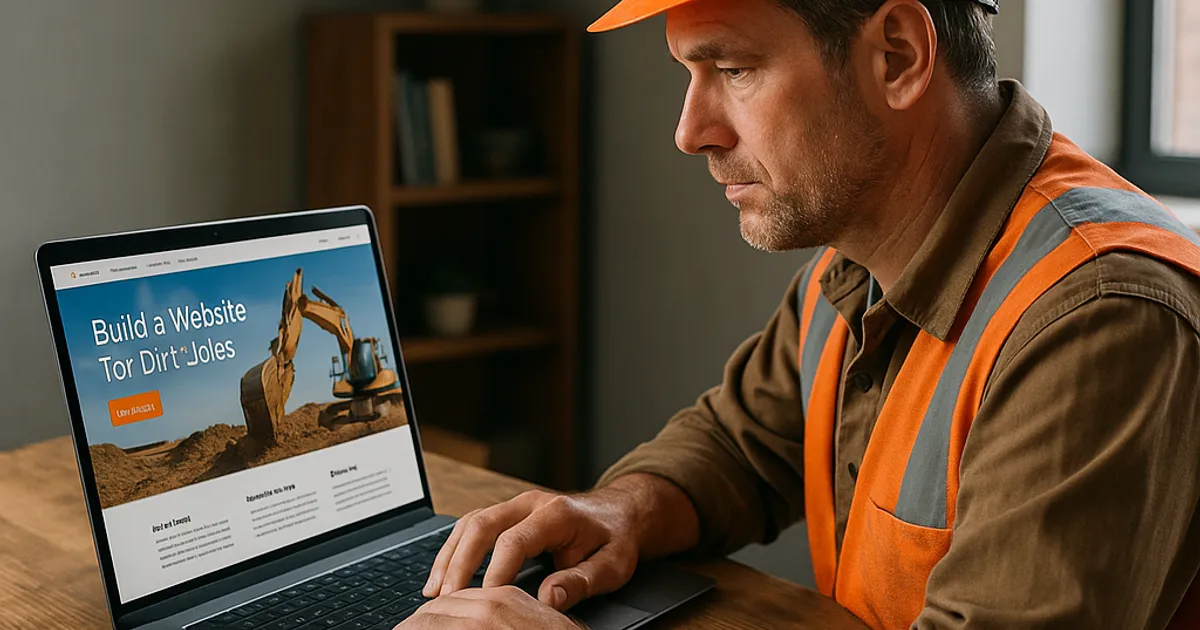
You do not need to hire a developer to build an effective contractor website. Several no-code and low-code platforms make it possible for anyone to build a professional site in a weekend. The key is choosing the right platform for your needs and budget.
Platform Comparison for Excavation and Dirt Hauling Contractors
| Platform | Monthly Cost | Ease of Use | SEO Capability | Best For |
|---|---|---|---|---|
| WordPress.org | $5-$20 (hosting) | Moderate | Excellent | Contractors who want full control |
| Squarespace | $23-$65 | Very Easy | Good | Quick, polished sites |
| Wix | $17-$35 | Very Easy | Good | Beginners with no tech background |
| Webflow | $23-$39 | Moderate | Excellent | Those who want design flexibility |
| GoDaddy Websites | $12-$25 | Easiest | Moderate | Absolute beginners |
For most earthwork contractors who want a site that actually ranks on Google, WordPress.org with a hosting provider like SiteGround or WP Engine is the gold standard. It gives you complete control over your SEO settings, loads fast, and has thousands of contractor-specific templates available for under $60.
If you genuinely have zero interest in learning a new tool and just want something up quickly, Squarespace produces clean, mobile-friendly results with minimal effort. Either choice beats having no website at all by an enormous margin.
What You Need Before You Build
Gather these assets before you start building:
- High-quality photos of your equipment, job sites, and finished projects
- Your business license number and contractor license number
- Insurance certificate details (you will list these on your site)
- A list of 8 to 12 services you offer
- 3 to 5 client references or testimonials you can use
- Your service area cities and counties
Having these items ready before you open your website builder will cut your build time in half.
Step 3: The Essential Pages Every Earthwork Contractor Website Needs
A great contractor website does not need to be complicated. In fact, simplicity works in your favor. Project managers and GCs are busy people. They want to quickly confirm that you are legitimate, understand what you do, and find a way to contact you. Your website should make all three of those things effortless.
The Core Pages Your Site Must Include
Homepage Your homepage is your digital handshake. It should clearly state who you are, what you do, where you work, and why clients should choose you. Include your primary phone number above the fold (visible without scrolling), a strong headline, a short paragraph about your services, and a prominent call-to-action button such as "Get a Free Quote."
Services Page List every service you offer with a brief description of each. For earthwork contractors, this typically includes services like site grading, excavation, trench digging, dirt hauling, fill delivery, land clearing, demolition prep, road base installation, and aggregate spreading. Use the language that your clients actually search for. For example, "fill dirt delivery" and "topsoil hauling" are terms that generate real search volume.
About Page Buyers of construction services want to know who they are hiring. Share your company story, how many years you have been in business, the types of projects you specialize in, and the equipment you run. If you are a licensed contractor, display that prominently. Mentioning your equipment fleet, such as specific makes and models from manufacturers like Caterpillar or Komatsu, signals to knowledgeable buyers that you are the real deal.
Service Area Page Create a page that lists every city, county, and region you serve. This is one of the highest-value SEO pages on a contractor website because it tells Google exactly where you operate. Include a map if possible.
Contact Page Make it embarrassingly easy to reach you. Include your phone number, email address, a simple contact form, and your business address or general service area. Add your hours of operation. Include a note about typical response time so prospects know what to expect.
Photo Gallery or Portfolio A picture of a freshly graded building pad or a clean cut trench line speaks louder than any marketing copy. Upload real job site photos. Name the image files descriptively before uploading (for example: "residential-lot-grading-denver-co.jpg") because Google reads those file names.
Step 4: Writing Copy That Actually Wins Dirt Jobs
Most contractor websites are filled with generic phrases like "quality work" and "professional service" that could apply to any business in any industry. Your copy needs to be specific, credible, and focused on your client's actual needs.
What Your Homepage Headline Should Do
Your headline should answer three questions in one sentence: Who are you, what do you do, and where? Here are some examples that work well for earthwork contractors:
- "Denver's Trusted Dirt Hauling and Site Grading Contractor Since 2008"
- "Fast, Reliable Excavation and Fill Delivery Serving the Greater Seattle Area"
- "Boulder's Go-To Contractor for Land Clearing, Grading, and Aggregate Hauling"
Notice how each headline is specific about location and service. That specificity is what separates a website that ranks from one that does not.
Writing Your Services Descriptions
For each service, write a paragraph of 100 to 150 words that:
- Names the service clearly using the terms clients search for
- Describes what the service involves in plain language
- Explains who typically needs it (developers, homeowners, GCs, municipalities)
- Mentions the geographic area where you provide it
- Includes a call to action
For example, a "Fill Dirt Delivery" service description might read: "We supply and deliver clean fill dirt for residential and commercial projects throughout the Denver metro area. Whether you are filling a basement excavation, building up a low lot, or preparing a pad for construction, our fill dirt meets standard compaction requirements and is delivered on your schedule. We work directly with general contractors, developers, and homeowners. Call us for same-week availability and competitive per-load pricing."
Using Testimonials Strategically
Place testimonials close to your calls to action, not buried at the bottom of an about page. A short, specific testimonial from a GC or developer carries enormous weight. For example: "[Company Name] delivered 14 loads of fill dirt on a tight timeline for our multi-family project. Highly recommend them for any site prep work in the area." Specificity builds credibility.
Step 5: Local SEO Fundamentals for Excavation Company Websites
Local SEO is the process of optimizing your online presence so that your business appears in search results when someone in your area searches for the services you offer. For earthwork contractors, this is the single highest-ROI marketing activity available.
Google Business Profile: Your Most Important Free Tool
Before you worry about anything else on your website, claim and fully complete your Google Business Profile (formerly Google My Business). This is the listing that appears in the map pack at the top of local search results. Studies across the construction industry consistently show that map pack listings receive significantly more clicks than organic results below them.
To optimize your profile:
- Choose the most specific business category available (for example, "Excavating Contractor" rather than just "Contractor")
- Write a 750-character business description that includes your primary keywords and service area
- Upload at least 20 photos of your equipment, crew, and completed projects
- Add your full list of services with descriptions
- Ask every satisfied client for a Google review. Reviews are one of the strongest local ranking signals
- Post updates at least once a month. Google rewards active profiles
On-Page SEO for Your Contractor Website
These are the technical SEO elements that directly affect how Google ranks your pages:
Title Tags: Each page should have a unique title tag of 55 to 65 characters that includes your primary keyword and location. Example: "Fill Dirt Delivery Denver CO | [Your Company Name]"
Meta Descriptions: Write a 150 to 160-character summary of each page that entices searchers to click. Include the keyword and a value proposition.
Header Tags: Use H1 for your main page headline (one per page), H2 for section headings, and H3 for subsections. Include keywords naturally.
Image Alt Text: Every image on your site should have descriptive alt text. Example: "Excavator clearing a residential lot in Boulder Colorado."
NAP Consistency: Your Name, Address, and Phone number must be identical on your website, Google Business Profile, and every other online directory where you are listed. Even small discrepancies like "St." versus "Street" can hurt your local rankings.
Building Local Citations
A citation is any online mention of your business name, address, and phone number. Submit your business to the following directories as a starting point:
- Google Business Profile
- Yelp for Business
- Bing Places
- Apple Maps Connect
- Angi (formerly Angie's List)
- HomeAdvisor
- BBB (Better Business Bureau)
- Your local Chamber of Commerce
- State contractor licensing board directory
Each citation reinforces your local relevance to search engines and creates additional pathways for potential clients to find you.
Find or Post Dirt, Rock & Aggregate
Join thousands of contractors using DirtMatch to buy, sell, and exchange earthwork materials.
Try DirtMatch FreeStep 6: Photography and Visual Content That Builds Trust
In the earthwork industry, your work speaks for itself. A well-graded pad, a perfectly sloped drainage swale, a clean excavation cut: these visuals communicate competence to other construction professionals in a way that no amount of marketing copy can match.
How to Build a Strong Photo Portfolio Without a Professional Photographer
You do not need to hire a photographer. Modern smartphones shoot excellent photos in good lighting. Here is a simple system for capturing job site photos consistently:
- Take before photos at the start of every job. Wide shots that capture the full site condition
- Take progress photos during the most visually significant phases
- Take after photos that clearly show the finished work from multiple angles
- If possible, capture equipment in action. A dozer pushing grade or an excavator loading trucks gives energy to the image
- Always shoot in landscape orientation (horizontal) for web use
- Avoid photos with messy backgrounds, identifiable workers without consent, or unsafe conditions visible in frame
Drone Photography for Earthwork Contractors
Drone footage has become one of the most effective marketing tools for earthwork contractors because it captures the scale of your work in a way ground-level photos cannot. In 2026, you can hire a FAA Part 107-certified drone operator for a single job site shoot for between $150 and $400. The resulting aerial photos and video clips can be used across your website, Google Business Profile, and social media for years.
If your projects routinely involve large site clears or significant earthmoving volume, drone content is worth the investment. Consider using it for your two or three most impressive completed projects.
Step 7: Adding a Lead Capture System That Actually Works
Getting visitors to your website is only half the battle. The other half is converting those visitors into leads. A lead capture system is simply the combination of forms, phone numbers, and calls to action that prompt visitors to reach out.
The Anatomy of a High-Converting Quote Request Form
Keep your contact form short. Research in the construction industry consistently shows that form completion rates drop significantly with each additional field. For a dirt hauling or excavation website, ask for:
- First and Last Name
- Phone Number
- Email Address
- Project Type (dropdown: Grading, Excavation, Fill Delivery, Land Clearing, Other)
- Project Location (City/Zip)
- Brief Project Description (text box, optional)
That is it. Six fields. Anything more will cost you leads. The additional details you need can be gathered during the initial phone call.
Response Time Matters More Than You Think
A 2026 study of construction subcontractor leads found that contractors who responded to online inquiries within one hour were significantly more likely to win the job than those who responded the next day. Set up email notifications so that every form submission hits your phone immediately. If possible, use an auto-responder to confirm receipt and let the prospect know you will call within a few hours.
Adding Live Chat or Text-Back Functionality
Tools like Podium, Birdeye, and SimpleTexting allow you to add a live chat widget to your site that routes messages directly to your cell phone as text messages. For busy contractors who are on job sites all day, this is far more practical than sitting at a computer monitoring a chat window. Many contractors report that text-based web chat generates 30 to 50 percent more contacts than email forms alone.
Step 8: Pairing Your Website With Platforms Like DirtMatch for Maximum Project Flow
A well-built website generates inbound leads passively over time as your SEO rankings improve. But what do you do right now, while your site is still new and not yet ranking? And how do you fill gaps in your schedule between inbound leads?
This is where pairing your website with a project matching platform becomes genuinely powerful. DirtMatch connects earthwork contractors with nearby projects that need dirt hauling, fill delivery, grading, and aggregate work. Rather than waiting for the phone to ring, you can browse active projects in your area and submit bids directly through the platform.
For contractors operating in markets like Denver, Los Angeles, or Seattle, DirtMatch surfaces projects that would otherwise require expensive advertising or deep GC relationships to access. Think of it as a supplement to your website: your site builds long-term credibility and passive lead flow, while DirtMatch keeps your equipment busy in the short term.
Many contractors use both strategies together. When a potential client visits their website and wants to verify the company's reputation and capabilities, a strong web presence closes the deal. When work is slow or a new equipment purchase increases overhead, DirtMatch fills the gap with active project opportunities. If you are ready to see how the platform works, you can get started with DirtMatch in minutes without any long-term commitment.
Step 9: Website Maintenance and Ongoing Content Strategy
One of the most common mistakes contractors make is building a website and then never touching it again. Search engines interpret a stagnant website as a less relevant one. Regular updates signal that your business is active and engaged.
A Simple Content Calendar for Earthwork Contractors
You do not need to write long blog articles every week. A realistic content calendar for a working contractor looks like this:
Monthly tasks:
- Update your Google Business Profile with a new photo or project update
- Add one new project photo to your website gallery
- Check that all contact forms are working correctly
- Verify that your phone number and hours are current
Quarterly tasks:
- Add one new page or blog post about a relevant topic (examples: "What to Know Before Starting a Land Clearing Project in Colorado" or "How Much Does Fill Dirt Delivery Cost in the Denver Metro?")
- Ask any recent satisfied clients for Google reviews
- Check your site speed using Google's free PageSpeed Insights tool and address any major issues
Annually:
- Review and refresh your services pages
- Update your photo gallery with new project photos from the past year
- Check that all links on your site are working
- Review your Google Analytics data to understand which pages are driving the most traffic and leads
The Power of Project-Specific Blog Content
Blog posts that answer specific questions your clients are asking perform exceptionally well for local SEO. Some high-value content ideas for earthwork contractor websites include:
- "How Much Does Site Grading Cost Per Acre in [Your State]?"
- "What Is Clean Fill Dirt and Why Does It Matter for Your Project?"
- "How to Find a Reliable Dirt Hauling Contractor in [Your City]"
- "Trench Excavation: What Homeowners and GCs Need to Know Before Breaking Ground"
- "How Many Cubic Yards of Fill Dirt Do I Need? A Simple Calculator Guide"
Each of these posts can rank for long-tail search queries that bring in highly qualified visitors who are actively planning a project. A single well-written post can generate leads for years.
Step 10: Tracking Results and Knowing What Is Working
You cannot improve what you do not measure. Setting up basic tracking on your contractor website takes about 30 minutes and gives you visibility into where your leads are coming from.
Essential Analytics Tools for Contractor Websites
Google Analytics 4 (GA4): Free and powerful. Install it on your site from day one. At minimum, track total visitors, traffic sources (organic search vs. direct vs. referral), and which pages get the most views.
Google Search Console: Also free. This tool shows you exactly which search queries people used to find your site, how many impressions and clicks each query generated, and whether Google has any issues indexing your pages. Connect it to your site and check it monthly.
Call Tracking: Use a tool like CallRail or a simple trackable phone number to determine how many calls your website is generating each month. Without this, you will never know with certainty whether your site is driving revenue.
Setting Realistic Benchmarks
For a new earthwork contractor website with solid on-page SEO and an active Google Business Profile, realistic benchmarks over the first 12 months look like this:
- Months 1 to 3: Site is indexed, receiving small amounts of branded traffic (people searching your company name)
- Months 4 to 6: Beginning to rank for long-tail local keywords, receiving 5 to 20 organic visitors per week
- Months 7 to 12: Ranking for primary service keywords in your area, receiving 20 to 100+ organic visitors per week, generating 2 to 8 inbound leads per month
These timelines assume consistent effort on SEO, Google Business Profile, and content. Contractors who also build citations, earn reviews, and publish occasional blog content tend to see results at the faster end of this range.
For contractors who want to accelerate their project pipeline while their website gains traction, DirtMatch Pro offers enhanced visibility and priority access to projects in your market. It is a practical bridge between launching your website and achieving the organic lead flow you are building toward.
Step 11: Mobile Optimization and Site Speed for Contractor Websites
More than 60 percent of all web searches in the construction industry now originate from mobile devices, particularly for service contractors where project managers and site supers are searching from their phones while on the go. If your website is not mobile-friendly, you are losing more than half your potential traffic before it even has a chance to convert.
How to Test Your Site's Mobile Performance
Google's free Mobile-Friendly Test tool (accessible at search.google.com) scans your website and tells you immediately whether it passes mobile usability standards. Most modern website builders like Squarespace and Wix produce mobile-responsive sites by default, so this is mainly a concern for older WordPress sites or custom-built pages.
Site Speed: Why It Matters for SEO and Lead Conversion
Google uses page speed as a ranking factor. Additionally, research consistently shows that conversion rates drop sharply as page load time increases. A site that takes five seconds to load loses a meaningful percentage of visitors compared to one that loads in two seconds.
To improve your site speed:
- Compress all images before uploading them. Free tools like TinyPNG reduce file sizes by 50 to 80 percent without visible quality loss
- Use a content delivery network (CDN). Many hosting providers include this at no extra cost
- Minimize the number of plugins or third-party scripts on your site
- Choose a fast hosting provider. Cheap shared hosting plans often produce slow load times
For most earthwork contractors using modern website builders, these optimizations are handled automatically. If you are on WordPress, install a plugin like WP Rocket or W3 Total Cache to handle caching and speed optimization.
Bringing It All Together: Your Website as the Foundation of a Stronger Business
Building an effective website for your earthwork contracting business is not a one-time task you complete and forget. It is a living asset that grows more valuable over time as your content accumulates, your reviews build up, and your local search rankings improve.
The contractors who succeed online in the dirt, grading, and excavation space are not necessarily the ones who spend the most money on their websites. They are the ones who are consistent: consistent about updating their Google Business Profile, consistent about asking for reviews, consistent about adding new photos and content, and consistent about making it easy for potential clients to reach them.
Start simple. A clean five-page website with accurate information, real photos, clear service descriptions, and a working contact form is infinitely better than a perfect website you never finish building. Get it live, claim your Google Business Profile, submit your citations, and start working the system.
And while your website is building its organic authority, let platforms like DirtMatch keep your calendar full. The combination of a strong web presence and active participation in a project matching network gives earthwork contractors a significant competitive advantage over the majority of competitors who rely on word of mouth alone. The contractors building that combination today are the ones who will dominate their local markets for the next decade.